
Pakistan must localize climate finance to strengthen resilience
MG News | January 31, 2026 at 11:25 PM GMT+05:00

January 31, 2026 (MLN): Climate experts and policymakers have called
for greater decentralization of climate governance, urging that local
governments be empowered with direct access to finance to strengthen resilience
at the community level.
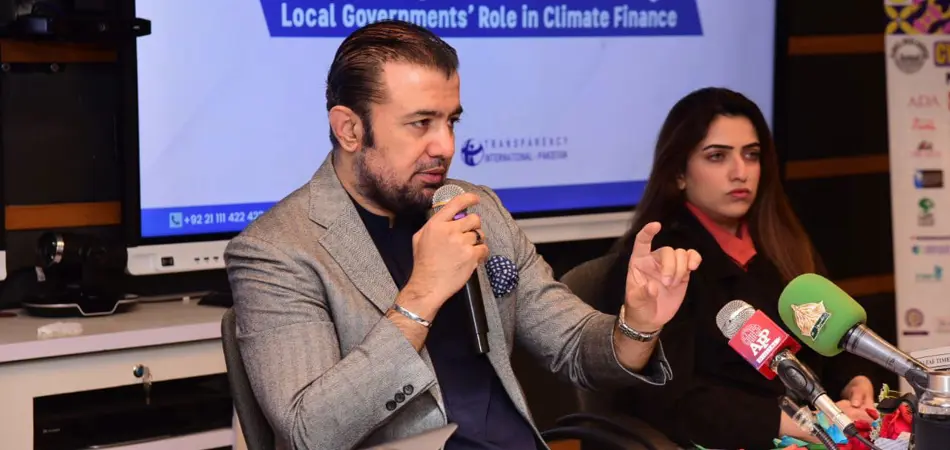
The appeal came during a high-level panel session titled
“Decentralizing Climate Action: Unlocking Local Governments’ Role in Climate
Finance,” held at the Institute of Business Administration (IBA), Karachi, as
part of Day 3 of Climate Week Karachi (CWK).
Jointly organized by the Centre for Business and Economic
Research (CBER), IBA, and Transparency International Pakistan with support from
the Climate Action Center (CAC), the session focused on how shifting financial
authority closer to cities and districts can accelerate climate adaptation and
improve on-ground implementation, according to a press release issued.
Distinguished panelists included Khurram Schehzad, Advisor
to the Finance Minister; Khalid Waleed of the Sustainable Development Policy
Institute; Kashif Ali from Transparency International Pakistan; Zubair Channa,
Secretary, Sindh Environment; climate finance expert Ali Tauqeer Sheikh; Imtiaz
Bhatti, Director General at the Provincial Ombudsman’s Secretariat, Karachi;
Prof. Lubna Naz, Director CBER-IBA; Sahar Arshad, Assistant Professor at IBA;
Shahid Javed, economist at the State Bank of Pakistan; and Naveed Bhutto,
Maternal and Child Nutrition Expert and Technical Lead Public Health (NUSP,
Sindh), supported by the World Bank.
Khurram Schehzad stressed the urgency of relocating climate
governance and finance closer to communities most vulnerable to climate risks.
He observed that while international discussions often revolve around pledges
and frameworks, real resilience depends on execution, financial access, and
last-mile delivery.
He added that Pakistan must move beyond strategy papers
toward scalable financing solutions enabling households, farmers, micro, small
and medium enterprises (MSMEs), and local governments to invest in resilience.
Highlighting recent federal initiatives, Khurram Schehzad outlined five priority pathways for expanding access to climate finance.
Climate-smart agricultural lending for smallholders through digital,
collateral-free models; financing for household and MSME energy transition
including electric mobility, efficient appliances, and distributed
solarization; affordable climate-resilient housing; outcomes- and results-based
instruments such as social and skills impact bonds to attract private capital;
and risk-sharing mechanisms supported by digital public infrastructure to
reduce banking sector exposure and accelerate investment.
The discussion identified three major priorities for
strengthening localized climate action.
Panelists called for institutional frameworks that allow
capable local administrations to directly access climate funds, including
decentralized approval systems and stronger use of localized vulnerability data
for evidence-based planning.
Participants also pointed to structural gaps between
community needs, provincial planning, and national commitments, recommending
reforms to planning tools particularly simplifying the PC-1 process to ensure
small-scale adaptation projects can be implemented more efficiently.
Emphasis was also placed on converting governance reforms
into bankable opportunities through innovative instruments such as the National
Climate Resilience Fund, blended finance windows, and Nature-Based Solutions,
including the proposed Sindh Coastal Resilience Bond and mangrove-linked carbon
credits.
De-risking private investment was described as critical to
mobilizing commercial finance for community-level projects.
The panel further highlighted two urgent challenges for
Pakistan’s climate finance roadmap.
The rapid, largely organic transition toward solar energy
requires structured de-risking mechanisms so local governments can support
community solar grids while ensuring equitable access.
Additionally, speakers stressed the need for rapid-response
liquidity frameworks to enable local administrations to access emergency
funding during floods, heatwaves, and other extreme weather events.
The role of academia was also highlighted, with IBA Karachi through
CBER reaffirming its commitment to
advancing evidence-based policymaking by converting dialogue into actionable
research, refined concept notes, and policy-relevant outputs.
The session concluded with a call for sustained
collaboration among government institutions, academia, civil society, and
development partners to promote locally driven, execution-focused, and
finance-enabled climate action across Pakistan.
Copyright Mettis Link News
Related News



| Name | Price/Vol | %Chg/NChg |
|---|---|---|
| KSE100 | 167,089.28 109.91M | -0.21% -352.63 |
| ALLSHR | 101,117.40 308.32M | -0.15% -155.10 |
| KSE30 | 49,841.71 50.59M | -0.28% -142.15 |
| KMI30 | 240,372.43 78.75M | -0.02% -45.72 |
| KMIALLSHR | 65,518.16 188.07M | -0.05% -35.70 |
| BKTi | 46,228.77 7.60M | -0.60% -281.04 |
| OGTi | 33,974.66 4.20M | -0.27% -91.31 |
| Symbol | Bid/Ask | High/Low |
|---|
| Name | Last | High/Low | Chg/%Chg |
|---|---|---|---|
| BITCOIN FUTURES | 83,140.00 | 83,320.00 82,645.00 | 670.00 0.81% |
| BRENT CRUDE | 104.54 | 105.09 102.33 | 0.26 0.25% |
| RICHARDS BAY COAL MONTHLY | 128.50 | 0.00 0.00 | 0.75 0.59% |
| ROTTERDAM COAL MONTHLY | 143.40 | 143.40 143.40 | -1.15 -0.80% |
| USD RBD PALM OLEIN | 1,167.50 | 1,167.50 1,167.50 | 0.00 0.00% |
| CRUDE OIL - WTI | 91.66 | 0.00 0.00 | -0.19 -0.21% |
| SUGAR #11 WORLD | 20.27 | 20.44 20.09 | 0.12 0.60% |
Chart of the Day
Latest News
Top 5 things to watch in this week
 PIB Auction
Pakistan Stock Movers
| Name | Last | Chg/%Chg |
|---|
| Name | Last | Chg/%Chg |
|---|