
Oil prices swing on Iran war disrupts global supply

MG News | March 11, 2026 at 10:04 AM GMT+05:00

March 11, 2026 (MLN): Global oil prices fluctuated sharply on Wednesday as markets reacted to growing geopolitical tensions in the Middle East and discussions among major economies about releasing emergency oil reserves to stabilize supply disruptions linked to the ongoing U.S.-Israel war with Iran.
Crude benchmarks initially moved higher but later reversed course amid reports that the International Energy Agency (IEA) is considering a massive coordinated release of strategic oil reserves to cushion the market from supply shocks caused by the conflict.
Currently, Brent crude future is at $86.87 per barrel,
according to Mettis Global data.
West Texas Intermediate (WTI) crude futures decreased by $0.40,
or 0.48%, to $83.05 per barrel by [10:07 am] PST.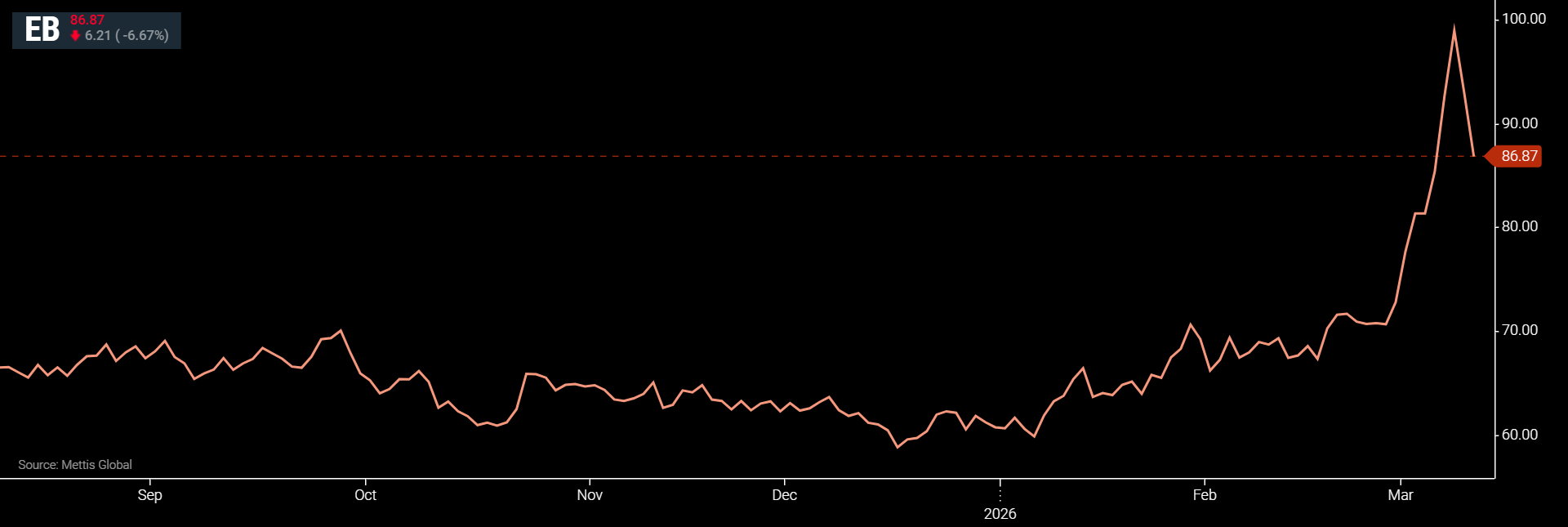
The potential drawdown is expected to surpass the 182
million barrels released by member nations in 2022 following Russia’s invasion
of Ukraine.
Market volatility intensified after both Brent and West
Texas Intermediate (WTI) crude contracts dropped suddenly, erasing earlier
gains.
The price swings came a day after oil recorded its steepest
single-day percentage fall since 2022.
On Tuesday, crude prices plunged more than 11%, reversing a
dramatic rally that had pushed prices above $119 per barrel earlier in the
week, the highest level since June 2022.
The sharp movements highlight the growing uncertainty
surrounding global energy supplies as military tensions escalate in the region.
The United States and Israel carried out some of the most intense airstrikes of
the war against Iran on Tuesday, according to U.S. defense officials and
witnesses on the ground.
The U.S. military also reported destroying 16 Iranian
vessels suspected of laying naval mines near the strategically critical Strait
of Hormuz.
Washington warned Tehran that any mines deployed in the
waterway must be removed immediately.
Despite the heightened security risks, Iran has continued
exporting crude oil through the Strait of Hormuz, primarily to China.
Satellite-based shipping monitoring shows that at least 11.7m
barrels of Iranian crude have passed through the strait since the conflict
began on February 28, with shipments largely destined for Chinese buyers.
Independent shipping data provider Kpler estimates that
roughly 12m barrels of crude oil have moved through the strait since the
conflict started, as reported by CNBC.
Much of the oil is likely bound for China, which has been
the primary buyer of Iranian crude in recent years, though confirming final
destinations has become increasingly difficult due to the lack of tracking
signals.
The Strait of Hormuz, a narrow but vital maritime corridor
connecting the Persian Gulf to global markets, typically handles about one-fifth
of the world’s oil and gas shipments.
Since the conflict erupted, tanker traffic through the
passage has slowed dramatically as shipping companies attempt to avoid the
high-risk zone.
Security incidents have already disrupted operations in the
region.
Within the first two weeks of the war, at least ten vessels
in or near the strait came under attack attributed to Tehran, resulting in the
deaths of seven seafarers, according to maritime authorities.
Iranian officials have warned that tankers navigating the
strait must exercise extreme caution as tensions remain elevated.
The conflict has also triggered disruptions to regional
energy infrastructure. Abu Dhabi’s national oil company ADNOC
temporarily shut its Ruwais refinery following a fire at a facility within the
complex after a drone strike, adding to concerns over supply stability.
Meanwhile, major oil exporters are adjusting logistics to
compensate for potential disruptions.
Saudi Arabia is increasing shipments through its Red Sea
export routes, particularly via the Yanbu terminal, though available data
suggests these volumes remain insufficient to fully offset possible losses from
restricted flows through the Strait of Hormuz.
Output reductions have also been reported across parts of
the Gulf, with Iraq, Kuwait and the United Arab Emirates scaling back
production as the regional conflict continues.
Leaders of the Group of Seven (G7) economies have
begun emergency consultations on coordinated measures to stabilize the global
energy market.
French President Emmanuel Macron is scheduled to host a
virtual meeting of G7 leaders to discuss the conflict’s economic impact and the
possibility of releasing strategic oil reserves.
Oil prices may remain extremely volatile in the coming weeks
as traders react to military developments and policy responses from major
economies.
Copyright Mettis Link News
Related News
_20260421112347985_f8783f.jpeg?width=280&height=140&format=Webp)

| Name | Price/Vol | %Chg/NChg |
|---|---|---|
| KSE100 | 167,089.28 109.91M | -0.21% -352.63 |
| ALLSHR | 101,117.40 308.32M | -0.15% -155.10 |
| KSE30 | 49,841.71 50.59M | -0.28% -142.15 |
| KMI30 | 240,372.43 78.75M | -0.02% -45.72 |
| KMIALLSHR | 65,518.16 188.07M | -0.05% -35.70 |
| BKTi | 46,228.77 7.60M | -0.60% -281.04 |
| OGTi | 33,974.66 4.20M | -0.27% -91.31 |
| Symbol | Bid/Ask | High/Low |
|---|
| Name | Last | High/Low | Chg/%Chg |
|---|---|---|---|
| BITCOIN FUTURES | 83,280.00 | 83,320.00 82,645.00 | 810.00 0.98% |
| BRENT CRUDE | 104.54 | 105.09 102.33 | 0.26 0.25% |
| RICHARDS BAY COAL MONTHLY | 128.50 | 0.00 0.00 | 0.75 0.59% |
| ROTTERDAM COAL MONTHLY | 143.40 | 143.40 143.40 | -1.15 -0.80% |
| USD RBD PALM OLEIN | 1,167.50 | 1,167.50 1,167.50 | 0.00 0.00% |
| CRUDE OIL - WTI | 91.66 | 0.00 0.00 | -0.19 -0.21% |
| SUGAR #11 WORLD | 20.27 | 20.44 20.09 | 0.12 0.60% |
Chart of the Day
Latest News
Top 5 things to watch in this week
 PIB Auction
Pakistan Stock Movers
| Name | Last | Chg/%Chg |
|---|
| Name | Last | Chg/%Chg |
|---|