
Post-Budget Press Briefing: Govt Shifts Gears from Stabilisation to Export-Led Growth
MG News | June 14, 2026 at 08:36 AM GMT+05:00

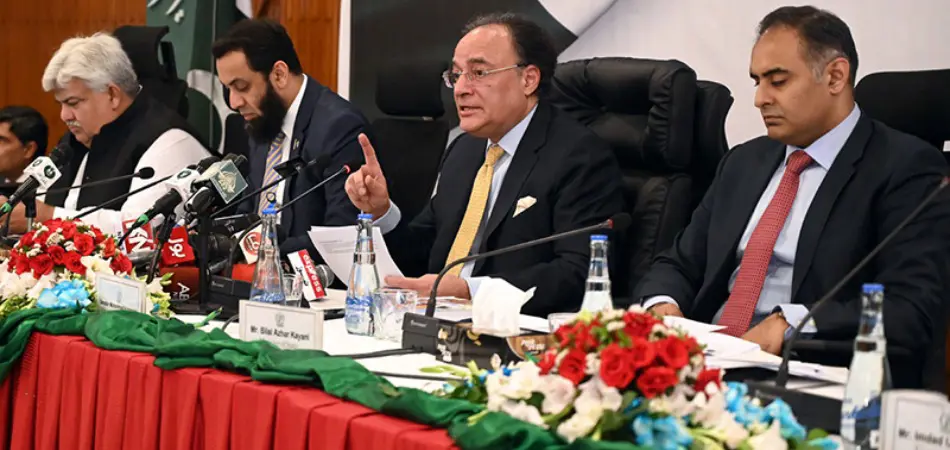
June 14, 2026 (MLN): A day after unveiling the Rs18.8 trillion federal budget for FY2026-27, the government's economic team gathered in Islamabad to defend what it called a "people-friendly and growth-oriented" financial plan aimed at steering Pakistan from economic stabilisation towards export-led growth.
Standing alongside Information Minister Attaullah Tarar, Minister of State for Finance Bilal Azhar Kayani, Finance Secretary Imdadullah Bosal, FBR Chairman Rashid Mahmood Langrial, and Head of the Tax Policy Office Najeeb Memon, Finance Minister Muhammad Aurangzeb said the budget marked a significant shift in the country's economic journey.
"We have made meaningful progress in the direction of travel, from economic stabilisation to economic growth," Aurangzeb said during the post-budget press conference.
Export-Led Growth Takes Centre Stage
The finance minister said the government's primary focus was to create an enabling environment for exports through tax relief, subsidies and affordable financing.
The budget proposes the abolition of advance tax for exporters and the complete elimination of super tax for all exporters. Additionally, exporters will receive financing at a concessional rate of 4.5% under an enhanced Export Finance Scheme (EFS).
To support the sector, the government has earmarked a subsidy of Rs70-71 billion and reduced duties on the import of raw materials to lower production costs and improve competitiveness.
Aurangzeb stressed that the issue was not merely taxation but also access to financing, adding that the refinance scheme would be taken "to a different level" to boost exports.
IT Exports Expected to Reach $4.5bn
Highlighting the growing importance of services exports, particularly information technology, Aurangzeb said Pakistan's IT exports are projected to reach $4.5 billion next year.
He announced that the 0.25% Final Tax Regime (FTR) for the IT industry and freelancers would continue, following consultations with the sector and the Pakistan Software Houses Association (P@SHA).
Relief for Salaried Class, Businesses
Calling the budget "people-friendly," the finance minister said the government had reduced the tax burden on salaried individuals and introduced measures to support businesses, exporters and the construction sector.
The government also announced a 7% increase in salaries and pensions for federal employees, which Aurangzeb described as satisfactory considering the current inflation trends and tax relief measures.
Minister of State for Finance Bilal Azhar Kayani termed the financial plan "the budget of the salaried class, industrialists, exporters and the construction sector," saying the government had attempted to provide meaningful relief to taxpayers after a prolonged period of economic hardship.
Agriculture and Construction Get Major Push
The finance minister said agricultural financing had crossed Rs2 trillion, registering a 15% year-on-year increase.
He highlighted the collateral-free "Zarkhez-e Scheme" for small farmers and noted that Rs125 billion out of the Rs262 billion allocated under the Prime Minister's Youth Business and Agriculture Loan Scheme had been earmarked for agriculture.
The government has also abolished customs duties and regulatory duties on several imported agricultural machines to improve productivity and yields.
Aurangzeb said housing and construction remained key drivers of economic activity, noting that transaction taxes had been reduced to stimulate the sector.
Information Minister Attaullah Tarar added that nearly 12 industries are linked to the housing sector, making construction a crucial engine of growth and employment.
AI and Automation to Drive Tax Reforms
On taxation reforms, Aurangzeb said the government was working on both deepening and broadening the tax base.
He revealed that a new tax operation model was being designed to reduce human intervention through automation and artificial intelligence.
"We want to move towards automation and AI," he said, adding that digital monitoring systems were already generating additional revenues.
The government also plans to introduce a simplified digital tax system for small retailers and shopkeepers, enabling them to file taxes through a mobile application in local languages without requiring tax consultants.
Petroleum Levy to Remain Unchanged
Responding to concerns about fuel prices, the finance minister clarified that there was no proposal to increase the petroleum levy.
However, he warned that the recent Middle East conflict and disruptions to global energy infrastructure could spill over into the next fiscal year.
"It is unrealistic to expect that the Strait of Hormuz and energy supply chains will normalise within a week or two," he said, warning that the impact on oil and LNG markets could persist.
Population Growth an 'Existential Issue'
Aurangzeb termed Pakistan's rapidly growing population an "existential issue" and stressed the need for a comprehensive national strategy.
He said the government had removed taxes on contraceptives and would work with provinces and the Ministry of Health to address population growth, child stunting and learning poverty.
The finance minister also suggested that population should be reconsidered as a determining factor in the next National Finance Commission (NFC) Award.
Provinces Supporting Federal Fiscal Needs
The finance minister appreciated the provinces for stepping up to support the federal government in meeting pressing national requirements.
He said some of these arrangements had been reflected in the defence budget and would likely continue for the next three years.
Aurangzeb also advocated greater reliance on public-private partnerships, citing Sindh's Thar projects as a successful example.
Government Defends Budget as Pro-Growth and Pro-People
Defending the Rs18.8 trillion budget, Information Minister Attaullah Tarar described it as a relief-oriented financial plan that benefits workers, farmers, salaried individuals, industrialists and women.
He highlighted the abolition of sales tax on sanitary products and contraceptives, improved transparency within the Federal Board of Revenue (FBR), and initiatives to promote a cashless and documented economy.
Tarar said the economic team had transformed an economy once feared to be heading towards default into one now embarking on a path of growth.
"This budget provides relief, a way forward and a roadmap towards economic growth," he said.
The government hopes that the combination of tax relief, export incentives, support for key sectors and structural reforms will help Pakistan move decisively from economic stabilisation to sustainable and export-led growth.
Copyright Mettis Link News
Related News
.jpg?width=280&height=140&format=Webp)
| Name | Price/Vol | %Chg/NChg |
|---|---|---|
| KSE100 | 165,406.45 45.25M | 0.17% 282.04 |
| ALLSHR | 100,270.08 198.35M | 0.11% 112.39 |
| KSE30 | 49,068.85 24.43M | 0.13% 64.69 |
| KMI30 | 238,547.44 16.44M | 0.31% 733.46 |
| KMIALLSHR | 65,070.88 88.94M | 0.29% 188.12 |
| BKTi | 45,579.41 5.09M | 0.13% 57.41 |
| OGTi | 33,540.78 1.17M | -0.05% -17.26 |
| Symbol | Bid/Ask | High/Low |
|---|
| Name | Last | High/Low | Chg/%Chg |
|---|---|---|---|
| BITCOIN FUTURES | 83,920.00 | 84,025.00 81,070.00 | 995.00 1.20% |
| BRENT CRUDE | 105.30 | 106.14 105.00 | -1.35 -1.27% |
| RICHARDS BAY COAL MONTHLY | 128.50 | 0.00 0.00 | 1.00 0.78% |
| ROTTERDAM COAL MONTHLY | 144.75 | 0.00 0.00 | -0.05 -0.03% |
| USD RBD PALM OLEIN | 1,167.50 | 1,167.50 1,167.50 | 0.00 0.00% |
| CRUDE OIL - WTI | 92.39 | 93.49 92.17 | -1.35 -1.44% |
| SUGAR #11 WORLD | 20.86 | 20.89 20.00 | 0.61 3.01% |
Chart of the Day
Latest News
Top 5 things to watch in this week
Pakistan Stock Movers
| Name | Last | Chg/%Chg |
|---|
| Name | Last | Chg/%Chg |
|---|