
Balochistan's treasure trove faces rough terrain
Hayyan Mansuri | July 13, 2026 at 11:46 AM GMT+05:00

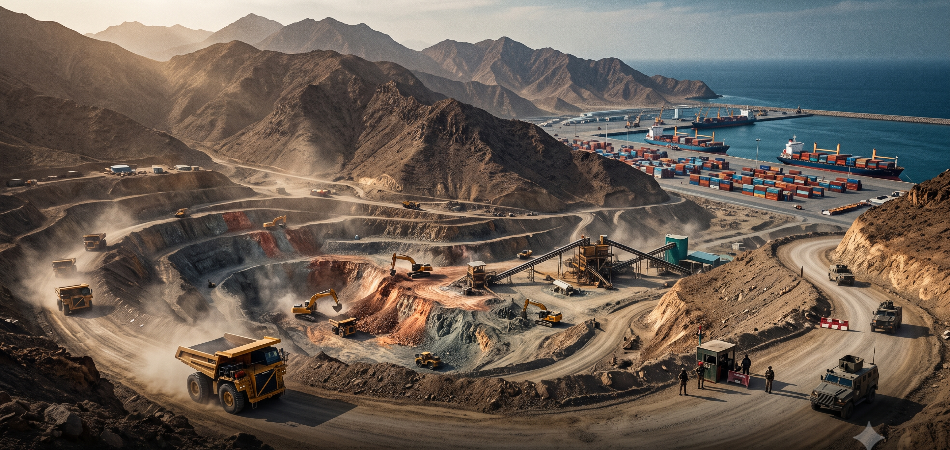
July 13, 2026 (MLN): Balochistan's vast reserves of gas, copper, gold and its strategic Gwadar port position the province as a central pillar of Pakistan's economic future, but a fragile security environment continues to weigh on investment flows and project timelines.
This year has already brought repeated disruptions to ordinary business activity across the province, often triggered by a fresh wave of attacks on security personnel, transport and infrastructure.
In June,
transporters, traders, coal mine operators and doctors in Quetta observed a
province-wide shutter-down and wheel-jam strike over rising lawlessness, with
freight and passenger vehicles reportedly hijacked and torched on national
highways and shopkeepers describing being served extortion notices; organisers
linked the protest directly to a fresh attack in Quetta.
Each such closure, even when confined to a single city or district, temporarily halts retail sales, freight movement and mine-linked commercial activity in a province where formal economic infrastructure is already thin.
This emphasizes how directly security incidents translate into
lost business days on the ground losses
that, taken together, ripple beyond Balochistan into the wider national economy
through disrupted trade routes, fuel supply chains and mineral exports.
Balochistan's outsized resource base
Balochistan holds around most of Pakistan's mineral wealth and sits at
the crossroads of South Asia, Central Asia and the Middle East, giving it
significant geo-economic weight despite historically contributing only a small
share to national GDP.
|
Indicator |
Figure |
|
Share of Pakistan's mineral wealth |
~75% |
|
National GDP growth (FY 2025-26) |
3.7% |
|
PSDP allocation to Balochistan (FY 2025-26) |
Rs206bn |
Reko Diq: the flagship project, and a recent setback
The Reko Diq copper-gold project in Chagai district remains the single
largest bet on Balochistan's long-term economic future.
The project secured $3.5bn in international financing in late 2025 from
the Asian Development Bank, the US Export-Import Bank and other lenders, moving
it from planning into construction, with first copper exports projected for
2029.
The mine could generate up to $70-75bn in revenue over its roughly
37-year life.
However, in March 2026 Barrick Mining, the project's Canadian operator,
said it would slow development and extend its review of the project by 12
months starting July, citing a deterioration in the security environment in
Pakistan and wider regional tensions.
Gwadar's traffic surge at risk
Gwadar Port has seen a sharp rise in cargo traffic this year, partly
driven by regional shipping disruptions near the Strait of Hormuz.
The port processed around 11,000 shipping containers in April 2026 alone,
compared with roughly 8,300 for all of 2025 combined.
Nationally, CPEC has attracted $25.9bn in investment and created more
than 261,000 jobs since its inception.
Security concerns weighing on delivery
Balochistan's slower-than-planned project delivery is linked to the
province's security situation.
Attacks on infrastructure and personnel connected to CPEC and mining
projects have previously prompted delays, cost increases and caution among
foreign investors, a pattern Barrick's own decision to reassess its Reko Diq
review this year reflects.
The province has seen a series of security incidents in recent months,
including in and around Gwadar district, that continue to be watched closely by
investors and international partners with a stake in the corridor.
Recent reporting has also pointed to a widening range of tactics used
against security installations and transport infrastructure in the province,
adding to the risk calculus for large-scale projects.
Even so, the federal and provincial governments are pressing ahead with
efforts to position Balochistan as an investment hub.
The province is set to host its first-ever trade and investment
exposition, BITE 2026, this month, organised by the Balochistan Board of
Investment and Trade in collaboration with BUITEMS, aimed at connecting local
youth and startups with investors.
In my assessment, the risk for Balochistan is not a single dramatic shock
but a slow erosion of the economic case the province is supposed to represent.
If the security situation is left to run on its current trajectory rather
than being treated as a fixable, priority problem, the costs will show up less
in headlines and more in balance sheets: financing partners quietly extending
timelines, as Barrick has already done with Reko Diq; insurance and freight
premiums on routes through Balochistan creeping higher; and multilateral
lenders pricing in a higher risk premium on the next tranche of support, at a
time when Pakistan can least afford it.
That said, Pakistan's own recent history suggests this kind of problem is not beyond the Government's ability to turn around quickly once it is treated as a genuine priority rather than a background issue.
Dollar smuggling to
Afghanistan, until recently, seen as an entrenched, almost unsolvable drain on
the country's foreign exchange reserves yet coordinated crackdowns led by the FIA,
with backing from the country's intelligence and security apparatus, repeatedly
forced smuggling networks underground within days and helped the rupee recover
meaningfully each time.
The lesson is less about currency markets specifically and more about
what focused, well-resourced state action can achieve against a problem that
had come to be seen as intractable.
The same logic can be applied to Balochistan.
None of this is unmanageable if the Government brings a similar level of
coordinated, sustained focus to the province's security environment rather than
a reactive surge after each incident.
Balochistan's mineral wealth and
Gwadar's trade volumes are real and growing assets; whether they become the
growth engine the Government describes, or remain a story of unrealised
potential, will likely come down to whether the same resolve shown elsewhere is
applied here, and sustained.
Copyright Mettis Link News
Related News
| Name | Price/Vol | %Chg/NChg |
|---|---|---|
| KSE100 | 167,089.28 109.91M | -0.21% -352.63 |
| ALLSHR | 101,117.40 308.32M | -0.15% -155.10 |
| KSE30 | 49,841.71 50.59M | -0.28% -142.15 |
| KMI30 | 240,372.43 78.75M | -0.02% -45.72 |
| KMIALLSHR | 65,518.16 188.07M | -0.05% -35.70 |
| BKTi | 46,228.77 7.60M | -0.60% -281.04 |
| OGTi | 33,974.66 4.20M | -0.27% -91.31 |
| Symbol | Bid/Ask | High/Low |
|---|
| Name | Last | High/Low | Chg/%Chg |
|---|---|---|---|
| BITCOIN FUTURES | 83,875.00 | 84,320.00 82,645.00 | 1405.00 1.70% |
| BRENT CRUDE | 104.54 | 105.09 102.33 | 0.26 0.25% |
| RICHARDS BAY COAL MONTHLY | 128.50 | 0.00 0.00 | 0.75 0.59% |
| ROTTERDAM COAL MONTHLY | 143.40 | 143.40 143.40 | -1.15 -0.80% |
| USD RBD PALM OLEIN | 1,167.50 | 1,167.50 1,167.50 | 0.00 0.00% |
| CRUDE OIL - WTI | 91.66 | 0.00 0.00 | -0.19 -0.21% |
| SUGAR #11 WORLD | 20.27 | 20.44 20.09 | 0.12 0.60% |
Chart of the Day
Latest News
Top 5 things to watch in this week
 PIB Auction
Pakistan Stock Movers
| Name | Last | Chg/%Chg |
|---|
| Name | Last | Chg/%Chg |
|---|