
BIPL spotlights Pakistan’s economic crossroads with Ali Hasanain
_20260802134304914_4b9d26.jpeg?width=950&height=450&format=Webp)
MG News | August 02, 2026 at 07:08 PM GMT+05:00

August 02, 2026 (MLN): Pakistan is not poor for want of resources or talent, she
is because of its own rules that make unproductive activity more profitable
than productive activity.
Dr. Ali Hasanain, Associate Professor at Lahore
University of Management Sciences (LUMS), highlighted this while speaking at a
seminar titled "Pakistan Economic Outlook: FY2027 and Beyond,"
organized by BankIslami Pakistan Limited (BIPL) at Karachi.
The seminar was also addressed by President and CEO BIPL
Rizwan Ata, Deputy Governor SBP Muhammad Amin Lodhi, Ali Khizer of Business
Recorder, Dr. Faisal Mushtaq of MiTE Karachi, Khurram Husain, and Advisor to
the Finance Minister Khurram Schehzad. Attendees included senior bankers,
investors, and representatives of the business community.
Dr. Hasanain took aim at what he called a persistent
myth that Pakistan imports too much.
In reality, it is exports that are dramatically and unusually low: the country is simply not producing what the world wants to buy.
The real question, he argued, is why other low-to-middle income countries like
India and Bangladesh export successfully while Pakistan does not, noting that
Pakistan's imports have also recently fallen below regional peers.
Both imports and exports matter for economic
efficiency, and the country cannot grow without either; if a neighboring
country can produce something more cheaply, he said, Pakistan should be buying
from them rather than producing it domestically.
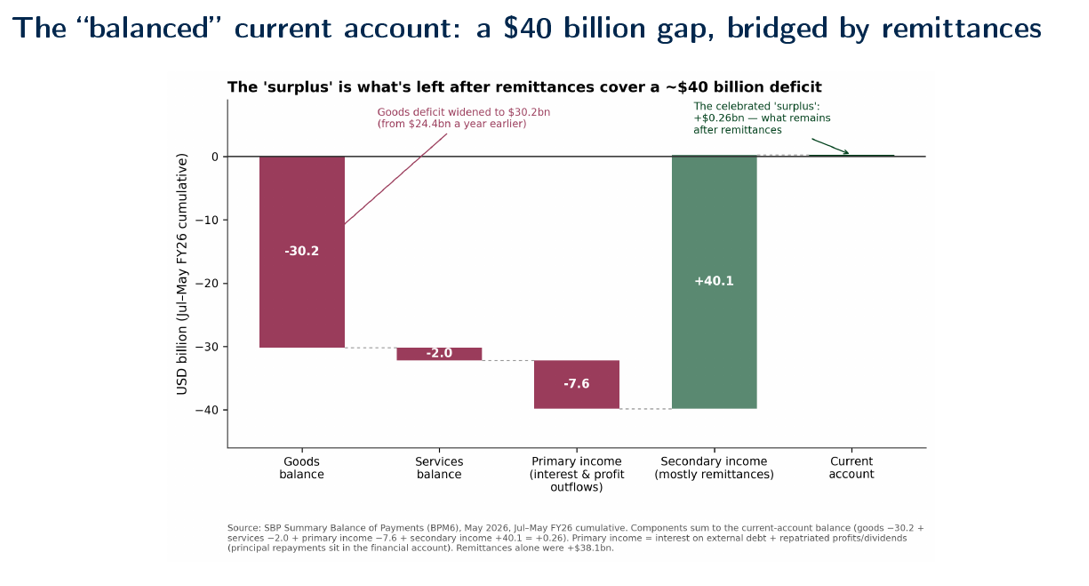
Exports have stayed near 10% of GDP for 25 years, he noted, with workers' remittances now exceeding total exports and the current account's reported "surplus" actually reflects a $40bn trade and income gap bridged by remittances rather than genuine trade competitiveness; i.e., the country has failed to direct remittances into building reserves, rather it uses remittances for imports.
The real exchange rate has appreciated about 20% since
2023 despite the nominal rate holding steady, he added, and a cheap dollar
works against building exports: the currency needs to be adjusted in a
controlled way, since building exports ultimately means earning dollars.
His prescription included automatic tax refunds for
exporters, sunset clauses on protections, and an end to spending reserves to
prop up an overvalued rupee.
An estimate a decade ago suggested Pakistan needed to
grow at 8% a year to absorb the population entering it’s the labor force; the
country instead grew at around 3.7% that decade.
The result, Dr. Hasanain said, is that of more than
180m Pakistanis of working age (18-60), only 77m are employed, leaving 103m
unemployed, many of them women leaving the central question of how much
Pakistan actually needs to grow to become a genuinely productive economy.
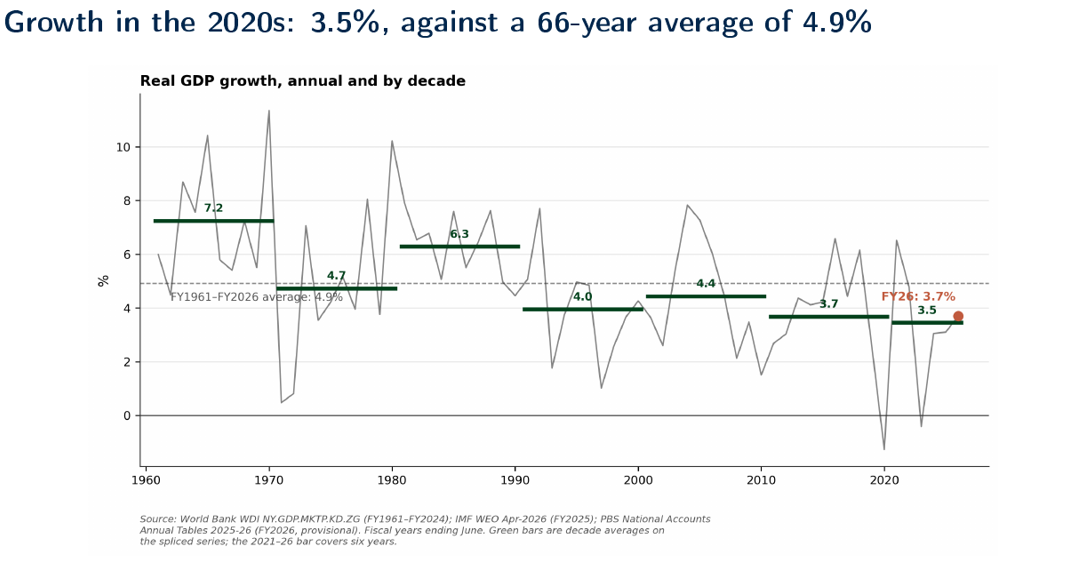
Real GDP growth has averaged 3.5% through the 2020s, below the 66-year average of 4.9%, with the growth rate declining steadily decade after decade and GDP per capita growing slower than comparable economies, he said.
Pakistan led the region in per-capita income for decades
in the 1960s through the 1980s, there was no question it would outshine all
regional peers; however, every regional peer in fact outshone it eventually.
Twenty-two more children per 1,000 die in Pakistan than
its income level would suggest, Dr. Hasanain noted, and the country's factories
operate at roughly two-thirds of their capacity, the lowest utilization among
regional peers’ factories that, he added, will not get Pakistan to the
government's own export targets, because the country has not invested in the
right businesses in the first place.
Both of Pakistan's reform-era growth booms, he said,
ended once growth pushed the current account deficit past the same threshold, i.e.,
4% of GDP, forcing a humble knock at the IMF’s door.
He noted that inflation has been brought under control,
calling it one of the country's genuine positives, but noted that while
inflation has eased to around 7%, the price level has doubled in five years
warning that if Pakistan fails to convert this stabilization into actual
growth, it will slide back into what he called a failing grade.
Pakistan, he said, keeps hearing about "structural
reforms" without ever being told clearly what they are, and even when they
are understood, they are underdelivered, if at all.
Interest payments alone consumed nine of every Rs10 in
net revenue the federal government retained in FY25, an extraordinarily high
number by international comparison, even as the debt-to-GDP ratio itself
remains comparatively sustainable, he said.
This, he argued, brings the discussion back to a
central point: Pakistan is not poor to service its debt, rather Pakistani
government is poor enough to just barely service its debt; because of a
taxation system that fails to raise enough revenue, and unless the government
moves to raise the tax-to-GDP ratio, there will never be enough money to spend
on development.
Tax revenue has stayed stuck at 10-11% of GDP, lower
than virtually every other comparator, except Bangladesh, with agriculture,
retail, and real estate lightly taxed on income, he said.
Defence spending is not unusual as a share of GDP, he
added, but is extraordinarily high as a share of tax revenue, calling it the
same underlying problem as the debt-servicing burden, and arguing that the
hardest-to-tax parts of the economy are precisely where Pakistan must extend
taxation if it wants to grow.
His prescriptions here included sunsetting statutory
tax exemptions with a public register of beneficiaries, abolishing the
inter-corporate dividend tax, and broadening the base without new exemptions.
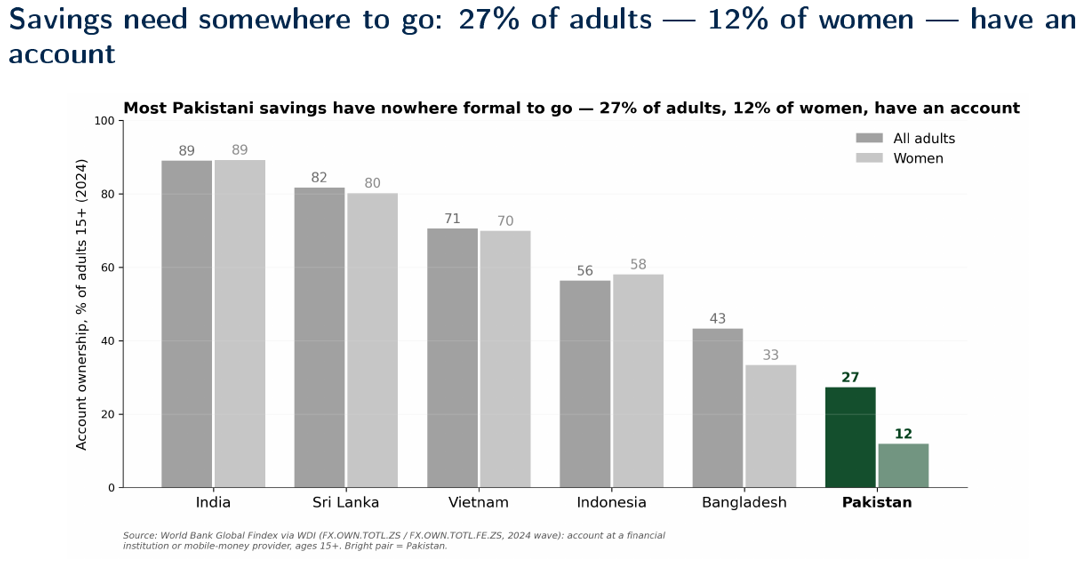
Private sector credit has fallen back to its 1960s share of GDP, roughly a third of regional peers, with savings and investment running at about half the regional rate and only 27% of adults and 12% of women hold a bank account.
State-owned enterprises lose over Rs800bn a year even
after subsidies are counted as their revenue, he said, calling for hard budget
constraints, professional boards, and eventual privatization.
On reserves, he said that every crisis since 1998 has bottomed out below three months of import cover, with Pakistan under an IMF program 55% of the time since 1958 across 26 arrangements.
He proposed a
legislated ceiling on inflation-adjusted spending along with automatic
fuel-price pass-through.
Policy uncertainty, meanwhile, has more than doubled
since the 2022 crisis and functions as a tax in itself, he said, calling for
commercial courts with time standards, one-window licensing, and digital
procurement.
On the two larger structural choices, Dr. Hasanain said
that agriculture makes up roughly a quarter of the economy but contributes a
negligible share of income tax collections, and that the petroleum import bill
alone absorbs more than half of Pakistan's goods-export earnings.
He pointed to the scale-up of the Benazir Income Support Programme; its coverage has grown nearly six-fold since 2009 to over 10m households, as an evidence that Pakistan already knows how to run large-scale programs.
He said that what remains is fiscal space and political will to implement reforms through large scale delivery systems.
_20260802134310966_a1fd30.jpeg)
Concluding his talk, Dr. Hasanain appreciated BankIslami and its treasury team for providing a well-organized, high profile platform for such critical dialogs. Rizwan Malik, Zahid Khan, and Sajjad Qureshi, from BankIslami, organized the event.
Copyright Mettis Link News
Related News

| Name | Price/Vol | %Chg/NChg |
|---|---|---|
| KSE100 | 167,089.28 109.91M | -0.21% -352.63 |
| ALLSHR | 101,117.40 308.32M | -0.15% -155.10 |
| KSE30 | 49,841.71 50.59M | -0.28% -142.15 |
| KMI30 | 240,372.43 78.75M | -0.02% -45.72 |
| KMIALLSHR | 65,518.16 188.07M | -0.05% -35.70 |
| BKTi | 46,228.77 7.60M | -0.60% -281.04 |
| OGTi | 33,974.66 4.20M | -0.27% -91.31 |
| Symbol | Bid/Ask | High/Low |
|---|
| Name | Last | High/Low | Chg/%Chg |
|---|---|---|---|
| BITCOIN FUTURES | 83,735.00 | 83,735.00 82,645.00 | 1265.00 1.53% |
| BRENT CRUDE | 104.54 | 105.09 102.33 | 0.26 0.25% |
| RICHARDS BAY COAL MONTHLY | 128.50 | 0.00 0.00 | 0.75 0.59% |
| ROTTERDAM COAL MONTHLY | 143.40 | 143.40 143.40 | -1.15 -0.80% |
| USD RBD PALM OLEIN | 1,167.50 | 1,167.50 1,167.50 | 0.00 0.00% |
| CRUDE OIL - WTI | 91.66 | 0.00 0.00 | -0.19 -0.21% |
| SUGAR #11 WORLD | 20.27 | 20.44 20.09 | 0.12 0.60% |
Chart of the Day
Latest News
Top 5 things to watch in this week
 PIB Auction
Pakistan Stock Movers
| Name | Last | Chg/%Chg |
|---|
| Name | Last | Chg/%Chg |
|---|