
Pakistan accelerates clean energy transition, thermal reliance drops

MG News | June 11, 2026 at 06:03 PM GMT+05:00

June 11, 2026
(MLN): Pakistan's energy
sector is undergoing a historic green transformation, with total installed
capacity surging to 49,651 MW as the nation decisively pivots away from
expensive thermal power.
For the first time, clean and
indigenous sources hydel, nuclear, and renewables have captured the absolute
majority share, generating 53.1% of the country's electricity.
Driven by a massive explosion in
consumer-led solar net-metering and strategic policy shifts, this transition is
actively shielding the economy from global oil market volatility while laying
the groundwork for sustainable, long-term power security, according to Chapter
14 (Energy) of the officially released Pakistan Economic Survey FY26.
In March 2026, the nation’s
electricity generation capacity expanded by 8.5% to reach 49,651 MW.
This growth was heavily fueled by
consumer-driven solar net-metering, which contributed an impressive 7,319 MW to
the national grid.
Consequently, the reliance on thermal
power dropped significantly from 56.7% to 49.2%.
During the first nine months of the
fiscal year, total electricity generation stood at 92,835 GWh, with sustainable
sources taking the lead to transition the economy away from imported fossil
fuels.
|
Energy Source |
Installed Capacity (MW) |
Share of Capacity (%) |
Generation (GWh) |
|
Thermal |
24,405 |
49.2% |
43,581 |
|
Hydel |
11,615 |
23.4% |
27,961 |
|
Renewable (inc. Net Metering) |
10,101 |
20.3% |
4,160 |
|
Nuclear |
3,530 |
7.1% |
17,133 |
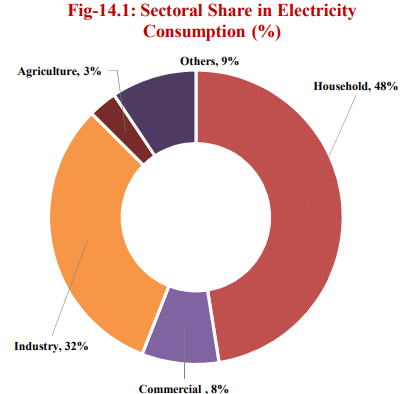
Total electricity consumption
increased by 3.8% to reach 83,143 GWh during the reviewed period.
As visually depicted in the Sectoral
Share in Electricity Consumption (%) charts, the household sector remains
the absolute largest consumer, accounting for roughly 48% of the national
grid's usage, though this reflects a slight reduction from previous years due
to rising tariffs and conservation efforts.
The industrial sector follows closely,
capturing a robust 32% share as manufacturing demands rebound.
The remaining consumption is distinctly segmented, with the commercial sector taking 8%, agricultural usage dropping sharply to 3% due to a massive shift toward solar-powered tube wells, and other governmental or public lighting categories absorbing the final 9%.
The Private Power and Infrastructure
Board (PPIB) continues to attract massive private investments, currently
overseeing 90 operational Independent Power Producers (IPPs) with a combined
capacity of 20,769 MW.
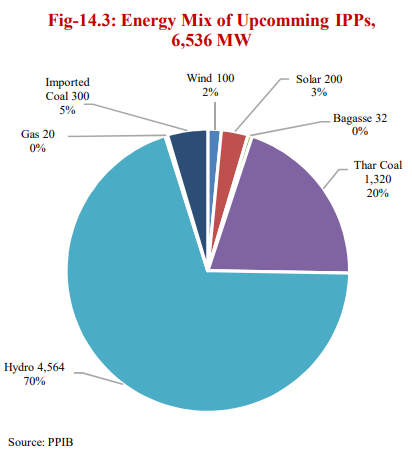
Looking toward the future, the Energy Mix
of Upcoming IPPs, 6,536 MW perfectly illustrates the state's aggressive
indigenization strategy.
A visual breakdown of this upcoming
6,536 MW pipeline reveals an overwhelming dominance of clean energy, with
Hydropower accounting for a staggering 70% (4,564 MW) of the future capacity.
Thar Coal projects represent 20%
(1,320 MW) to ensure baseline grid security, while the remaining pipeline is
fragmented into Imported Coal at 3% (300 MW), Solar at 3% (200 MW), Wind at 2%
(100 MW), and negligible traces of Bagasse and Gas.
|
Upcoming IPP Pipeline |
Capacity (MW) |
Share of Future Mix (%) |
|
Hydropower |
4,564 |
70% |
|
Thar Coal |
1,320 |
20% |
|
Imported Coal |
300 |
3% |
|
Solar & Wind |
300 |
5% |
The petroleum sector recorded a total
consumption of 13.64 million metric tonnes (MMT) during the July-March FY26
period, marking a 3.5% year-on-year increase heavily dominated by the transport
sector, which absorbed 82.5% of total demand.
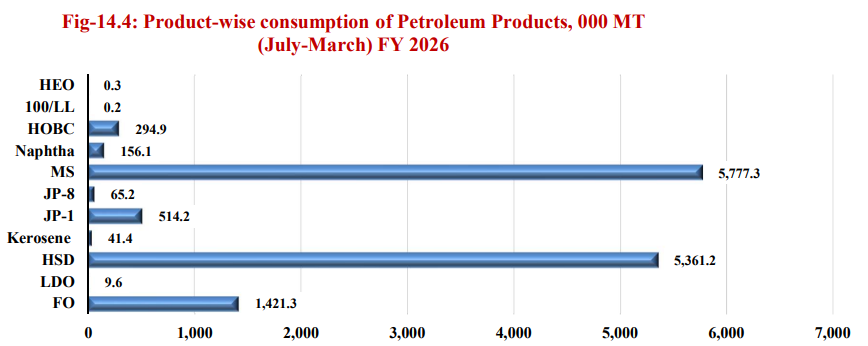
An analysis of the Product-wise
consumption of Petroleum Products, 000 MT highlights the monumental scale
of specific transport fuels. Motor Spirit (MS) leads the volume charts at an
incredible 5,777.3 thousand MT, directly followed by High-Speed Diesel (HSD)
which registered a massive consumption of 5,361.2 thousand MT.
Furnace Oil (FO) continues to hold a significant but declining footprint at 1,421.3 thousand MT due to the power sector shifting to coal and hydel, while premium fuels like HOBC stand at 294.9 thousand MT alongside aviation and kerosene fuels making up the residual fractions.
Natural gas, providing roughly 29.3%
of the primary energy supply, saw consumption average at 2,929 MMCFD, which
incorporates 613 MMCFD of imported Re-gasified Liquefied Natural Gas (RLNG) to
bridge persistent domestic shortfalls.
Simultaneously, the push for
indigenous fuel security has accelerated local coal consumption, particularly
within the power sector which absorbed 12,758.3 thousand metric tonnes,
accounting for nearly 59.6% of national coal usage, while brick kilns and
cement industries consumed the remainder.
Copyright Mettis Link News
Related News



| Name | Price/Vol | %Chg/NChg |
|---|---|---|
| KSE100 | 167,089.28 109.91M | -0.21% -352.63 |
| ALLSHR | 101,117.40 308.32M | -0.15% -155.10 |
| KSE30 | 49,841.71 50.59M | -0.28% -142.15 |
| KMI30 | 240,372.43 78.75M | -0.02% -45.72 |
| KMIALLSHR | 65,518.16 188.07M | -0.05% -35.70 |
| BKTi | 46,228.77 7.60M | -0.60% -281.04 |
| OGTi | 33,974.66 4.20M | -0.27% -91.31 |
| Symbol | Bid/Ask | High/Low |
|---|
| Name | Last | High/Low | Chg/%Chg |
|---|---|---|---|
| BITCOIN FUTURES | 83,875.00 | 84,320.00 82,645.00 | 1405.00 1.70% |
| BRENT CRUDE | 104.54 | 105.09 102.33 | 0.26 0.25% |
| RICHARDS BAY COAL MONTHLY | 128.50 | 0.00 0.00 | 0.75 0.59% |
| ROTTERDAM COAL MONTHLY | 143.40 | 143.40 143.40 | -1.15 -0.80% |
| USD RBD PALM OLEIN | 1,167.50 | 1,167.50 1,167.50 | 0.00 0.00% |
| CRUDE OIL - WTI | 91.66 | 0.00 0.00 | -0.19 -0.21% |
| SUGAR #11 WORLD | 20.27 | 20.44 20.09 | 0.12 0.60% |
Chart of the Day
Latest News
Top 5 things to watch in this week
 PIB Auction
Pakistan Stock Movers
| Name | Last | Chg/%Chg |
|---|
| Name | Last | Chg/%Chg |
|---|