
Highlights of Budget 2026-27
MG News | June 12, 2026 at 05:12 PM GMT+05:00

June 12, 2026 (MLN): Federal Minister for Finance and Revenue, Senator Muhammad Aurangzeb, has begun presenting the Federal Budget for FY2026-27 in the National Assembly, unveiling the government’s fiscal strategy, taxation measures, and economic priorities for the upcoming financial year.
He stated that Pakistan is increasingly recognised and admired worldwide for its economic and strategic role.
He further said that discussions also included Pakistan–Saudi Arabia defence cooperation, along with broader deliberations on wartime preparedness and strategic coordination between the two countries.
The minister’s remarks underscore the need to strengthen bilateral ties and maintain ongoing engagement on security and defence-related matters at the policy level.
“The government has reviewed the impact of rising global oil prices and acknowledged the pressure it places on domestic inflation and external accounts,” he said.
He clarified that the government has not passed the full impact of global oil price increases onto consumers. Instead, it has provided targeted subsidies and relief measures to shield vulnerable segments of society from the immediate burden of rising energy costs.
The minister emphasized that this approach reflects a balanced strategy, managing fiscal pressure while ensuring relief is directed where it is needed most.
Economic Review
“This is the current government’s third budget. Therefore, I consider it essential to briefly cover the journey of the past two years at the beginning of this speech. We started this journey from a difficult position,” he added.
The Finance Minister said the government inherited a difficult economy but has achieved stabilization and recovery over the past two years.
He highlighted stronger macroeconomic indicators, including 3.7% growth, a $452 billion economy, higher per capita income, lower inflation, improved reserves, and rising remittances expected to cross $41 billion. Fiscal stability has also improved with a lower deficit and a primary surplus, while interest rates have been sharply reduced.
He noted improved investor confidence, supported by credit rating upgrades, successful return to international capital markets, a stronger stock market, and growing foreign and local investment.
On reforms, he pointed to privatization progress, major FBR restructuring that boosted revenues, and wider digitalization of tax and financial systems. He also emphasized expansion in financial inclusion through new loan schemes, youth programs, and digital banking growth.
In sectoral development, he cited export-friendly policies, energy reforms that reduced costs and circular debt risks, new oil and gas discoveries, and strong growth in IT and telecom exports.
Salient features of the budget for FY2026-27
- The economic growth rate for FY2026-27 is likely to remain at 4%. The average inflation rate is expected to be 8.2%. The budget deficit will be 3.6% of GDP, while the primary surplus will be 2% of GDP.
- FBR revenues are estimated at Rs 15,264 billion, which is 17.6% higher than the current fiscal year.
- The share of provinces in federal revenues will be Rs 8,848 billion.
- The federal government and provincial governments have agreed on an arrangement to collectively meet certain national requirements, which will have positive impacts at the national level.
- This arrangement has been settled under the spirit of cooperative federalism and without affecting the constitutional rights of the provincial governments. Under this arrangement, the share of provincial governments in the Federal Divisible Pool will continue according to the 7th National Finance Commission (NFC) Award.
- For FY2026-27, the expected collection of revenues by the Federal Board of Revenue (FBR) is Rs 15,264 billion. However, in view of strategic national requirements, an amount of at least Rs 13,350 billion has been kept reserved for distribution between the federal and provincial governments.
- The amount collected from Rs 13,350 billion up to Rs 15,264 billion will be available to the federal government in the form of grants from provincial governments under Article 164 of the Constitution of Pakistan 1973 to fulfill national strategic requirements.
- This arrangement will be applicable for FY2026-27 and will be renewed on similar grounds with mutual consultation of the federal and provincial governments for FY2027-28 and FY2028-29.
- The target for federal non-tax revenue will be Rs 5,336 billion.
- The net income of the federal government will be Rs 11,751 billion.
- The total expenditures of the federal government are estimated at Rs 18,771 billion, out of which Rs 8,054 billion will be allocated for markup payments.
- A budget of Rs 1,000 billion has been allocated for the federal Public Sector Development Programme (PSDP).
- The current expenditure of the federal government is estimated at Rs 17,495 billion.
- National defence is the most important priority of the government. Rs 3,000 billion will be provided for this national duty.
- Rs 1,071 billion are being allocated for civil administration expenditures. Rs 1,169 billion have been allocated for pension expenditures. An amount of Rs 1,091 billion is being allocated as a subsidy for electricity and other sectors.
- In the category of grants, Rs 2,680 billion are being allocated for BISP, Azad Jammu & Kashmir, Gilgit-Baltistan, and the newly merged districts of Khyber Pakhtunkhwa.
- An amount of Rs 71 billion has been allocated for the Prime Minister’s Apna Ghar Scheme.
- Rs 88 billion have been allocated for the expansion of the Export Refinance Scheme, which will help promote exports.
- The government intends to increase the coverage of flagship initiatives of BISP. To implement this, the Kafaalat programme will be expanded to 12 million families. The educational scholarships programme will be further expanded so that approximately 9,200,000 children can benefit. In the next fiscal year, it is proposed to allocate Rs 838 billion for BISP, which is 17% higher compared to last year.
- From current expenditures, it is proposed to allocate Rs 146 billion for Azad Jammu & Kashmir, Rs 88 billion for Gilgit-Baltistan, and Rs 95 billion for the newly merged districts of Khyber Pakhtunkhwa.
The federal government’s proposed fiscal framework for FY2026-27 outlines a total budget size of Rs18.771 trillion, reflecting continued fiscal tightening amid rising structural expenditure pressures.
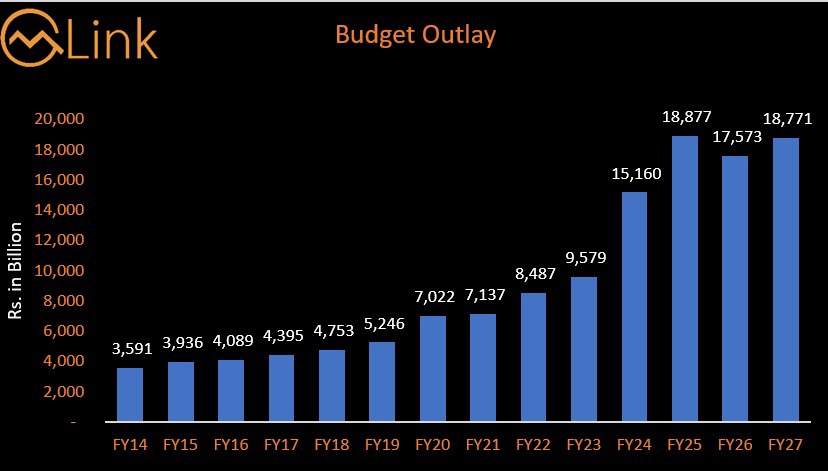
According to budget documents, current expenditures are projected at Rs17.495 trillion, with the single largest component being debt servicing and mark-up payments amounting to Rs8.054 trillion.
This includes
domestic debt servicing of Rs6.983 trillion and external debt payments of
Rs1.071 trillion, highlighting persistent pressure from the country’s growing
debt burden.
On the defence side, allocations are set at Rs3 trillion,
while pensions are projected at Rs1.169 trillion, including Rs822
billion for military pensions and Rs272.5 billion for civil pensions.
Subsidies have been budgeted at Rs1.091 trillion,
while the running of civil government expenses stand at Rs1.071
trillion. Meanwhile, grants and transfers are estimated at Rs2.68
trillion, reflecting higher intergovernmental and institutional support.
The government has also allocated Rs430 billion for
emergency and contingency requirements, including disaster-related
provisions.
On the resource side, the Federal Board of Revenue (FBR) has
been assigned a tax collection target of Rs15.264 trillion, while
non-tax revenue is projected at Rs5.336 trillion, taking gross revenue
receipts to Rs20.6 trillion.
After provincial transfers of Rs8.848 trillion, net
federal revenue stands at Rs11.751 trillion. Additional financing will
come from bank and non-bank borrowing, external inflows, and privatisation
proceeds, collectively forming a significant portion of total resources.
For development spending, the Public Sector Development
Programme (PSDP) has been set at Rs1 trillion, indicating a relatively
restrained development outlay compared to the heavy current expenditure load.
Overall, the budget framework reflects a tightly balanced fiscal position, with both total resources and expenditures aligned at Rs18.771 trillion, underscoring continued reliance on borrowing and a dominant share of spending directed toward debt servicing and defence.
Public Sector Development Programme (PSDP)
The Public Sector Development Programme (PSDP) is the instrument of government investment through which national and foreign resources are utilized for social and economic development.
In the National Economic Council meeting held on June 10, 2026, the national development programme for FY2026-27 was approved, with a total volume of Rs 3,675 billion. This includes Rs 1,000 billion for the federal development programme (PSDP), Rs 2,224 billion for provincial development programmes, and Rs 451 billion for investment by State-Owned Enterprises (SOEs).
This distribution reflects the post–18th Constitutional Amendment framework, under which social sector responsibilities have largely been devolved to the provinces, while the federation focuses on strategic projects of national importance.
More than 60% of the federal development programme is allocated to key sectors including transport & communication, water resources, and energy, while the remaining portion is distributed among IT, science & technology, agriculture, health, and education. These projects are aligned with “Uraan Pakistan” and the National Economic Transformation Plan’s 5 Es.
Transport and Communication
A total of Rs 365 billion has been allocated for transport infrastructure development.
Key allocations include:
- Rs
100 billion for dualization of N-25 Pakistan Expressway (Karachi–Chaman)
- Rs
30 billion for M-6 (Sukkur–Hyderabad Motorway)
- Rs
25 billion for Karachi–Rohri section of ML-1 (ADB financing)
- Rs
2 billion for Thar Coal Connectivity Project
- Over
Rs 93 billion for Gwadar Port infrastructure and transport projects across
provinces
Energy and Power
An allocation of Rs 116.2 billion has been made for the power sector.
This includes hydropower projects such as Dasu Hydropower Project, Tarbela 5th Extension, and Mohmand Hydropower Project. For transmission enhancement, Rs 10.2 billion has been allocated for STATCOM systems and Rs 3 billion for battery storage systems.
Water Resources
A total of Rs 103.1 billion has been allocated for 43 water projects.
Major allocations include:
- Rs 14 billion for Diamer Bhasha Dam
- Rs
22 billion for Mohmand Dam
- Rs
15 billion for Dasu Hydropower Project
- Rs 10 billion for Karachi K-IV water supply project
The sector continues to face serious challenges, including depleting storage capacity and climate-induced floods. Flood losses were recorded at Rs 822 billion, highlighting urgent investment needs.
Physical Planning & Housing
An allocation of Rs 54.6 billion has been made for sustainable urban development and housing.
Planned outcomes include construction of 150,000 climate-resilient housing units, preparation of digital master plans for 10 major cities, and improvements in urban water and sanitation systems.
Industry and Production
Approximately Rs 6.6 billion has been allocated for industry and commerce.
This includes development of Block A of Karachi Industrial Park, establishment of industrial design and automation centers in Karachi, Lahore, and Sialkot, and expansion of 1,000 industrial stitching units under SMEDA for textile exports and employment generation.
Health
An allocation of Rs 25.1 billion has been made for health projects.
These include expansion of tertiary healthcare facilities, strengthening emergency and critical care, expansion of cancer treatment facilities, disease surveillance systems, and modernization of diagnostic infrastructure.
Higher Education and Science & Technology
Higher education sector has been allocated Rs 46 billion, compared to Rs 34.9 billion last year.
Science & technology has been allocated Rs 3.6 billion, focusing on technology transfer, SMEs, renewable energy, electronics, agriculture, and health technologies.
Basic Education, Colleges and Skills
A total of Rs 22 billion has been allocated for Daanish Schools.
Overall education and college development stands at Rs 26.3 billion, covering teacher training, enrollment expansion, early childhood education, and digital learning.
An additional Rs 7.9 billion has been allocated under the Prime Minister’s Youth Skills Development Programme (NAVTTC).
Governance and Institutional Reforms
An allocation of Rs 13 billion has been made for governance reforms, including civil service improvement, justice sector reforms, police modernization, and digital governance expansion.
- Azad Jammu & Kashmir, Gilgit-Baltistan & Merged Districts
- A total of Rs 144.9 billion has been allocated for underdeveloped regions.
Breakdown:
- Azad
Jammu & Kashmir: Rs 45 billion + Rs 5 billion special package
- Gilgit-Baltistan:
Rs 44 billion + Rs 4 billion special package
- Merged
districts of KP: Rs 56 billion
Income Tax Relief Measures
Relief for Salaried Class
Relief has been announced for salaried individuals across four income slabs:
- Rs
2.2 million–Rs 3.2 million: tax reduced from 23% to 20%
- Rs
3.2 million–Rs 4.1 million: 30% to 25%
- Rs
4.1 million–Rs 5.6 million: 35% to 29%
- Rs 5.6 million–Rs 7 million: 35% to 32%
The surcharge on salaried class, previously reduced from 10% to 9%, has now been completely abolished.
Super Tax Reduction
The super tax ranging from 1% to 7.5% on business income from Rs 150 million to Rs 500 million has been abolished.
For income above Rs 500 million, the rate has been reduced from 10% to 8%.
Surcharge on banks, oil & gas exploration companies, and fertilizer companies will remain unchanged.
Construction Sector Relief
Withholding tax on property transactions has been rationalized:
Purchase
tax reduced from 2.5% to 1.25%
Sales
tax reduced from 5.5% to 2.75%
Export and IT Sector
The 0.25% FTR concession on IT exports, previously expiring on June 12, 2026, has been extended until June 30, 2029.
Export tax has been reduced from 2% to 1.25%, classified under minimum tax.
International Transactions
Withholding tax on international debit/credit card usage has been reduced from 5% to 0.5%.
Capital Value Tax
Capital Value Tax on foreign assets has been abolished to encourage documentation of foreign holdings.
Social Relief
- Tax
on sanitary products abolished
- Tax
on contraceptives abolished
- Fixed Tax for Small Shopkeepers
A fixed tax regime under Section 99B has been introduced:
- Eligible
turnover: up to Rs 20 million
- Fixed
tax rate: 1% of annual sales
- Minimum
tax: Rs 25,000
- No
routine audit
- No
POS requirement
- One-page
return system in local languages
- QR-coded
compliance plaque introduced
Sales Tax and Compliance
FMCGs
included in Third Schedule
Withholding
tax extended to individuals and AOPs purchasing from unregistered suppliers
FBR Tax Operating Model
A National Faceless Centre has been introduced.
Key features:
- Single
Blind and Double Blind audit system
- Automated
case selection via risk scoring
- IRIS
portal-based communication
- No direct taxpayer-officer interaction
Central data hub integrates:
- Property
records
- Vehicle
data
- Bank
data
- Utility data
Algorithm-based settlement system introduced for automated resolution of discrepancies.
Federal Excise Duty Measures
- Rs
80 per litre duty on petroleum-based solvents
- Higher
duties on vehicles above 2000cc–3000cc
- Increased
duty on vehicles above 3000cc
- Luxury
EVs above Rs 20 million taxed
- Business
class travel FED abolished
- EV
incentives on motorcycles, rickshaws, cars, buses maintained
- 1%
sales tax facility on imported electric trucks
Healthcare and Tariff Policy
Customs duty abolished on more than 100 raw materials used in local manufacturing of medicines under National Tariff Policy 2025-30.
Relief Measures
A
7% increase has been announced in salaries of government employees. Pension
payments have also been increased by 7%, while the minimum wage has been raised
by 10%.
Concluding Remarks
At the conclusion of his speech, he said this was no ordinary journey but a difficult and arduous one, traversed with national spirit, leadership’s willpower, and far-sightedness.
He added that stability was not the destination but only the beginning, and the journey continues with renewed conviction and enthusiasm. He expressed confidence that the budget measures would further strengthen this path.
He said progress is not merely the growth of statistics, but improvement that reaches every household, farmer, business, and youth.
The government’s commitment, he noted, is to ensure broad-based, sustainable, and equitable development whose benefits reach all regions and segments of society. He termed the budget a step toward this comprehensive progress.
He further paid tribute to Prime Minister Shehbaz Sharif for his leadership and guidance in achieving economic stability, and acknowledged the role of the military leadership, especially Field Marshal Syed Asim Munir, for strengthening national defence.
He also thanked coalition partners for their support, appreciated the opposition for constructive criticism, and praised provincial governments for their cooperation in achieving strategic national goals.
He said the ultimate objective of all efforts is to improve the standard of living of the people of Pakistan and provide them with the facilities and comfort they deserve.
Copyright Mettis Link News
Related News
.png?width=280&height=140&format=Webp)

| Name | Price/Vol | %Chg/NChg |
|---|---|---|
| KSE100 | 167,089.28 109.91M | -0.21% -352.63 |
| ALLSHR | 101,117.40 308.32M | -0.15% -155.10 |
| KSE30 | 49,841.71 50.59M | -0.28% -142.15 |
| KMI30 | 240,372.43 78.75M | -0.02% -45.72 |
| KMIALLSHR | 65,518.16 188.07M | -0.05% -35.70 |
| BKTi | 46,228.77 7.60M | -0.60% -281.04 |
| OGTi | 33,974.66 4.20M | -0.27% -91.31 |
| Symbol | Bid/Ask | High/Low |
|---|
| Name | Last | High/Low | Chg/%Chg |
|---|---|---|---|
| BITCOIN FUTURES | 83,560.00 | 84,320.00 82,645.00 | 1090.00 1.32% |
| BRENT CRUDE | 104.54 | 0.00 0.00 | -0.18 -0.17% |
| RICHARDS BAY COAL MONTHLY | 128.50 | 0.00 0.00 | 0.75 0.59% |
| ROTTERDAM COAL MONTHLY | 143.40 | 143.40 143.40 | -1.15 -0.80% |
| USD RBD PALM OLEIN | 1,167.50 | 1,167.50 1,167.50 | 0.00 0.00% |
| CRUDE OIL - WTI | 91.66 | 0.00 0.00 | -0.19 -0.21% |
| SUGAR #11 WORLD | 20.27 | 20.44 20.09 | 0.12 0.60% |
Chart of the Day
Latest News
Top 5 things to watch in this week
 PIB Auction
Pakistan Stock Movers
| Name | Last | Chg/%Chg |
|---|
| Name | Last | Chg/%Chg |
|---|