
Halal power race: Who will define the $1.8tr standard?
MG News | May 25, 2026 at 12:51 PM GMT+05:00

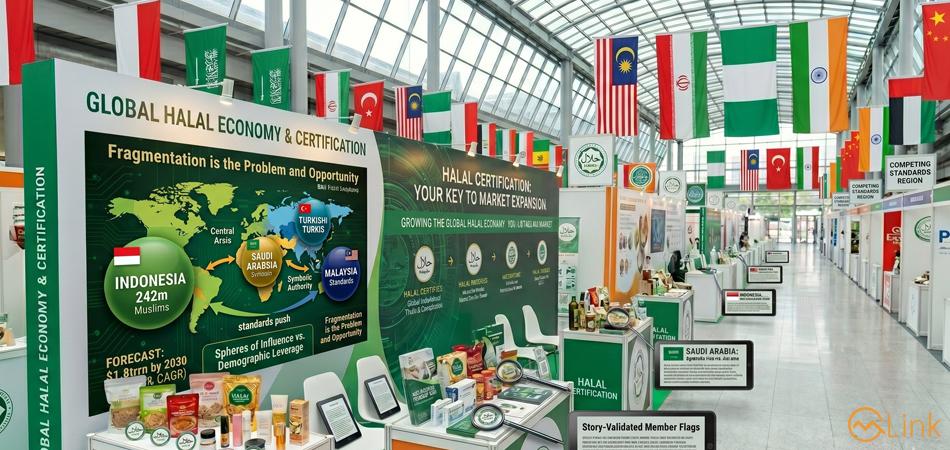
May 25, 2026 (MLN): Halal certification, once a niche religious compliance matter, has quietly evolved into one of the most strategically charged regulatory battlegrounds in global trade.
According to a new deep-dive analysis by BMI Fitch
Solutions, global halal food and drink spending is forecast to grow from $1.3
trillion in 2026 to $1.8tr by 2030, expanding at 6.9% annually outpacing both
non-halal food spending growth of 4.3% and the global headline rate of 4.7%.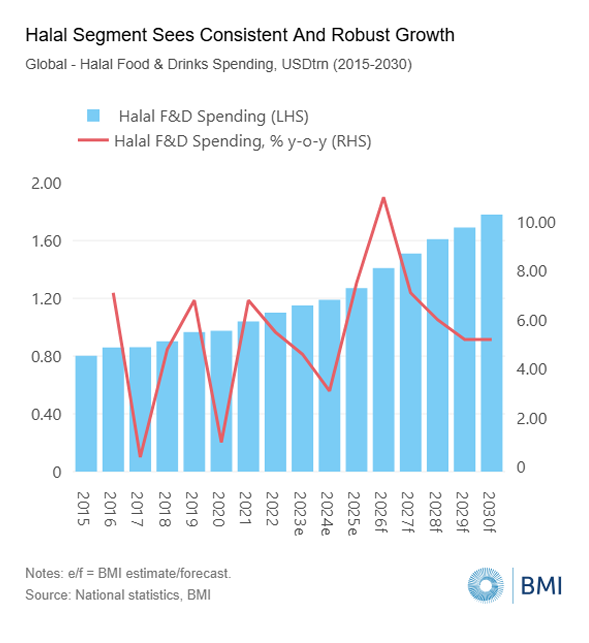
The stakes are straightforward: whichever country's halal
standards gain widest international recognition stands to make trade smoother
for its own exporters, attract halal-linked investment, and position itself as
an indispensable hub in a rapidly deepening global supply chain.
Yet despite the existence of umbrella bodies like the
Organisation of Islamic Cooperation, no single globally accepted halal standard
exists today.
A certificate recognised in Kuala Lumpur may carry little
weight in Riyadh. This fragmentation is the central problem and the central
opportunity.
Indonesia
No country can match Indonesia's sheer demographic leverage.
Home to roughly 242 million Muslims, it is the world's most populous Muslim
nation.
Since 2024, Indonesia has made halal certification mandatory
for all domestic food products, with imported goods facing a final compliance
deadline of October 2026.
The logic is powerful: if international manufacturers want
access to Indonesia's enormous consumer base, they must align with Indonesian
standards.
But execution has muddied the picture. The country's
certification architecture involves both the state authority BPJPH and the
influential Ulema Council, which retains authority over religious rulings on
halal compliance.
For foreign firms, navigating this dual structure can feel
slow and opaque. In halal certification, efficiency matters as much as scale
and Indonesia has yet to fully resolve that tension.
Saudi Arabia
Saudi Arabia brings something no other country can
replicate: custodianship of Islam's two holiest cities.
In a domain where trust is inseparable from religious
legitimacy, that symbolic weight is a genuine competitive asset, reinforced
annually by millions of Hajj and Umrah pilgrims keeping the kingdom at the
centre of the global Muslim experience.
Yet religious prestige does not automatically translate into
regulatory supremacy.
Halal trade is governed by technical specifications and
bilateral recognition agreements domains where symbolism only carries so far.
With a population of just 35.2 million, Saudi Arabia also
lacks the market leverage of larger neighbours, limiting its ability to compel
global manufacturers to align with its standards.
Malaysia
If Indonesia has size and Saudi Arabia has symbolism,
Malaysia has something arguably more durable in trade terms: institutional
credibility.
Its JAKIM certification system, operating since 1994, is
widely regarded as the global benchmark for rigour and professional
administration.
That first-mover advantage still matters in a fragmented
market hungry for trusted reference points, and Malaysia's broader halal
ecosystem spanning Islamic finance, pharmaceuticals and tourism strengthens its
case further.
The limitation is coercive power. Malaysia cannot compel
international firms to adopt its standards the way Indonesia can through sheer
market demand. Credibility is a powerful asset, but not a mandate.
The Rest of the Field
Türkiye's advantage lies in geography and diplomatic reach.
Through the Organization of Turkic States a bloc of over 170 million people
Ankara can quietly shape halal norms within a Turkic regulatory sphere.
But it lacks the reputational capital of Malaysia, the
religious authority of Saudi Arabia, or the market pull of Indonesia.
Iran, despite a large Muslim population of 93.2m, faces a
structural ceiling.
As a Shia-majority state, its religious institutions do not
carry automatic legitimacy in the overwhelmingly Sunni environments that
dominate global halal trade.
Combined with broader geopolitical isolation, the prospect
of Tehran becoming a universal reference point remains remote.
Egypt has made deliberate moves to build a national halal
export architecture, but regulatory inconsistency including the removal of
halal certification requirements on UK dairy imports in 2025 has undermined its
credibility.
Nigeria, with approximately 135.7 million Muslims,
represents a longer-term demographic story as a potential anchor for West
African halal development. For now, both remain emerging markets rather than
recognised global authorities.
India and China each bring vast Muslim populations to this
contest, but both face the same structural obstacle: in a domain where
religious legitimacy is foundational, non-Muslim-majority countries face
credibility limitations that commercial scale cannot easily overcome.
In Western markets, the picture is a fragmented patchwork of
private certifiers and community organisations with uneven international
recognition, leaving businesses seeking export access to pursue certification
from already-established players like JAKIM.
The Verdict
No single country is close to becoming the unchallenged
global halal standard-setter. Indonesia has the scale but must resolve its
governance complexity.
Malaysia has the credibility but lacks coercive leverage.
Saudi Arabia has the symbolism but not the volume.
The more likely near-term outcome is a regionalised halal
world a Southeast Asian cluster, a Gulf sphere, a Turkic bloc developing in
parallel rather than converging around a single dominant model. For exporters
navigating this landscape, the fragmentation remains a burden.
For the countries competing within it, the contest remains very much open.
|
Region |
Market |
Halal Certification
Authority |
|
APAC |
Indonesia |
BPJPH (Halal Product
Assurance Organizing Agency) |
|
APAC |
Pakistan |
PHA (Pakistan Halal
Authority) |
|
APAC |
India |
Jamiat Ulama-i-HindHalal
India |
|
APAC |
Bangladesh |
Bangladesh Islamic
FoundationBangladesh Standards and Testing Institution |
|
APAC |
Iran |
Halal World Institute |
|
APAC |
Uzbekistan |
Uzstandard Agency |
|
APAC |
Malaysia |
JAKIM (Department of
Islamic Development Malaysia) |
|
APAC |
Philippines |
National Commission on
Muslim Filipinos |
|
--- |
--- |
--- |
|
MENA |
Nigeria |
Nigeria Halal
Certification Authority |
|
MENA |
Egypt |
IS EG Halal |
|
MENA |
Algeria |
IANOR (Algerian
Standardisation Institute) |
|
MENA |
Iraq |
Central Organisation for
Standardisation and Quality Control |
|
MENA |
Morocco |
IMANOR (Institut
Marocain de Normalisation) |
|
MENA |
Saudi Arabia |
SFDA (Saudi Food and
Drug Authority) |
|
--- |
--- |
--- |
|
NA & Europe |
Türkiye |
HAK (Halal Accreditation
Agency) |
|
NA & Europe |
UK |
Halal Food Authority |
|
NA & Europe |
US |
Islamic Food and
Nutrition Council of AmericaAmerican Halal Foundation |
|
NA & Europe |
France |
Grande Mosquée de
ParisAssociation Rituelle de la Grande Mosquée de Lyon |
Copyright Mettis Link News
Related News
_20260421112347985_f8783f.jpeg?width=280&height=140&format=Webp)

| Name | Price/Vol | %Chg/NChg |
|---|---|---|
| KSE100 | 167,089.28 109.91M | -0.21% -352.63 |
| ALLSHR | 101,117.40 308.32M | -0.15% -155.10 |
| KSE30 | 49,841.71 50.59M | -0.28% -142.15 |
| KMI30 | 240,372.43 78.75M | -0.02% -45.72 |
| KMIALLSHR | 65,518.16 188.07M | -0.05% -35.70 |
| BKTi | 46,228.77 7.60M | -0.60% -281.04 |
| OGTi | 33,974.66 4.20M | -0.27% -91.31 |
| Symbol | Bid/Ask | High/Low |
|---|
| Name | Last | High/Low | Chg/%Chg |
|---|---|---|---|
| BITCOIN FUTURES | 83,875.00 | 84,320.00 82,645.00 | 1405.00 1.70% |
| BRENT CRUDE | 104.54 | 105.09 102.33 | 0.26 0.25% |
| RICHARDS BAY COAL MONTHLY | 128.50 | 0.00 0.00 | 0.75 0.59% |
| ROTTERDAM COAL MONTHLY | 143.40 | 143.40 143.40 | -1.15 -0.80% |
| USD RBD PALM OLEIN | 1,167.50 | 1,167.50 1,167.50 | 0.00 0.00% |
| CRUDE OIL - WTI | 91.66 | 0.00 0.00 | -0.19 -0.21% |
| SUGAR #11 WORLD | 20.27 | 20.44 20.09 | 0.12 0.60% |
Chart of the Day
Latest News
Top 5 things to watch in this week
 PIB Auction
Pakistan Stock Movers
| Name | Last | Chg/%Chg |
|---|
| Name | Last | Chg/%Chg |
|---|