
Govt releases FY26 Economic Survey
MG News | June 11, 2026 at 02:47 PM GMT+05:00

June 11, 2026 (MLN): Finance Minister Muhammad Aurangzeb presented the Economic Survey FY2025-26 during a scheduled press conference, outlines a narrative of macroeconomic stabilization, structural transition, and cautious optimism.
Against a highly volatile global backdrop marked by
geopolitical conflicts and trade barriers, Pakistan’s economy accelerated its
growth momentum, registering a GDP growth rate of 3.70% compared to
3.18% in the previous fiscal year.
This comprehensive review details the sectoral
transformations, fiscal corrections, digital milestones, and structural
vulnerabilities that defined the country's economic landscape in FY26.
1. The Global Backdrop: A Fractured Resilience
The international economic environment in late 2025 and
early 2026 was characterized by deep divisions, showing initial trade
resilience with a 5.1% global trade volume expansion in 2025 before the outlook
darkened rapidly due to the outbreak of conflict in the Middle East.
According to the IMF, global growth is projected to moderate
from 3.4% in 2025 to 3.1% in 2026, while global headline inflation is expected
to tick upward to 4.4% from 4.1%.
Among the major economies, the US remained a strong driver
with growth projected to rise to 2.3% in 2026 due to technology momentum and
expansionary policies, whereas China’s growth is expected to moderate to 4.4%
under the adverse effects of higher US effective tariffs, which hit an
estimated 13.5% by April 2026.
Ultimately, these escalating trade barriers and regional
conflicts triggered severe energy supply route disruptions, heightened shipping
and insurance costs, and added significant downside risks that slowed global
trade volume growth to a projected 2.8% for 2026.
2. Real Sector Performance: Sectoral Triggers of Growth
Pakistan’s GDP growth of 3.70% was anchored by positive
contributions across all three major sectors of the economy services, industry,
and agriculture pushing the total GDP valued at current market prices to Rs
126.9 trillion ($452.1 billion), which marks an 11.3% increase over the
previous year.
Agriculture: Defying the Flood Waters
Despite suffering from the devastating monsoon floods of
2025, the agriculture sector demonstrated remarkable resilience by posting a
growth of 2.89%, which is a significant recovery from the 1.53% growth
recorded in the prior year.
The crucial crop sub-sector shook off a previous contraction
of 1.01% to grow by 1.44% in FY26, as bumper harvests in sugarcane (up 6.2% to
89.45m tonnes), wheat (up 4.3% to 29.61m tonnes), and rice (up 2.8% to 9.99m
tonnes) effectively offset production declines in cotton and maize.
This performance was heavily supplemented by the livestock
sub-sector, which expanded by 3.75% with a renewed policy impetus from the
newly established National Meat Sector Transformation and Export Council.
To sustain this upward trajectory, financial institutions
also scaled up their expansion plans, targeting total agricultural credit
disbursements of Rs3.062tr, representing a 19% increase over the previous
year's allocation.
Manufacturing and Mining: The Industrial Rebound
The industrial sector expanded by 3.51% overall,
driven primarily by a powerful turnaround in Large-Scale Manufacturing (LSM),
which recorded a robust growth rate of 6.11% due to favorable
macroeconomic conditions, a stable exchange rate, and relatively easing
monetary policy.
Out of 22 key manufacturing industries, 16 reported positive
trajectories, including textiles, food, wearing apparel, automobiles, and
petroleum products, culminating in a striking 11.1% year-on-year surge in the
Quantum Index of Manufacturing (QIM) in March 2026 alone.
Simultaneously, the Mining and Quarrying sector broke a
painful four-year streak of continuous contraction to post a marginal positive
growth of 0.4%.
Massive extractions were witnessed during the July-March
period for magnesite (164.8%), rock salt (109.9%), gypsum (67.0%), and iron ore
(41.5%), though critical domestic energy components like natural gas (-3.7%)
and crude oil (-0.6%) experienced slight declines.
Services: The Economic Engine
The services sector maintained its status as the absolute
powerhouse of Pakistan's economy, comprising the largest share at 58.42% of
the total GDP.
The sector expanded by 4.09% during the fiscal year
under review, a growth momentum that was heavily anchored by explosive
acceleration within the information and communication services sub-sector,
which expanded by 7.52%.
3. Macroeconomic Indicators: Income, Investment, and
Savings
The combination of enhanced economic activity and strict
fiscal management trickled down into improved national wealth, allowing
Pakistan's per capita income to rise from $1,751 to $1,901 while the
national exchange rate remained remarkably stable at an average of Rs 280.65
per US Dollar.
The investment-to-GDP ratio stood steady at 14.38%,
primarily driven by a 12.8% increase in private sector capital formation, which
reflected renewed business confidence and pushed total Gross Fixed Capital
Formation (GFCF) up 10.9% to reach Rs 16,071.2 billion.
Furthermore, national savings were recorded at 14.13% of
GDP, which successfully contained foreign savings reliance to just 0.24% of
GDP, signaling that the country managed to significantly limit its dependence
on volatile external debt financing for immediate capital requirements.
4. Fiscal and Monetary Discipline: Reining in the Deficit
The defining feature of the FY26 economic trajectory was a
sharp commitment to fiscal consolidation, widely supported by implementation
coordination via the National Fiscal Pact to improve revenue mobilization and
strengthen expenditure efficiency.
During the July-March FY26 period, the national fiscal
deficit narrowed drastically to just 0.7% of GDP (Rs 856.4 billion) from
the 2.6% of GDP recorded in the same period last year, while the primary
surplus rose to 3.2% of GDP (Rs 4,091.5 billion).
Total national revenue increased by 10.7% to Rs14.80tr boosted
by an 11.3% growth in tax revenues and a 10.1% rise in FBR net collections while
total public expenditures actually declined by 4.2% to Rs15.65tr, driven almost
entirely by a massive 23.2% drop in debt markup payments.
In the monetary domain, Broad Money (M2) expanded by 15.4%,
yet government borrowing for budgetary support fell dramatically from Rs1.32tr
down to Rs850.6bn, creating essential fiscal space that allowed private sector
credit to absorb Rs934.1bn for working capital and fixed investment loans.
5. Financial and Capital Markets: Investor Euphoria
Pakistan's capital markets outpaced several major global
stock indexes during the fiscal year, buoyed by strong corporate earnings, a
decline in the policy rate, and investor confidence stemming from successful
reviews and tranche disbursements under the IMF-EFF Programme.
The benchmark KSE-100 index posted a significant growth of 18.4%
during the July–March FY26 period, pushing total Pakistan Stock Exchange (PSX)
market capitalization up 8.5% to close at Rs16.534tr ($59.23bn) by March 31,
2026.
Islamic finance saw massive institutional expansion, with
Shariah-compliant assets growing to represent 64% of total market
capitalization ($10.6tr) across 308 listed securities.
The government capitalized on this momentum by successfully
generating Rs2.25tr through sovereign Sukuk issuances including a new 10-year
zero-coupon fixed-rate Sukuk which effectively expanded the share of
Shariah-compliant instruments within total government securities to 14.5%.
6. External Sector, Trade, and Public Debt Profile
While the structural architecture of the external sector
stabilized, the core trade balance remained under distinct geopolitical
pressure.
Supported by robust remittance channels, the current account
recorded a marginal surplus of $72m for July–March FY26, anchored
single-handedly by overseas workers' remittances which grew 8.2% to achieve an
inflow of $30.3bn.
Conversely, the merchandise trade deficit widened to $27.9bn
from $22.7bn last year, as an economic rebound caused imports to rise by 6.9%
while formal exports contracted by 8% due to weakened global demand and
regional shipping lane gridlocks.
This trade gap was partially salvaged by the services
account deficit narrowing to $2.1bn on the back of a 19.8% surge in IT
exports, helping push liquid foreign exchange reserves to $21.8bn
($16.4bn with the SBP).
Total public debt stood at Rs83.285tr ($92.2bn in
external debt), but prudent borrowing limits restricted debt growth to 3.4%
during the nine-month period compared to 6.7% previously, while active debt
portfolio risk management operations helped increase the average time to
maturity of domestic debt to 3.86 years.
7. Inflation and Energy: Vulnerability to Global Crises
Despite structural adjustments, the final quarter of the
fiscal year exposed Pakistan's persistent exposure to external volatility.
Average CPI inflation for the July-April period sat at 6.2%,
but regional conflicts and supply chain constraints in late spring caused an
abrupt spike, jumping from 7.3% in March 2026 to 10.9% in April 2026.
These same geopolitical tensions around the Strait of Hormuz
drove the national energy import bill up by 6.3% to $8.9bn due to
international oil price volatility.
In response to these vulnerabilities, Pakistan pressed
forward on its indigenous green energy transition, expanding total installed
generation capacity to 49,651 MW, where clean, environment-friendly sources hydel,
nuclear, and renewables successfully captured the majority share (50.8%)
over thermal alternatives.
8. Technology and Digital Infrastructure: The 5G Era
Begins
The Information Technology and telecommunication sector
served as a standout performer, accelerating Pakistan's shift toward a
knowledge-based digital economy.
On March 10, 2026, the Pakistan Telecommunication
Authority (PTA) successfully executed the long-awaited 5G spectrum auction,
generating $509.6m across multiple bands and elevating Pakistan to
"G5 Regulator Advanced Level" status by the International
Telecommunication Union.
This digital boom was mirrored in earnings as total ICT
export remittances jumped 19.7% to $3.38bn, while tech freelancer
exports surged 51% to $856.3m, fueled by programs like DigiSkills.pk
which conducted 5.14m trainings.
Infrastructure and regulatory frameworks were further
enhanced as total telecom subscriptions reached 207.2m, broadband penetration
rose to 64.2% (161m subscribers), and the federal government formally approved
the Artificial Intelligence Policy 2025 to accelerate AI adoption across
key sectors.
9. Social Horizons: Education, Health, and Employment
While fiscal adjustments often squeeze social sectors, the
survey highlighted localized improvements in human capital metrics.
The national literacy rate improved to 63% (73% for
males, 54% for females), while focused provincial expansion plans slashed the
national ratio of Out-of-School Children (OOSC) from 38% down to 28%,
with Balochistan recording the most dramatic turnaround by cutting its
out-of-school ratio from 69% to 45%.
Pakistan’s estimated population reached 252.09 million
with a 2.07% growth rate, showing moderate improvements in life expectancy to
67.8 years and immunization coverage to 73%, alongside major legislative
enactments like the ICT Child Marriage Restraint Act 2025 and the ICT
Domestic Violence Act 2026 to enhance human protection.
On the labor front, the employed workforce expanded to 77.2m
individuals, but due to a massive influx of youth entering the working-age
bracket, the formal unemployment rate ticked upward from 6.3% to 7.1%,
highlighting a pressing need to further accelerate job creation.
10. Climate Change: The Present Reality
The survey leaves no room for ambiguity regarding Pakistan's
profound environmental vulnerability, noting that despite contributing less
than 1% to global greenhouse emissions, the country remains at the absolute
epicenter of climate fallout.
The year 2025 entered the record books as Pakistan's second
warmest year in over six decades, experiencing a national mean temperature of
23.9°C with shifting monsoon dynamics that triggered catastrophic
multi-provincial floods.
These late 2025 floods alone claimed 1,039 lives, displaced
4 million citizens, and directly inflicted Rs822bn in damages, cementing
climate change as a critical present risk and a major downside driver
threatening to disrupt Pakistan's medium-term economic growth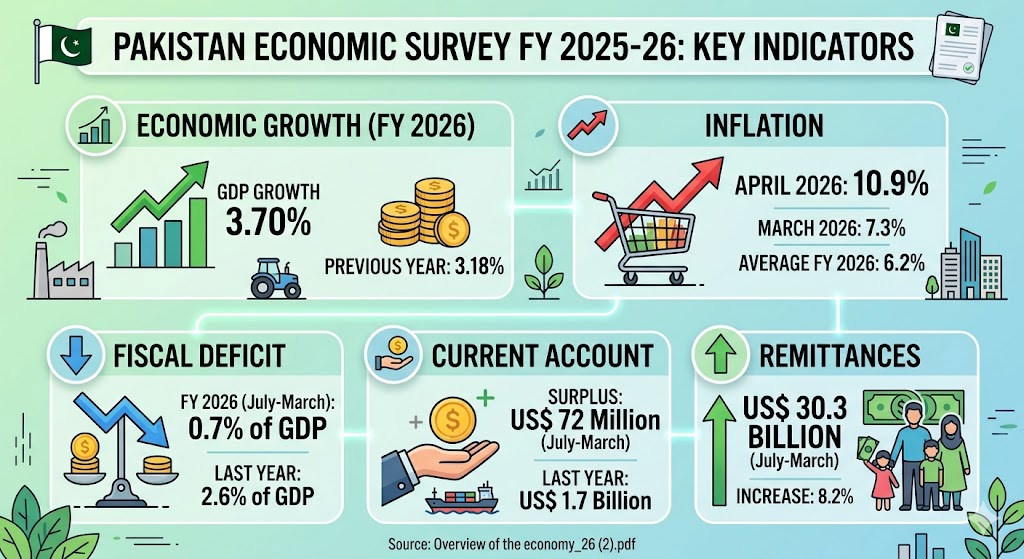
Copyright Mettis Link News
Related News
.png?width=280&height=140&format=Webp)


| Name | Price/Vol | %Chg/NChg |
|---|---|---|
| KSE100 | 167,089.28 109.91M | -0.21% -352.63 |
| ALLSHR | 101,117.40 308.32M | -0.15% -155.10 |
| KSE30 | 49,841.71 50.59M | -0.28% -142.15 |
| KMI30 | 240,372.43 78.75M | -0.02% -45.72 |
| KMIALLSHR | 65,518.16 188.07M | -0.05% -35.70 |
| BKTi | 46,228.77 7.60M | -0.60% -281.04 |
| OGTi | 33,974.66 4.20M | -0.27% -91.31 |
| Symbol | Bid/Ask | High/Low |
|---|
| Name | Last | High/Low | Chg/%Chg |
|---|---|---|---|
| BITCOIN FUTURES | 83,875.00 | 84,320.00 82,645.00 | 1405.00 1.70% |
| BRENT CRUDE | 104.54 | 105.09 102.33 | 0.26 0.25% |
| RICHARDS BAY COAL MONTHLY | 128.50 | 0.00 0.00 | 0.75 0.59% |
| ROTTERDAM COAL MONTHLY | 143.40 | 143.40 143.40 | -1.15 -0.80% |
| USD RBD PALM OLEIN | 1,167.50 | 1,167.50 1,167.50 | 0.00 0.00% |
| CRUDE OIL - WTI | 91.66 | 0.00 0.00 | -0.19 -0.21% |
| SUGAR #11 WORLD | 20.27 | 20.44 20.09 | 0.12 0.60% |
Chart of the Day
Latest News
Top 5 things to watch in this week
 PIB Auction
Pakistan Stock Movers
| Name | Last | Chg/%Chg |
|---|
| Name | Last | Chg/%Chg |
|---|