March 09, 2026 (MLN): Global oil prices surged past
the $110-a-barrel mark after Iran moved to close the strategically
vital Strait of Hormuz, which triggered sharp reactions across energy and
financial markets.
Currently, Brent crude futures went up by $23.91, or 25.8%,
to $116.6 per barrel, according to Mettis Global data.
West Texas Intermediate (WTI) crude futures increased by $24.33,
or 26.77%, to $115.23 per barrel by [9:03 am] PST.
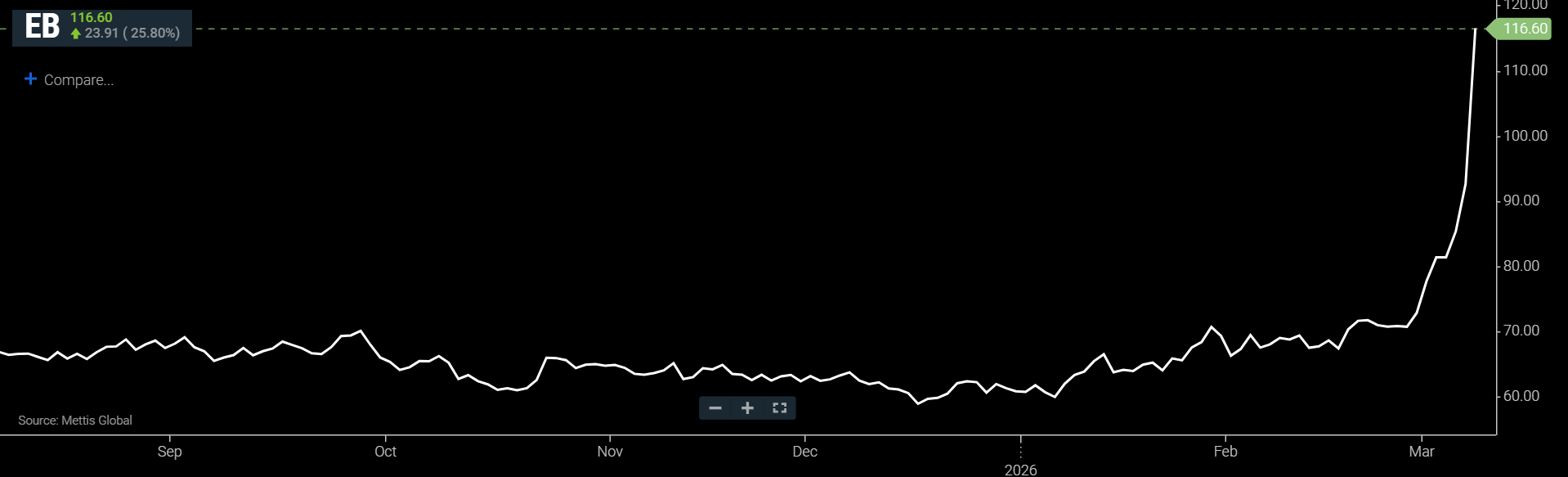
This is the first time oil has exceeded $100 since the early
stages of the Russia-Ukraine war in 2022.
The sudden spike rattled investors worldwide.
The surge comes as major Middle Eastern producers begin cutting output while the Strait of Hormuz a key global oil transit route remains closed due to the Iran conflict.
Kuwait, OPEC’s fifth-largest producer, shared precautionary reductions to crude production and refinery operations, citing Iranian threats to shipping in the Strait.
Oil output in Iraq, OPEC’s second-largest producer, has also been hit hard.
Production from its three main southern oilfields has dropped about 70% to around 1.3 million barrels per day from roughly 4.3 million bpd before the conflict, according to CNBC.
Meanwhile, the United Arab Emirates said it is adjusting offshore production to manage storage constraints. Abu Dhabi National Oil Company (ADNOC) noted that while offshore output is being carefully managed, onshore operations continue as normal.
Despite the market shock, U.S. President Donald Trump
downplayed the price surge, posting on Truth Social that short-term increases
in oil prices are “a very small price to pay”, as the conflict involving Iran
continues without clear signs of de-escalation.
The unfolding crisis is also putting pressure on global
diplomacy. President Trump is expected to meet Chinese President Xi Jinping
from March 31 to April 2, with discussions likely to include the Iran conflict
as well as ongoing trade tensions between the two nations.
Copyright Mettis Link News




_20260421112347985_f8783f.jpeg?width=280&height=140&format=Webp)
 Trade Balance