
Why the US-Iran conflict faces a dangerous stalemate
Hayyan Mansuri | March 27, 2026 at 10:47 AM GMT+05:00

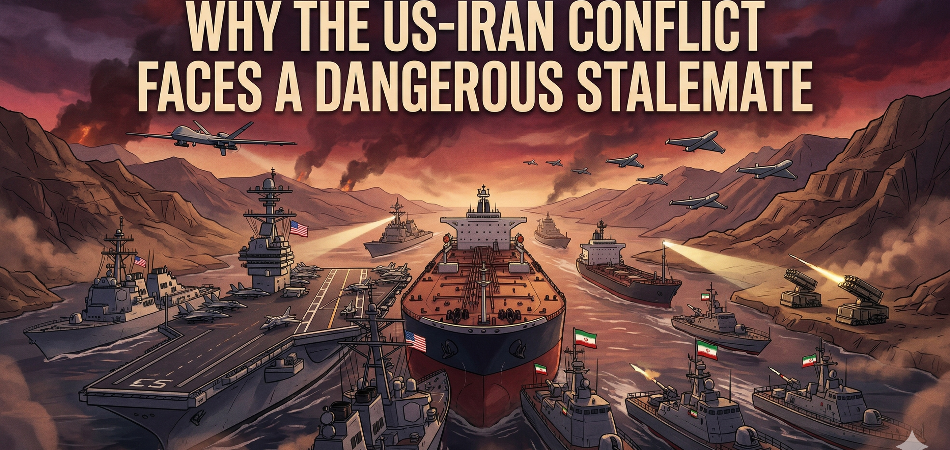
March 27, 2026 (MLN): Sending shockwaves through the
global economy, the United States and Israeli attack on Iran has triggered the
largest energy supply disruption in history.
As the conflict enters its third week, the global economy
faces immense pressure due to a near-total halt of shipping traffic in the
critical Strait of Hormuz, a maritime chokepoint through which 20% of global
oil supplies typically flow.
In a recent report by Goldman Sachs, it is warned that a
quick resolution to the hostilities appears highly unlikely.
According to Sanam Vakil, Director of the Middle East and
North Africa Programme at Chatham House, Tehran views the conflict as an
existential regime-change war and is prepared to utilize its asymmetric drone
capabilities to spread the conflict's costs.
Sanam Vakil notes that Iran has little incentive to end the
war until it can secure guarantees for the Islamic Republic's long-term
survival, which inherently includes sanctions relief.
Former US Middle East advisor Dennis Ross explains that
while President Trump might prefer to declare victory after severely degrading
Iran's nuclear programs and conventional military capabilities, the US cannot
unilaterally walk away as long as Iran maintains control over who can export
oil through the Strait of Hormuz.
To that end, Vice Admiral Kevin Donegan confirms that while US and allied military convoys could ensure safe transit through the Strait, they lack the capacity to restore oil flows to normal levels, potentially recovering only twenty percent of normal capacity.
The scale of the resulting oil shock is monumental.
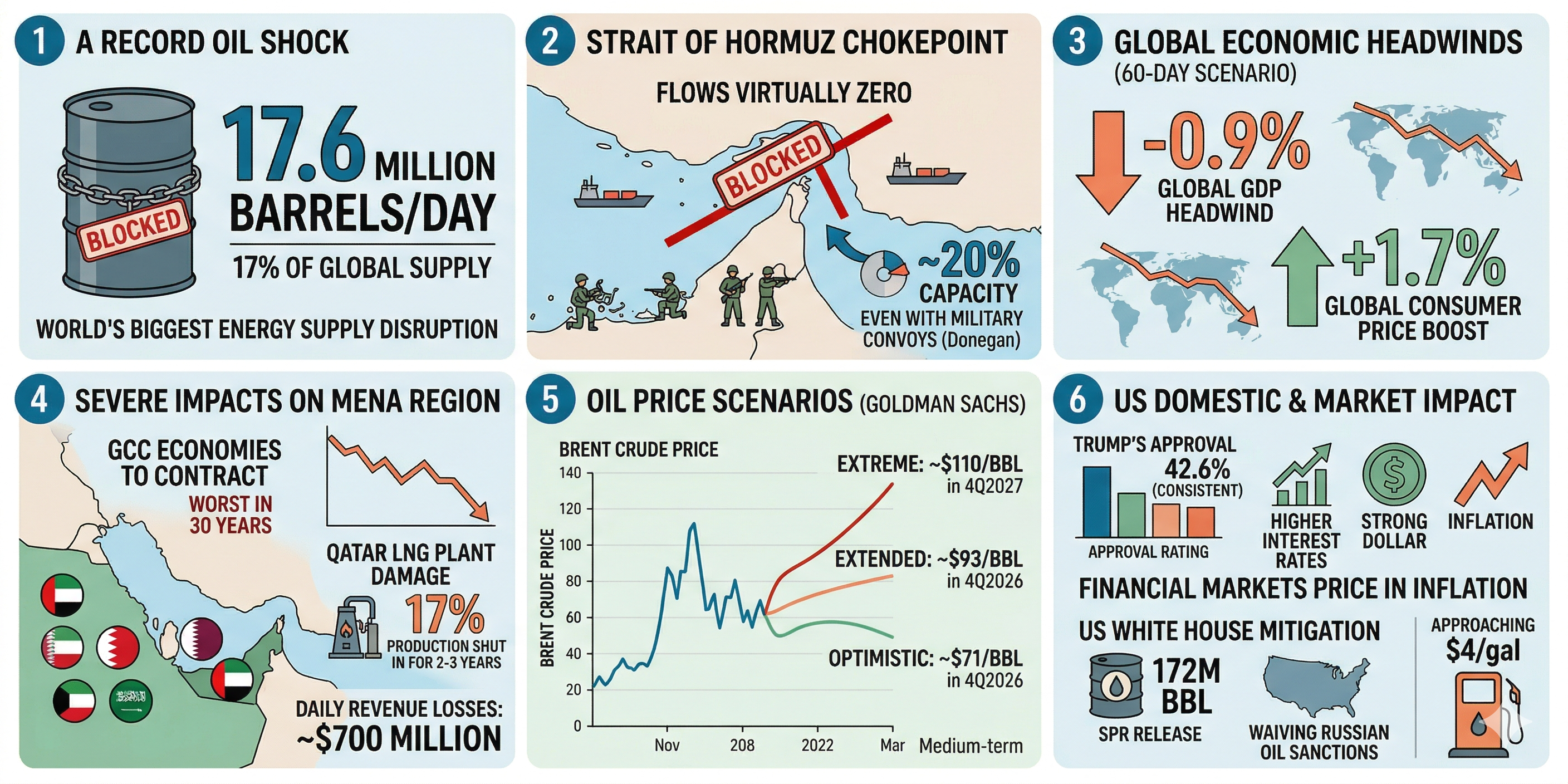
The estimated hit to total oil flows from the Persian Gulf
stands at 17.6 million barrels per day, representing 17% of global supply and
marking the largest supply shock in history.
Flows through the Strait of Hormuz have plummeted 97%from
normal levels.
This disruption has already driven oil prices significantly
higher, with Brent crude exceeding $100 per barrel.
Goldman Sachs Commodities Strategists have outlined multiple
medium-term scenarios regarding the disruption's trajectory and its resulting
impact on energy markets.
|
Scenario |
Description |
Estimated Brent Crude Price |
|
Optimistic |
A 21-day disruption with a full production recovery
returning to pre-war levels within a month. |
$71/bbl in 4Q2026 |
|
Extended |
A 60-day disruption (lasting through late April) followed
by a full production recovery. |
$93/bbl in 4Q2026 |
|
Extreme |
A 60-day disruption resulting in lasting damage, leaving
Middle Eastern production 2 million barrels per day lower. |
$110/bbl in 4Q2027 |
The broader economic fallout from these elevated energy
prices threatens to slow global growth while significantly boosting inflation.
Senior Global Economist Joseph Briggs estimates that a
sixty-day disruption scenario would result in a 0.9% headwind to global GDP and
a 1.7% boost to global consumer prices.
The Middle East and North Africa (MENA) region will bear the
heaviest economic burden.
GCC economies could face their largest economic contraction
in thirty years, with Kuwait and Bahrain potentially losing over a fifth of
their oil production this year.
Qatar is also facing severe impacts, with missile damage to
its Ras Laffan LNG plant expected to shut in seventeen percent of its LNG
production for the next two to three years, potentially driving its total
production down by up to one-third this year.
Furthermore, the GCC collectively is losing roughly $700
million in daily oil revenues, with total losses expected to approach $80
billion if the disruption lasts two months.
Financial markets have primarily priced this as an
inflationary shock, leading to higher interest rates and broad appreciation of
the US Dollar, but it is warned that a significant hit to global growth and
earnings could be the next shoe to drop.
Domestically, US political pressures currently pose a
limited constraint on the war's duration.
President Trump's approval rating has held steady at 42.6%,
bolstered by strong support from his MAGA base.
However, rising retail gasoline prices, which are nearing $4
per gallon, could shift public opinion and create political friction.
In an effort to mitigate the price shock, the White House
has declared a drawdown from the Strategic Petroleum Reserve of 172 million
barrels over 120 days and waived sanctions on purchases of Russian oil
currently on the water.
Ultimately, the path to a resolution remains remarkably
murky. Ambassador Dennis Ross suggests that unless the US can decisively wrest
control of the Strait of Hormuz, mediation potentially facilitated by Russia
and spurred by Chinese pressure on Tehran may be the only viable off-ramp.
As the conflict extends without a clear end in sight, financial markets that have so far absorbed the crisis primarily as an inflationary shock may soon be forced to price in a severe contraction in global growth and corporate earnings.
Copyright Mettis Link News
Related News
_20260421112347985_f8783f.jpeg?width=280&height=140&format=Webp)

| Name | Price/Vol | %Chg/NChg |
|---|---|---|
| KSE100 | 162,589.30 39.75M | -0.81% -1335.01 |
| ALLSHR | 98,871.77 147.97M | -0.66% -655.11 |
| KSE30 | 47,886.40 18.59M | -0.88% -427.40 |
| KMI30 | 233,598.53 23.35M | -0.87% -2038.65 |
| KMIALLSHR | 64,181.50 88.83M | -0.78% -501.58 |
| BKTi | 44,666.06 6.30M | -1.14% -515.15 |
| OGTi | 33,085.83 1.69M | -0.93% -309.78 |
| Symbol | Bid/Ask | High/Low |
|---|
| Name | Last | High/Low | Chg/%Chg |
|---|---|---|---|
| BITCOIN FUTURES | 81,710.00 | 81,920.00 81,055.00 | 255.00 0.31% |
| BRENT CRUDE | 114.27 | 114.72 112.74 | 1.10 0.97% |
| RICHARDS BAY COAL MONTHLY | 128.50 | 0.00 0.00 | -1.55 -1.19% |
| ROTTERDAM COAL MONTHLY | 147.10 | 0.00 0.00 | 1.80 1.24% |
| USD RBD PALM OLEIN | 1,167.50 | 1,167.50 1,167.50 | 0.00 0.00% |
| CRUDE OIL - WTI | 100.75 | 100.98 98.84 | 1.28 1.29% |
| SUGAR #11 WORLD | 20.13 | 20.64 20.10 | -0.32 -1.56% |
Chart of the Day
Latest News
Top 5 things to watch in this week
 Repatriation of Profit and Dividend
Pakistan Stock Movers
| Name | Last | Chg/%Chg |
|---|
| Name | Last | Chg/%Chg |
|---|