
The Quiet Flip: World Just Chose Gold Over US Treasuries
Nilam Bano | August 19, 2026 at 02:55 PM GMT+05:00

August 19, 2026 (MLN): In June 2026, the European Central Bank published its annual review of the international role of the euro.
Buried inside it was a single data line that quietly rewrites the modern monetary order: by the end of 2025, gold had overtaken US Treasury bonds as the world's single largest reserve asset.
A handful of financial trade outlets covered it for a few days- Mining.com, Yahoo Finance, Private Banker International, and then it dropped out of the conversation entirely, crowded out by tariff headlines and rate-decision noise.
Central banks now trust a metal that pays no interest, generates no yield and sits inertly in a vault more than they trust the debt of the United States government.
That has not happened since 1996, three full decades ago, before the euro even existed as a currency.
Gold now makes up 27% of official global reserves. US
Treasuries: 22%. This is the first time gold has outranked Treasuries since
1996, and unlike 1996, nobody is forecasting a quick reversal this time.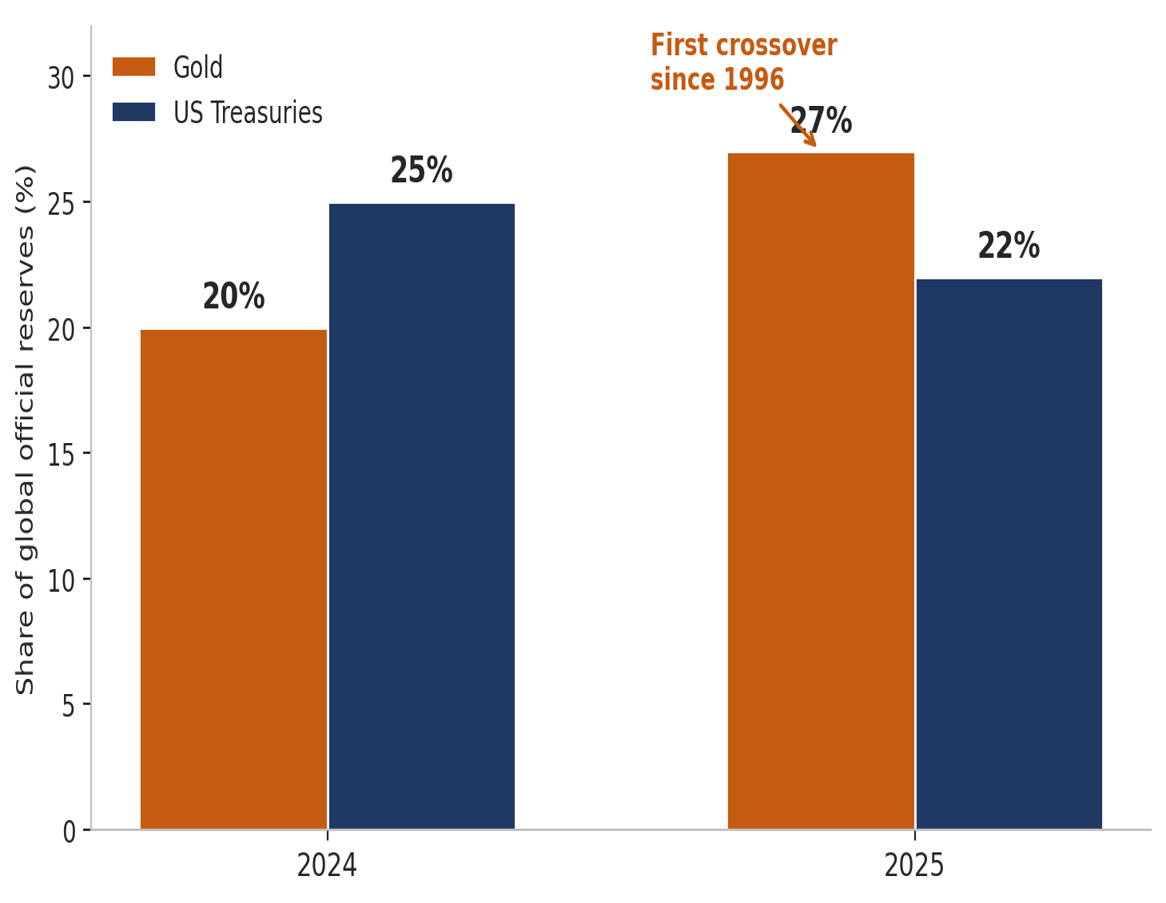 Source: European Central Bank, "The International Role
of the Euro," June 2026.
Source: European Central Bank, "The International Role
of the Euro," June 2026.
Every headline about gold this year has fixated on where the price is going next, $5,000, $6,000, or the more sensational $8,000 figures now circulating on social media.
That misses the real story. Price is an output. What actually changed is the plumbing underneath the entire global financial system: for the first time in a generation, the asset that the world's central banks trust most to hold their national wealth is not a paper claim on the US government.
It's a bar sitting in a vault that no foreign government can freeze, sanction, or devalue by printing more of it.
That is a statement about trust in the dollar-based financial order itself, made not by commentators or traders, but by the reserve managers who actually decide where to park trillions of dollars in national savings.
In the World Gold Council's 2026 Central Bank Gold Reserves Survey, 89% of central bankers said they expect global gold reserves to keep rising over the next 12 months, and 74% said they expect the US dollar's share of reserves to shrink over the next five years.
The Day the World's Central Banks Got Spooked
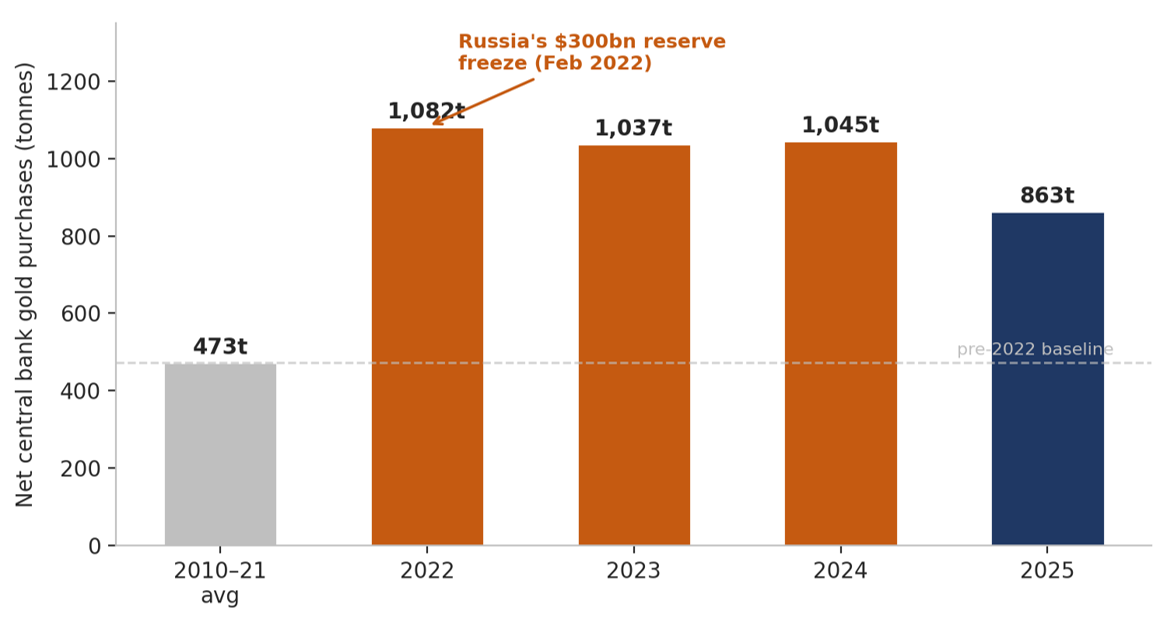
Rewind to February 2022. When the United States and European Union froze roughly $300 billion of Russia's central bank reserves in response to the invasion of Ukraine, it was intended as a targeted sanction.
Instead, it became a lesson broadcast to every finance ministry on earth: dollar and euro reserves are not truly yours until the country holding them decides they are.
China, India, Saudi Arabia, Turkey and dozens of smaller economies drew the same conclusion at roughly the same time, and started buying gold at a pace the market had never seen.
 Source: World Gold Council, Gold Demand Trends (annual
reports, 2022–2025).
Source: World Gold Council, Gold Demand Trends (annual
reports, 2022–2025).
Central banks had bought an average of 473 tonnes of gold a year for the entire decade before 2022. In the three years after, that more than doubled, 1,082 tonnes in 2022 alone, the highest since 1950, followed by 1,037 tonnes in 2023 and 1,045 tonnes in 2024.
Buying eased somewhat in 2025,
to 863 tonnes, as record prices made even committed buyers more price-sensitive, but that is still nearly double the pre-2022 norm.
The Buyer Nobody Expected
The list of the biggest gold accumulators since 2022 reads roughly as you would expect: China, Poland, India, Turkey, sovereign nations rebuilding their reserve buffers. Then the ECB's report drops one line that changes the tone of the entire story: in 2025, the single largest buyer of physical gold in the world was not a country at all.
It was Tether, the company behind the world's largest US-dollar stablecoin, which purchased more than 100 tonnes of gold over the year, over a tenth of everything every central bank on earth bought, combined.
A private company issuing digital dollars bought more
gold last year than most nations that issue their own currency.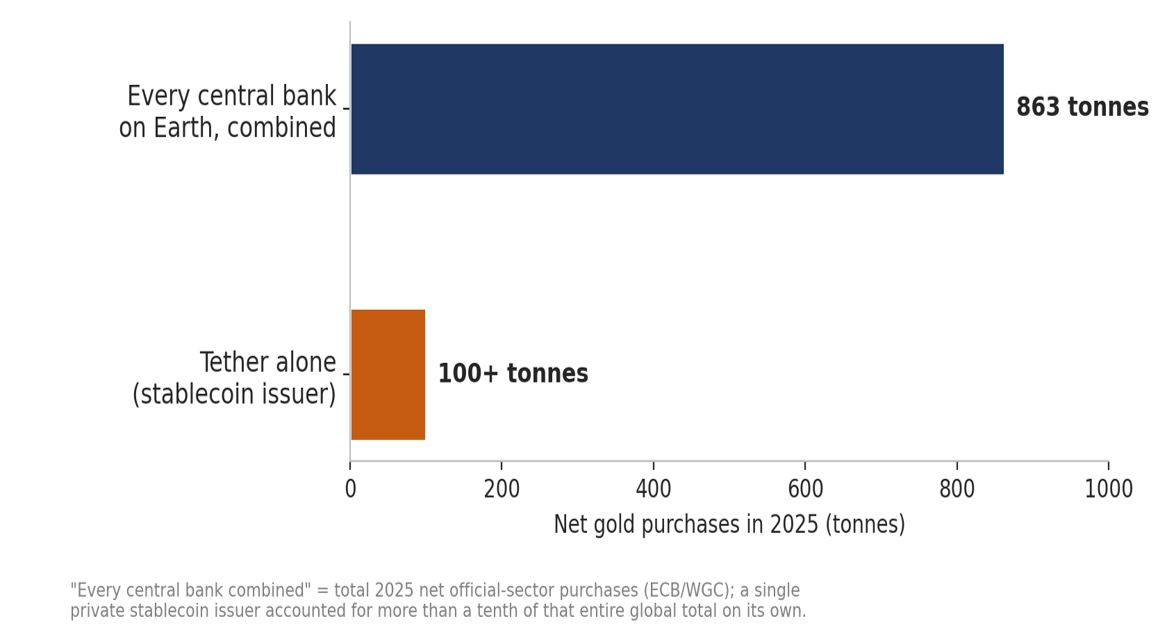 Source: European Central Bank, "International Role of
the Euro," June 2026 report.
Source: European Central Bank, "International Role of
the Euro," June 2026 report.
Thirty Years, Two Flips
The last time gold outranked Treasuries in global reserves was 1996, and the story of how that lead was lost is almost the mirror image of today's.
Through the late 1990s, European central banks were unloading gold ahead of the euro's 1999 launch, and Britain sold down its own reserves in the widely-criticised "Brown's Bottom" episode, helping push gold to a generational low near $255 an ounce by 1999.
Treasuries, by contrast, were the undisputed safe asset of the unipolar, post-Cold War dollar order.
Three decades, and two wars, a financial crisis, a pandemic, and a reserve freeze, later, the pendulum has swung all the way back, and gold has had a genuinely wild year in the process: an all-time high of $5,595 an ounce on January 28, 2026, followed by a sharp 27% correction to around $4,060 by mid-year, before settling into the $4,300–4,400 range it's held through most of August, trading at roughly $4,345 an ounce as of today.
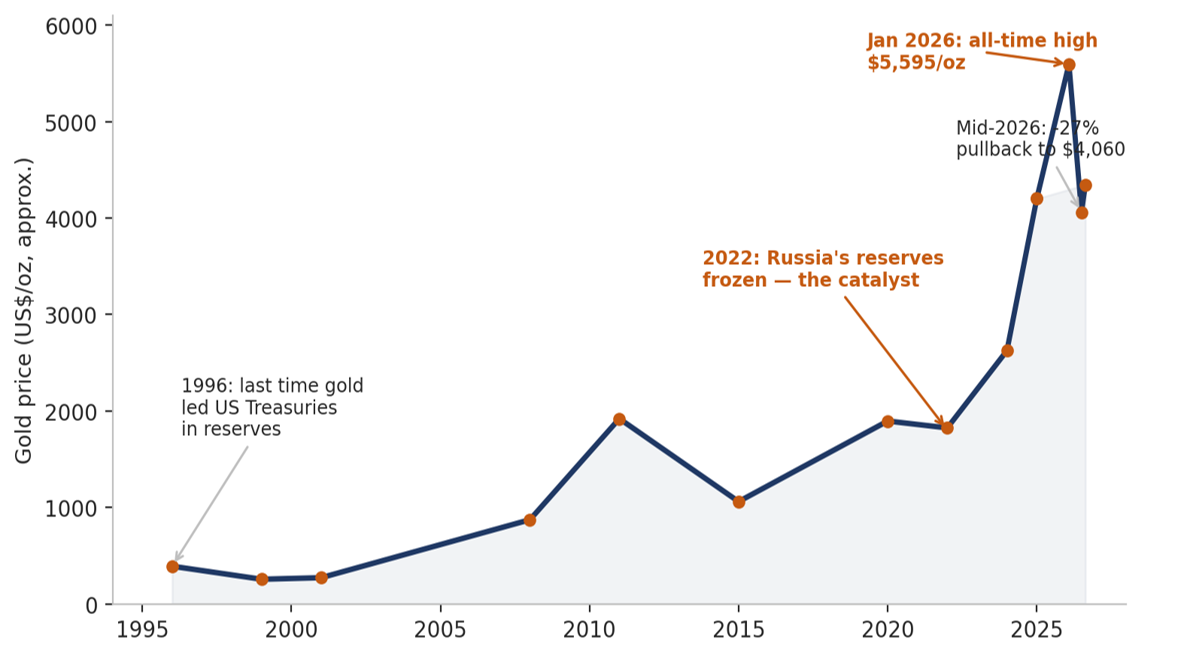
Illustrative annual gold price, US$/oz, with 2026 shown at
key points through the year. Source: LBMA/WGC historical price series.
What Wall Street Now Has to Reckon With
A structural reserve shift of this size doesn't reverse on a single Fed meeting, but 2026 has been a genuine stress test for anyone forecasting gold.
Between June and July alone, four major banks revised their
published targets, in one case by $1,500 an ounce between two notes. Treat any
single number below as a dated snapshot, not a certainty; the Reuters poll of
31 analysts is the closest thing to a consensus.
|
Institution |
Target |
Dated
to |
≈
PKR/tola at Rs277.57/$ |
|
Reuters
poll median (31 analysts) |
$4,916/oz |
End-2026 |
Rs 5.12
lakh |
|
Morgan Stanley |
$4,800/oz |
End-2026 |
Rs 5 lakh |
|
Goldman
Sachs |
$4,900/oz |
End-2026
(cut from $5,400, Jun 20) |
Rs 5.1
lakh |
|
J.P. Morgan |
~$5,000/oz |
Q4 2026 (cut from $6,300) |
Rs 5.2 lakh |
|
UBS |
$5,200–5,500/oz |
End-2026
/ mid-2027 |
Rs 5.41
lakh – Rs 5.72 lakh |
|
Yardeni Research |
$10,000/oz |
End of decade (2029/2030) |
Rs 10.41 lakh |
|
Bank of
America (bull case) |
$8,000/oz |
2027,
extreme-demand scenario only |
Rs 8.33
lakh |
PKR conversion illustrative only, using spot USD/PKR of Rs
277.57 (Aug 19, 2026) and 1 tola = 0.375 troy oz. A weaker rupee would push
these figures higher independently of the dollar price.
What It Means If You're Holding Rupees, Not Reserves
This is not just a story about central bank balance sheets in Frankfurt or Beijing. It helps explain why gold in Pakistan has moved the way it has this year: 24-karat gold hit Rs 461,936 per tola in Karachi's sarafa market today, August 19, up from Rs 453,700 just two trading sessions ago, even as the international price has spent the summer well below its January peak.
When the institutions that anchor the entire global financial system are simultaneously rotating out of government debt and into gold, that demand doesn't stay confined to central bank vaults; it feeds through to the price every ordinary saver in Karachi or Lahore pays for a tola, and it compounds with the rupee's own depreciation against the dollar.
A Pakistani saver holding gold today is, in effect, riding a smaller-scale version of the same structural trade that sovereign reserve managers are, just paying local making charges the central banks don't.
If the asset the world's most sophisticated financial institutions trust most has quietly become gold instead of US government debt, the interesting question is no longer whether the price of gold goes up or down 10% this quarter.
It is what a reserve system built for eighty years around the assumption that Treasuries were the world's risk-free asset looks like once that assumption has been contradicted by the very institutions that built it.
Nobody rang a bell when it happened. The ECB's own report is public record, dated and citable; it simply never became the headline the underlying fact deserved.
Every subsequent price move in gold, in Pakistan and everywhere
else, is downstream of that one line.
Copyright Mettis Link News
Related News

_20260421112347985_f8783f.jpeg?width=280&height=140&format=Webp)

| Name | Price/Vol | %Chg/NChg |
|---|---|---|
| KSE100 | 166,419.72 133.15M | 0.14% 233.55 |
| ALLSHR | 100,871.92 395.66M | 0.05% 48.64 |
| KSE30 | 49,316.65 59.50M | 0.05% 23.11 |
| KMI30 | 239,907.60 63.28M | -0.05% -114.34 |
| KMIALLSHR | 65,473.69 245.25M | -0.00% -2.07 |
| BKTi | 45,849.28 9.86M | 0.23% 104.46 |
| OGTi | 33,523.02 3.37M | -0.51% -171.71 |
| Symbol | Bid/Ask | High/Low |
|---|
| Name | Last | High/Low | Chg/%Chg |
|---|---|---|---|
| BITCOIN FUTURES | 81,330.00 | 82,995.00 80,805.00 | -1100.00 -1.33% |
| BRENT CRUDE | 109.21 | 109.72 104.91 | 3.29 3.11% |
| RICHARDS BAY COAL MONTHLY | 128.50 | 0.00 0.00 | 0.05 0.04% |
| ROTTERDAM COAL MONTHLY | 145.10 | 0.00 0.00 | 0.15 0.10% |
| USD RBD PALM OLEIN | 1,167.50 | 1,167.50 1,167.50 | 0.00 0.00% |
| CRUDE OIL - WTI | 98.68 | 99.00 95.29 | 2.18 2.26% |
| SUGAR #11 WORLD | 20.85 | 21.01 20.47 | -0.28 -1.33% |
Chart of the Day
Latest News
Top 5 things to watch in this week
 Current Account Balance
Pakistan Stock Movers
| Name | Last | Chg/%Chg |
|---|
| Name | Last | Chg/%Chg |
|---|