
Radical reforms anchor Pakistan’s climate survival plan

MG News | June 11, 2026 at 05:15 PM GMT+05:00

June 11, 2026
(MLN): Pakistan is on the
frontlines of a rapidly escalating global climate crisis.
The year 2025 served as a stark
reminder of this reality, ranking as the second warmest year in the past 65
years with a national average temperature of 23.9°C.
As extreme weather events transform
from rare anomalies into a persistent new normal, the country faced
catastrophic monsoon floods that inflicted Rs 822 billion in economic damages.
However, the nation is aggressively
fighting back through sweeping policy reforms, including the launch of the
monumental Pakistan Climate Prosperity Plan and securing massive international
climate finance to build a resilient, low-carbon future.
This deep dive is sourced directly
from Chapter 17 (Climate Change) of the newly released Pakistan Economic Survey
FY26.
Temperature Dynamics: A Year of
Relentless Heat
The year 2025 was marked by intense
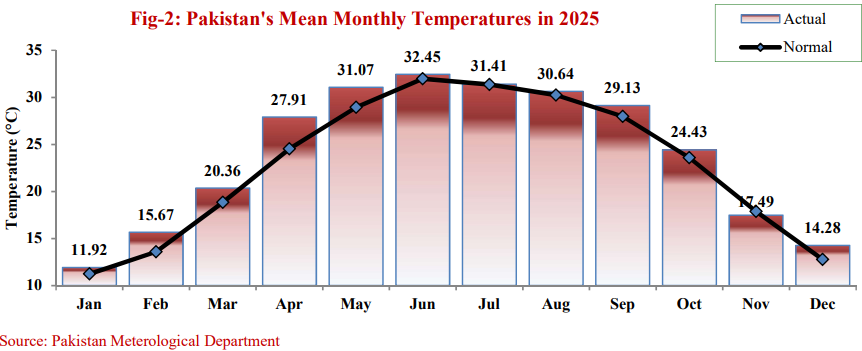
and relentless heat, with the national annual mean temperature reaching 23.9°C,
which is 1.09°C higher than the long-term historical baseline.
A closer look at the monthly
temperature dynamics reveals highly anomalous warming across the board. January
started the year 0.69°C warmer than average, but the heat surged dramatically
in February, recording an alarming 2.07°C above normal.
The pre-monsoon quarter of April to
June continued to scorch the nation, sitting 1.94°C above the country average.
Even the summer monsoon and
post-monsoon periods offered little relief, registering positive anomalies of
0.5°C and 0.64°C respectively.
This relentless warming has directly accelerated glacial melt in the northern regions and intensified atmospheric moisture, setting the stage for highly volatile and destructive weather patterns.
Rainfall Patterns: From Severe Drought
to Catastrophic Deluge
While the overall annual rainfall of
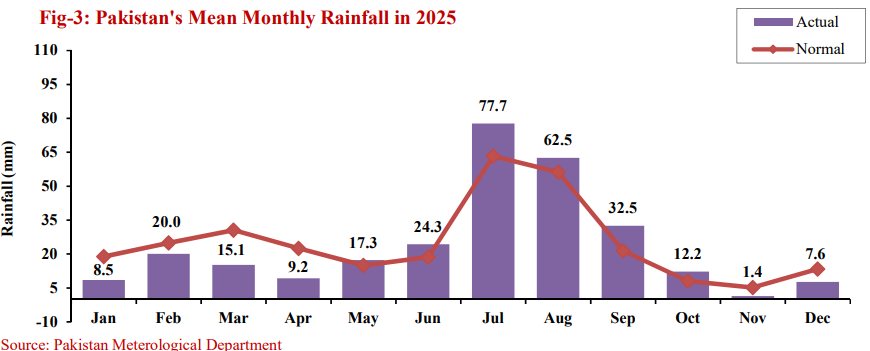
288.5 mm was just 3% below the national average, the temporal distribution
throughout the year was highly erratic and destructive.
The year commenced with severe dry
spells; the January to March period was the ninth driest on record,
experiencing a massive 41.2% deficit in precipitation.
The pre-monsoon season remained
heavily suppressed with a 9% shortfall.
However, this prolonged dry period was
violently interrupted by the monsoon season spanning July to September, which
unleashed a deluge of 172.8 mm of rain 23% above the historical average.
This sudden and concentrated burst of intense precipitation completely overwhelmed major river systems including the Sutlej, Ravi, and Chenab, resulting in catastrophic compound flooding before the post-monsoon season eventually reverted to a 19% rainfall deficit.
The Economic and Environmental Toll
The torrential monsoon rains of 2025
culminated in a multi-hazard disaster that displaced over 4 million people and
resulted in 1,039 tragic fatalities.
The economic devastation was
staggering, heavily impacting the nation's core productive sectors.
Compounding the climate crisis,
Pakistan also grappled with severe environmental degradation, ranking as the
most polluted country globally in 2025 with PM2.5 concentrations reaching 67.3
µg/m³, which is thirteen times higher than World Health Organization
guidelines.
|
Sectoral Impact / Crisis |
Estimated Damages & Human Toll |
|
Total Economic Damages |
Rs 822 billion (US$ 2.9 billion) |
|
Agricultural Losses |
Rs 430 billion (affecting vital
crops like cotton and rice) |
|
Infrastructure Destruction |
Rs 307 billion (primarily road
networks) |
|
Population Affected |
6.5 million people (with over 4
million displaced) |
|
Air Quality Crisis |
Ranked most polluted country
globally (Faisalabad hit 98.8 µg/m³) |
Strategic Policy and Climate Finance
In response to these existential
threats, the government aggressively mobilized institutional and financial
frameworks to safeguard the economy and its vulnerable populations.
The newly launched Pakistan Climate
Prosperity Plan serves as the ultimate blueprint, outlining a massive US$ 1.6
trillion investment requirement by 2050 to transition toward a low-carbon,
climate-resilient economy.
To immediately bolster disaster
preparedness and institutional capacity, the government secured US$ 500 million
through the Asian Development Bank's Climate and Disaster Resilience
Enhancement Programme (Subprogram-II).
Furthermore, strict environmental
governance is currently being enforced through the implementation of the
Pakistan Green Taxonomy and the fulfillment of crucial IMF Resilience and
Sustainability Facility reforms, which include energy subsidy adjustments and
the promotion of electric vehicles.
Copyright Mettis Link News
Related News
.png?width=280&height=140&format=Webp)


| Name | Price/Vol | %Chg/NChg |
|---|---|---|
| KSE100 | 167,089.28 109.91M | -0.21% -352.63 |
| ALLSHR | 101,117.40 308.32M | -0.15% -155.10 |
| KSE30 | 49,841.71 50.59M | -0.28% -142.15 |
| KMI30 | 240,372.43 78.75M | -0.02% -45.72 |
| KMIALLSHR | 65,518.16 188.07M | -0.05% -35.70 |
| BKTi | 46,228.77 7.60M | -0.60% -281.04 |
| OGTi | 33,974.66 4.20M | -0.27% -91.31 |
| Symbol | Bid/Ask | High/Low |
|---|
| Name | Last | High/Low | Chg/%Chg |
|---|---|---|---|
| BITCOIN FUTURES | 83,505.00 | 84,320.00 82,645.00 | 1035.00 1.26% |
| BRENT CRUDE | 104.54 | 0.00 0.00 | -0.18 -0.17% |
| RICHARDS BAY COAL MONTHLY | 128.50 | 0.00 0.00 | 0.75 0.59% |
| ROTTERDAM COAL MONTHLY | 143.40 | 143.40 143.40 | -1.15 -0.80% |
| USD RBD PALM OLEIN | 1,167.50 | 1,167.50 1,167.50 | 0.00 0.00% |
| CRUDE OIL - WTI | 91.66 | 0.00 0.00 | -0.19 -0.21% |
| SUGAR #11 WORLD | 20.27 | 20.44 20.09 | 0.12 0.60% |
Chart of the Day
Latest News
Top 5 things to watch in this week
 PIB Auction
Pakistan Stock Movers
| Name | Last | Chg/%Chg |
|---|
| Name | Last | Chg/%Chg |
|---|