
Pakistan upgraded to B3 from Caa1 by Moody’s
MG News | August 24, 2026 at 03:51 PM GMT+05:00

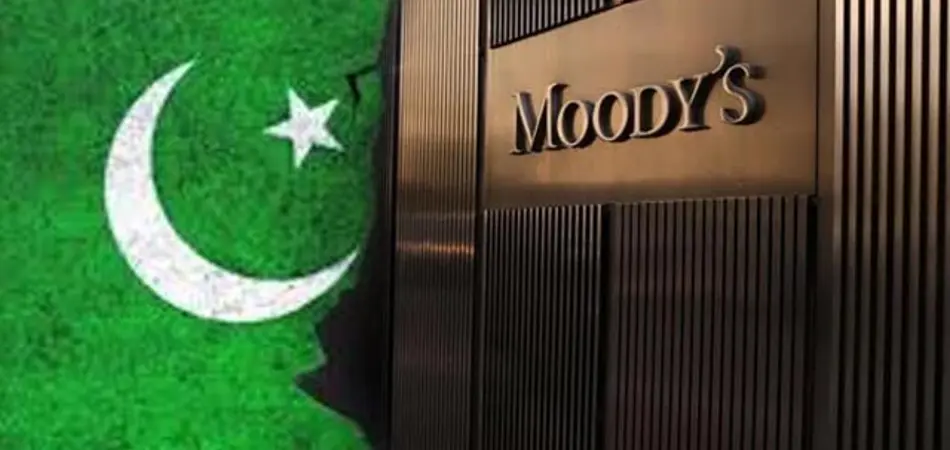
August 24, 2026 (MLN): Moody's Ratings has upgraded the Government of Pakistan's local and foreign currency issuer and senior unsecured debt ratings to B3 from Caa1, citing sustained improvements in the country's external position and strengthening fiscal metrics.
The rating agency has kept the outlook stable and also
raised the senior unsecured MTN programme rating to (P)B3 from (P)Caa1.
Moody's said the upgrade reflects its expectation that
improvements in governance will allow the government to sustain recent gains in
the external account while continuing to strengthen fiscal indicators.
Pakistan's external vulnerability risks have eased further
since the agency's last rating action in August 2025, with foreign exchange
reserves building steadily on the back of sustained macroeconomic
stabilization.
Lower domestic financing costs amid monetary easing,
alongside an improved fiscal position, have driven a material improvement in
Pakistan's debt affordability, the agency noted.
It added that Pakistan's strengthening credit profile is
showing greater resilience to external shocks compared to previous cycles,
including the ongoing conflict in the Middle East.
Despite these gains, Moody's flagged that Pakistan's credit
profile remains vulnerable, pointing to a structurally fragile external
position, weak debt affordability, a still-narrow revenue base, and constraints
on attracting investment and driving high-productivity growth.
These constraints remain embedded in the B3 rating, the
agency said.
The stable outlook, according to Moody's, balances the
possibility of faster improvement in Pakistan's credit fundamentals against
risks tied to the vulnerabilities above risks that, if realised, could weaken access
to foreign-currency financing and further reduce fiscal flexibility.
The upgrade to B3 from Caa1 also extends to the backed
foreign currency senior unsecured ratings for The Pakistan Global Sukuk
Programme Co Ltd, with Moody's viewing the associated payment obligations as
direct obligations of the Government of Pakistan.
The outlook for the Sukuk Programme Co Ltd also remains
stable.
Alongside the rating action, Moody's raised Pakistan's local
and foreign currency country ceilings to B1 and B3, from B2 and Caa1
respectively.
The agency said the two-notch gap between the local currency
ceiling and the sovereign rating stems from the government's relatively large
footprint in the economy, weak institutions, and high political and external
vulnerability risk, while the gap between the foreign and local currency
ceilings reflects incomplete capital account convertibility, relatively weak
policy effectiveness, and risks of transfer and convertibility restrictions
being imposed.
Pakistan's standing across the three major rating agencies now places Fitch's long-term foreign currency debt rating at B-, with a stable outlook, while S&P holds the country at B, also with a stable outlook.
Pakistan's foreign exchange reserves rose to about $17bn at end-July 2026, up from $14bn a year earlier, covering nearly three months of imports.
The report's estimate of Pakistan's External Vulnerability
Indicator the ratio of short- and
long-term maturing debt to foreign exchange reserves has improved to about 145% in 2026, compared
to 230% in 2025.
Continued implementation of the IMF-backed reform programme
has strengthened policy credibility and underpinned financing from official
creditors, the report said, while Pakistan has also regained gradual access to
market financing, including a three-year, $750mn Eurobond issued in April 2026
and a CNY 1.75bn (about $250mn) debut Panda bond in May 2026.
Reserves are projected to rise to about $19–20bn by the end of fiscal 2027 and $20–21bn in fiscal 2028, assuming continued progress on the IMF programme.
External financing needs are estimated at around $21bn in fiscal 2027 and about $30bn in fiscal 2028, of which $7bn and $12bn respectively comprise existing bilateral deposits expected to be rolled over.
Interest payments absorbed about 35% of government revenue in fiscal 2026, down sharply from 49% in fiscal 2025, largely on the back of lower domestic interest rates following a sharp decline in inflation.
The
policy rate stood at 11.5% in July 2026, down from a peak of 22% between June
2023 and May 2024, even after modest hikes as inflation rebounded.
Copyright Mettis Link News
Related News



| Name | Price/Vol | %Chg/NChg |
|---|---|---|
| KSE100 | 177,382.57 129.46M | 0.35% 610.38 |
| ALLSHR | 106,289.83 618.70M | 0.13% 141.72 |
| KSE30 | 51,822.39 81.72M | 0.48% 245.89 |
| KMI30 | 255,823.27 110.29M | 0.65% 1649.18 |
| KMIALLSHR | 68,759.73 247.31M | 0.07% 47.95 |
| BKTi | 48,432.52 12.51M | 0.23% 109.40 |
| OGTi | 35,759.50 5.47M | -0.13% -46.88 |
| Symbol | Bid/Ask | High/Low |
|---|
| Name | Last | High/Low | Chg/%Chg |
|---|---|---|---|
| BITCOIN FUTURES | 58,415.00 | 62,530.00 57,990.00 | -3625.00 -5.84% |
| BRENT CRUDE | 92.19 | 92.89 90.06 | 0.21 0.23% |
| RICHARDS BAY COAL MONTHLY | 127.15 | 0.00 0.00 | 3.60 2.91% |
| ROTTERDAM COAL MONTHLY | 131.75 | 0.00 0.00 | -0.50 -0.38% |
| USD RBD PALM OLEIN | 1,182.50 | 1,182.50 1,182.50 | 0.00 0.00% |
| CRUDE OIL - WTI | 83.17 | 83.25 80.78 | 0.73 0.89% |
| SUGAR #11 WORLD | 17.07 | 17.31 16.82 | -0.09 -0.52% |
Chart of the Day
Latest News
Top 5 things to watch in this week
 Large Scale Manufacturing (LSMI)
Pakistan Stock Movers
| Name | Last | Chg/%Chg |
|---|
| Name | Last | Chg/%Chg |
|---|