
Global cotton prices set to stay firm through H2 2026

MG News | July 20, 2026 at 11:09 AM GMT+05:00

July 20, 2026 (MLN): Cotton prices are expected to remain firm through the second half of 2026, driven by a tightening global supply outlook, with the market's focus increasingly shifting toward the Southern Hemisphere crop cycle where weather risks are building, particularly in Australia, according to a report by BMI, a Fitch Solutions company.
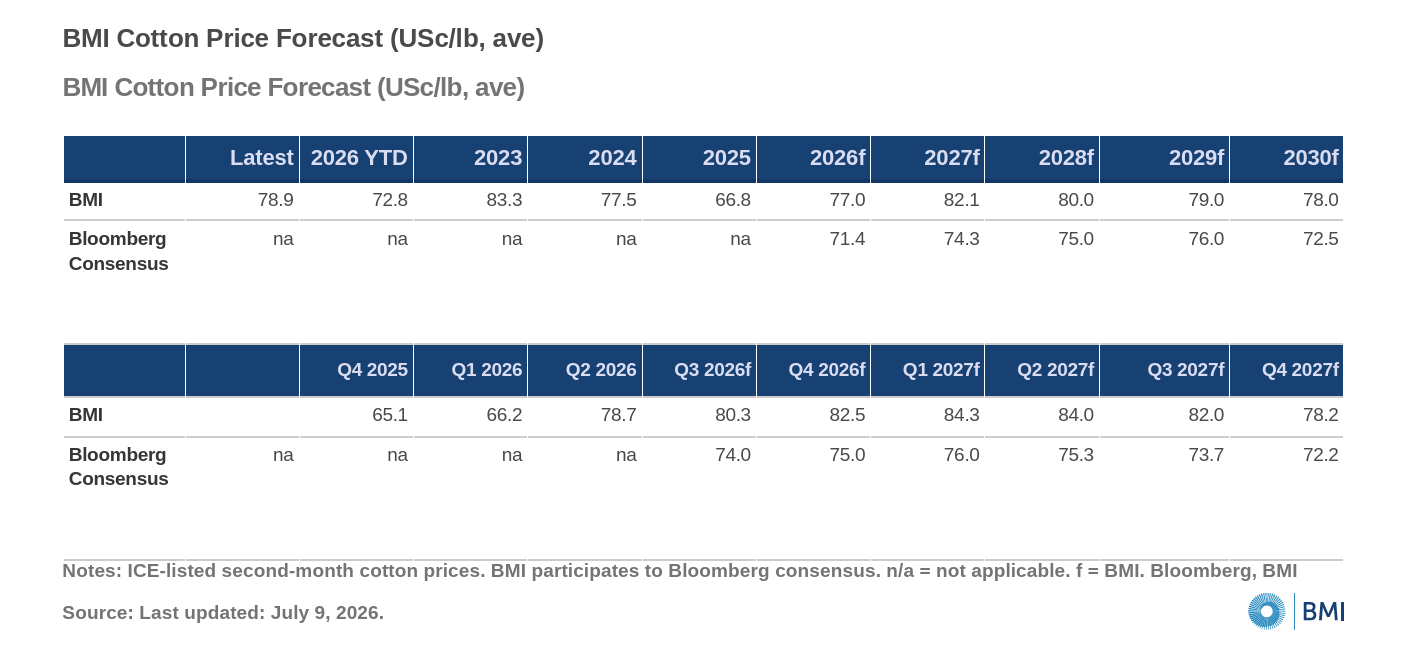
The 2026 annual average forecast for ICE-listed second-month
cotton futures has been revised upward from USc71.4/lb to USc77.0/lb,
representing a 15.3% increase compared to the 2025 annual average of
USc66.8/lb.
Prices are projected to reach USc80.3/lb in Q3 2026 and
USc82.5/lb in Q4 2026.
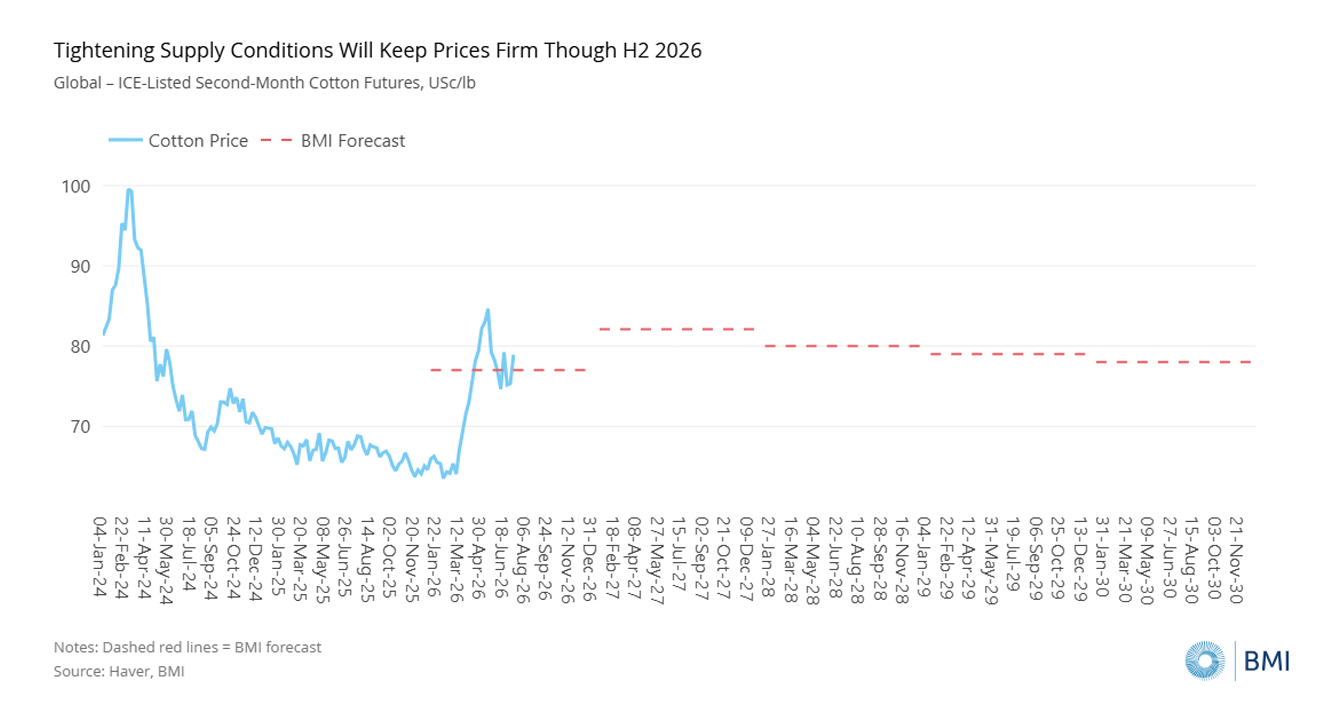
Since mid-May, cotton prices have lost some support from the
energy market, tracking the broader decline in oil prices.
However, the relatively limited pull-back in cotton prices,
down 10.1% between May 11 and July 9, compared with a 26.8% decline in crude
oil prices, suggests supply-side concerns are becoming an increasingly
important driver of market sentiment.
Prices have averaged USc72.8/lb year-to-date, up 8.9% from
the 2025 annual average.
With much of the 2026/27 crop already well advanced across
key Northern Hemisphere producers, including the US, Mainland China and India,
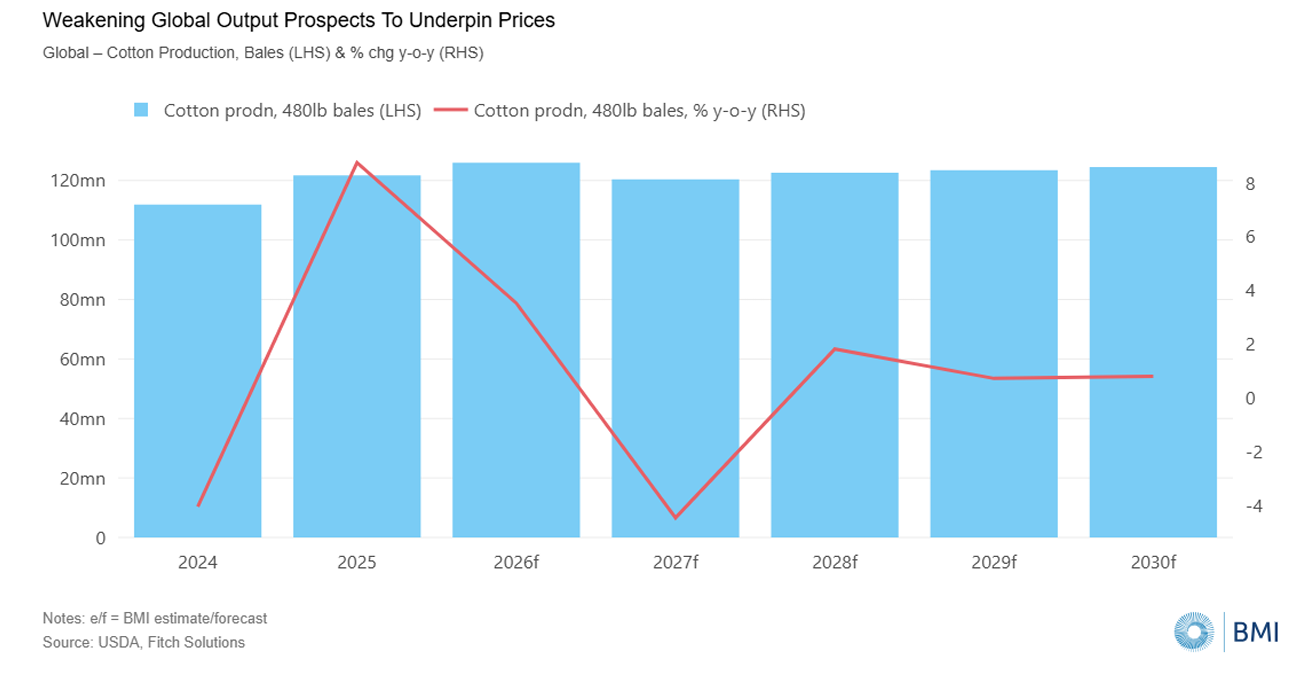
production prospects point to softer output.
Global cotton output is forecast to decline by 4.4% y-o-y to
120.4mn bales in 2026/27, as lower production in Mainland China and the US more
than offsets modest gains in India.
Mainland China's output is projected to fall 6.4% y-o-y to
33.5mn bales, reflecting lower acreage as policy support for grain production
weighs on cotton area expansion.
US output is expected to contract 4.3% y-o-y to 13.3mn bales
amid a continued shift toward more profitable crops, including soybeans.
India's output, by contrast, is forecast to rise 1.0% y-o-y
on modest acreage expansion and improving demand.
Market sentiment remains bullish, with net long positions at
31,985 contracts as of June 30, though positioning has eased from the 2026 peak
of 62,045 contracts recorded on May 19.
Weather-related risks are becoming a key market focus. The
US National Oceanic and Atmospheric Administration's Climate Prediction Center
declared El Niño conditions present in June 2026 and forecasts further
strengthening through H2 2026, assigning a 73% probability of at least a strong
event developing between July and September.
Northern Hemisphere producers are expected to be relatively
insulated, given limited overlap between weather-sensitive crop stages and the
period when El Niño impacts intensify.
Historically, El Niño conditions have been associated with
below-average rainfall in Mainland China and South Asia, which could prove
favourable for harvesting, while risks in the US stem mainly from
wetter-than-normal conditions that may disrupt harvesting without causing
significant yield losses.
Australia faces greater downside risk, where El Niño is
typically associated with below-average rainfall. According to the
Murray-Darling Basin Authority, government storage levels across key
cotton-producing regions of New South Wales and Queensland stood at 52.9% as of
July 1, 2026, down from 60.4% a year earlier.
USDA forecasts published in June project Australian cotton
acreage to decline by 30.9% y-o-y to 325,000 hectares, with expectations of a
smaller Australian crop, alongside weather-related risk premia, seen sustaining
bullish sentiment through H2 2026.
Global cotton consumption is forecast at 122.4mn bales in
2025/26 and 123.2mn bales in 2026/27, representing growth of 1.9% and 0.7%
y-o-y respectively, supported by an expanding global economy despite pressure
from a more uncertain macroeconomic and geopolitical backdrop, including
developments related to the US-Iran conflict.
The outlook points to a global deficit of 2.8mn bales in
2026/27, compared with a surplus of 3.6mn bales in 2025/26.
However, strong carryover inventories are expected to
provide a substantial buffer against supply shocks, limiting scope for the
sharp price increases observed in 2021 and 2022. Global ending stocks are
estimated at 76.6mn bales in 2025/26, up 2.8% y-o-y, before falling 7.2% y-o-y
to 71.1mn bales in 2026/27.
The 2027 price forecast is based on the assumption that
shipping flows through the Strait of Hormuz normalise by Q1 2027, allowing
fertiliser supply chains to stabilise and oil prices to ease.
Key risks to the outlook include weather developments in
Southern Hemisphere producers, a 45% probability assigned to a "Messy
Negotiations" scenario for the US-Iran conflict that could push energy and
fertiliser costs higher, and demand-side risks from a potential global economic
slowdown.
Copyright Mettis Link News
Related News



| Name | Price/Vol | %Chg/NChg |
|---|---|---|
| KSE100 | 171,402.08 123.44M | 0.15% 248.92 |
| ALLSHR | 103,762.74 640.45M | 0.28% 285.71 |
| KSE30 | 50,998.57 52.62M | 0.19% 96.59 |
| KMI30 | 244,665.18 69.20M | 0.37% 899.52 |
| KMIALLSHR | 67,290.94 377.69M | 0.30% 203.90 |
| BKTi | 47,479.22 9.62M | -0.28% -135.50 |
| OGTi | 35,149.09 4.24M | 0.85% 295.17 |
| Symbol | Bid/Ask | High/Low |
|---|
| Name | Last | High/Low | Chg/%Chg |
|---|---|---|---|
| BITCOIN FUTURES | 86,515.00 | 86,610.00 86,065.00 | 225.00 0.26% |
| BRENT CRUDE | 98.87 | 98.93 98.27 | -0.38 -0.38% |
| RICHARDS BAY COAL MONTHLY | 130.00 | 0.00 0.00 | 6.90 5.61% |
| ROTTERDAM COAL MONTHLY | 137.10 | 137.10 137.10 | -0.20 -0.15% |
| USD RBD PALM OLEIN | 1,228.00 | 1,228.00 1,228.00 | 0.00 0.00% |
| CRUDE OIL - WTI | 89.87 | 90.00 89.47 | -0.65 -0.72% |
| SUGAR #11 WORLD | 18.57 | 18.58 18.02 | 0.18 0.98% |
Chart of the Day
Latest News
Top 5 things to watch in this week
 Disbursement Report of Foreign Economic Assistance
Pakistan Stock Movers
| Name | Last | Chg/%Chg |
|---|
| Name | Last | Chg/%Chg |
|---|