
From The Pump To The Budget: The Story Of The Petroleum Levy
Javed Ahmedjee | September 25, 2026 at 03:53 PM GMT+05:00

September 25, 2026 (MLN): As global prices of petrol and diesel climb, calls
to cut the petroleum levy are growing louder. Before we decide what should
happen to it, it helps to understand what it is, what it pays for, and what the
real choices are.
When fuel prices go up, the first thing most of us
notice is the price board at the filling station. The second is everything that
follows: the rickshaw fare, the cost of vegetables, the school van, the
delivery charge. The debate that follows is usually about one word, the levy,
and whether the government should cut it to give people relief.
It is a fair question. It is also one that deserves a
clear answer, because the levy is widely discussed and rarely explained.
What You Pay For In A Litre
The price of a litre of petrol or diesel in Pakistan is built up in layers. The biggest part is the cost of the product itself, which follows international prices and the value of the rupee. On top of that come freight, the margins of oil companies and petrol pump dealers, and then the government's charges. The largest of those charges is the petroleum levy.
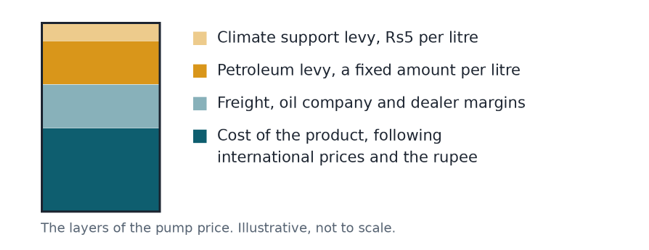
The levy is a fixed amount of rupees on every litre, not
a percentage of the price. There is also a separate climate support levy of Rs5
per litre. Petrol and diesel carry no sales tax, so for practical purposes the
petroleum levy is the government's main charge on fuel.
This year, the levy is expected to raise around Rs1.7
trillion. To put that in perspective, it is roughly a tenth of everything the
Federal Board of Revenue is expected to collect in taxes, raised from
essentially two products.
Why The Government Relies On It So Heavily
Three features make the levy unusually important to the
federal government.
First, it is kept entirely by the federal government.
Most taxes, such as income tax and sales tax, go into a common pool that is
shared with the provinces, and the provinces receive the larger share. The levy
is not a tax in legal terms, so it never enters that pool.
Second, it is quick to change. Since April 2025, there
has been no legal ceiling on the levy, and the rate can be adjusted every
fortnight alongside the regular fuel price revision without going to
parliament.
Third, it is easy and reliable to collect. It is paid at
a small number of points, by refineries and oil marketing companies, rather
than across millions of transactions. There is very little room for evasion.
For a government that struggles to collect enough tax
elsewhere, this makes the levy one of the few revenues it can count on. That is
why governments of every political colour have relied on it. The levy target is
also agreed with the IMF under Pakistan's current programme and forms part of
the plan the country has committed to.
What Happens When Global Prices Rise
This is where the current debate comes from. Because the
levy is a fixed amount per litre, it does not rise when international prices
rise. The increase people see at the pump in a rising market comes mainly from
the higher cost of the product itself, not from the levy.
But the levy is the one part of the price the government
controls directly. When international prices surge, cutting the levy is the
quickest way to cushion people, and it has been done before, including earlier
this year when prices spiked.
The difficulty is that every rupee cut from the levy is
a rupee missing from the budget. There is also a second effect that is less
visible. When fuel becomes expensive, people use less of it. Fewer litres sold
means less levy collected, even if the rate stays the same. So in a period of
rising prices, the government can find itself short of its target without
cutting anything at all.
The Cost Of Relief
It is natural to ask why the levy cannot simply be
removed. The answer is that the money it raises is already spent in the budget,
on salaries, debt payments, development and everything else. Because none of it
is shared with the provinces, the entire gap would fall on the federal
government. It would have to be filled through more borrowing, spending cuts or
new taxes, and each of those, in time, reaches the same households the relief
was meant to help.
Pakistan's own experience is instructive. In early 2022,
the levy was brought down to near zero as part of a relief package. The revenue
loss was not absorbed. It was recovered later through sharp increases once
financing pressure returned, and consumers faced some of the steepest fuel
price rises in the country's history. The relief was real, but it was borrowed
from the future.
None of this means relief is wrong. It means relief has
a cost, and the honest question is who bears it and when.
Is There A Better Way?
The debate is often framed as cut the levy or keep it.
The choices are actually wider.
A smaller, temporary cut can soften a price spike
while keeping most of the revenue, provided there is a plan to restore it once
prices ease.
A clear rule for adjustments would let people
know in advance how the levy will respond to price swings, for example lowering
it when international prices rise sharply and restoring it when they fall.
Predictability itself is a form of relief, because households and businesses
can plan.
Relief targeted at those who need it most, such
as motorcyclists, public transport and farmers, protects more of the revenue
while helping the people most exposed to fuel costs. Pakistan has attempted
this before. Making it work depends on delivery systems that are still being
built.
A broader rethink of how fuel is taxed, including
whether sales tax should return alongside a lower levy, would bring petroleum
back into the mainstream tax system. It would also change how the revenue is
shared with the provinces, so it is a longer conversation.
Greater transparency would help regardless of the
choice. If every fortnightly price notification showed clearly how much of each
litre goes to the product, the margins and the government, public debate would
be better informed and trust easier to build.
The Real Question
The petroleum levy is neither a villain nor a solution.
It reflects a system in which the federal government's own revenue base is
narrow, and reliable income is scarce. As long as that remains true, the levy
will carry a heavy load, and every attempt to cut it sharply will face the same
question: what takes its place?
As global prices rise and the debate heats up, that is
the question worth asking. The person at the filling station and the official
balancing the budget are part of the same arithmetic. A lasting answer has to
work for both.
About Author:
Javed Ahmedjee is a Fellow Chartered Accountant with
over 35 years of leadership experience in Pakistan's energy, pharmaceutical and
financial sectors, and currently serves as CEO of Hascol Petroleum Limited.
Disclaimer:
The views expressed are personal and intended for
general information.
Copyright Mettis Link News
Related News
| Name | Price/Vol | %Chg/NChg |
|---|---|---|
| KSE100 | 166,419.72 133.15M | 0.14% 233.55 |
| ALLSHR | 100,871.92 395.66M | 0.05% 48.64 |
| KSE30 | 49,316.65 59.50M | 0.05% 23.11 |
| KMI30 | 239,907.60 63.28M | -0.05% -114.34 |
| KMIALLSHR | 65,473.69 245.25M | -0.00% -2.07 |
| BKTi | 45,849.28 9.86M | 0.23% 104.46 |
| OGTi | 33,523.02 3.37M | -0.51% -171.71 |
| Symbol | Bid/Ask | High/Low |
|---|
| Name | Last | High/Low | Chg/%Chg |
|---|---|---|---|
| BITCOIN FUTURES | 81,670.00 | 81,795.00 80,850.00 | 70.00 0.09% |
| BRENT CRUDE | 109.74 | 110.00 104.91 | 3.82 3.61% |
| RICHARDS BAY COAL MONTHLY | 128.50 | 0.00 0.00 | 0.05 0.04% |
| ROTTERDAM COAL MONTHLY | 145.10 | 0.00 0.00 | 0.15 0.10% |
| USD RBD PALM OLEIN | 1,167.50 | 1,167.50 1,167.50 | 0.00 0.00% |
| CRUDE OIL - WTI | 99.04 | 99.34 95.29 | 2.54 2.63% |
| SUGAR #11 WORLD | 20.85 | 21.01 20.47 | -0.28 -1.33% |
Chart of the Day
Latest News
Top 5 things to watch in this week
 Current Account Balance
Pakistan Stock Movers
| Name | Last | Chg/%Chg |
|---|
| Name | Last | Chg/%Chg |
|---|