
SE Fruits IPO: The CTIs Said All Was Well. So What Went Wrong?

MG News | October 17, 2026 at 03:21 PM GMT+05:00

October 17, 2026 (MLN): SE Fruits and Vegetable Limited’s (SEFL) PKR 1.2 billion initial public offering has been reversed, and Mettis Global has learned why.
The sales figures the company presented to investors
appear to have raised questions when compared with other records, including its
tax and customs filings. Concerns over how the company’s records were
maintained also seem to have emerged, and these were not reflected in the
prospectus.
On October 13, Mettis Global reported that investors in the
offering were getting their money back. Brokers and large investors who took
part in book building confirmed they had already received refunds, while retail
applicants' refunds were still being processed. Sources close to the matter,
speaking on condition of anonymity, said the IPO stood cancelled and that all
investors should be repaid within 48 hours.
That timeline has slipped for some. Public investors we
spoke to this week said they had not yet been told anything by the Central
Depository Company (CDC) and were informed their refunds would be processed
next week. As of this writing, the Pakistan Stock Exchange (PSX) has issued no
notice on the cancellation.
On October 16, the Securities and Exchange Commission of
Pakistan (SECP) went public. In a press release, it said it was initiating
regulatory action over material discrepancies in the prospectus, that it had
suspended proceedings after book building to protect investors, and that the
company had subsequently withdrawn the IPO voluntarily, intending to return
later with enhanced disclosures.
The regulator added that it is reviewing the case to
establish responsibility for procedural irregularities, and used the episode to
call for a stronger Audit Oversight Board.
Doubts Surface Before Book Building
SECP approved the prospectus on September 9, 2026, two days
after the PSX had cleared it. The disclosure regime that governs Pakistani IPOs
is built on trust: the regulator relies on the consultant to the issue's due
diligence certificate, the company's undertakings that its information is true,
and audited accounts. The prospectus itself carried the standard disclaimer
that SECP takes no responsibility for the company's financial soundness or the
accuracy of its statements.
On September 10, a day after the prospectus was approved, a
complaint was filed with the regulator and the tax authorities challenging the
numbers behind the offering. Its main allegation was that the sales SEFL showed
investors did not match what the company and its predecessor firm, Shaheen
Enterprises, had declared to the tax authority.
According to the complaint, the export sales that appear in
FBR’s records, which are fed automatically from customs data and cannot be
changed by the taxpayer, were only a fraction of what the prospectus showed. It
alleged that exports shown to investors were nearly four times the declared
figure in FY26 and close to three times in FY25. Mango was the starkest case.
The complaint claimed the prospectus implied a per-ton export price about three
times what was declared, and a volume about six times higher than official
records showed.
The Numbers That Didn’t Add Up
Information obtained by Mettis Global, together with sources
familiar with the matter, gives a clearer picture of what went wrong.
Two sets of numbers. Over five years, sales in the
company’s accounts appear to have been higher than those declared for sales tax
by close to PKR 4 billion. Nearly half of that gap falls in FY26, the year the
IPO was built on. There also seem to be gaps in the income tax filings.
Exports on paper, not at the port. Customs
declarations appear to cover less than half of the export sales booked in FY26.
Mango stands out: invoiced prices seem to be several times higher than those
declared to customs.
Paperwork that raises questions. Questions are
understood to have been raised over how some sales invoices were prepared and
documented.
Money outside the company. This is the most serious
concern. Roughly half of FY26’s reported sales of PKR 2.13 billion appears to
have been received in bank accounts not held in the company’s name, including a
substantial sum in the sponsors’ personal accounts.
Sales to itself. The prospectus shows PKR 281.66
million of FY26 sales to Shaheen Enterprises, the predecessor firm whose
business SEFL says it absorbed in July 2025. No clear commercial reason for
these sales appears to have emerged.
Little of this seems to have been visible to investors in
the final prospectus. The related-party disclosures covered sales to the
predecessor firm. They do not appear to show how some customer receipts were
handled outside the company’s own accounts. Investors would reasonably have
expected that kind of information before deciding whether to subscribe.
Was It Really Voluntary
The SECP press release frames the outcome as a voluntary
withdrawal by the company but a withdrawal that arrives after a regulator has
built that case is not the same as a company stepping back on its own
initiative.
Calling it voluntary, and promising to return with better
disclosures, lets the issuer frame the story as one of incomplete paperwork. It
also risks giving everyone who signed off on the prospectus a quiet exit.
Who Answers For This? And What About Investors’ Trust In The CTI?
Every party in Pakistan’s IPO chain is paid for its role,
and every party protects itself with a disclaimer. The company certifies its
own information. The auditor certifies the accounts. The PSX reviews the
prospectus and invites public comment. SECP approves it while disclaiming
responsibility for its accuracy. And at every step, the investor is told to do
their own due diligence.
One party, however, stands in front of investors more
than any other: the Consultant to the Issue.
For most investors, the CTI is the face of an IPO. It
structures the offer, drafts the prospectus, runs the investor briefing
sessions, presents the growth story and answers the questions. Many investors,
retail investors especially, subscribe not because they have read a 200-300-page
prospectus but because they trust the name of the firm behind the deal. That
trust is exactly what the CTI is paid for.
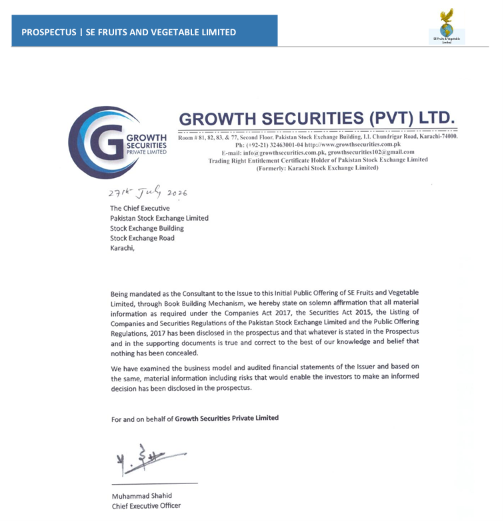
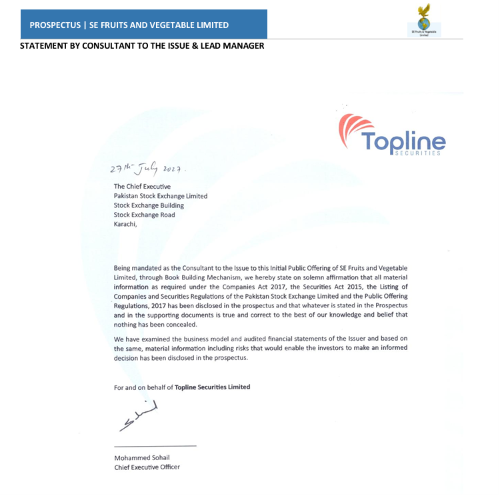
In SEFL’s case, that trust was put in writing. In a signed certificate to the Pakistan Stock Exchange, Topline Securities, and Growth Securities as Consultant to the Issue, stated on solemn affirmation that the prospectus disclosed all material information required under the Companies Act, the Securities Act, the PSX rulebook and the Public Offering Regulations.
They also affirmed that everything stated in the prospectus and its supporting documents was true and correct, and that nothing had been concealed. The certificate adds that the CTI had examined the issuer’s business model and audited financial statements, and that on that basis investors had been given what they needed to make an informed decision.
That last line deserves attention. By its own account, the CTIs assurance rested on the audited financial statements, the same accounts whose reliability is now in question.
A CTI has full access to the
company’s books, bank statements, tax filings and export documents. If the
sales in those accounts could not be matched with tax and customs records, why
was that not tested before the CTI certified to the exchange that nothing had
been concealed? Reconciling reported sales with tax returns and bank receipts
is not an extraordinary forensic exercise. It is the basic groundwork a due
diligence certificate is supposed to rest on.
An ordinary investor cannot walk into FBR to compare a
company’s tax returns with its prospectus, pull customs declarations, or ask to
see sponsors’ bank statements. They rely on the people who can, and who have
certified that they did.
The law is clear on paper. The public offering
regulations place responsibility for the quality and accuracy of prospectus
disclosures on the issuer and the Consultant to the Issue. Section 92 of the
Securities Act makes a misleading statement, or the omission of required
information, in a prospectus a criminal offence. It carries up to three years’
imprisonment, a fine of up to PKR 100 million, or both, unless the person shows
the statement was immaterial or that they had reasonable grounds to believe it
was true.
Nor does a withdrawal wipe the slate clean. Experts in
the area are of the opinion that withdrawing the IPO and refunding investors
is, at most, a mitigating factor when a penalty is decided. Submitting untrue
or incomplete information to the Commission, they say, remains a violation of
the law, whatever later happens to the offering.
The test now is whether those provisions are applied to
the company, its consultant and its auditor, or whether a “voluntary
withdrawal” quietly closes the file. If the face of an IPO can certify that
nothing was concealed, and then walk away untouched when the offering
collapses, investors will draw their own conclusions about what that signature
is worth on the next deal.
The exchange has published no notice on the cancellation, no
refund schedule, and no figures on how many investors applied in the public
portion or how much was subscribed. Applicants deserve to know when
their money will arrive and how many of them were affected.
Where were these disclosures earlier? Some warning signs
were in the prospectus for anyone who looked: operating cash flow of just PKR
3.74 million against a reported profit after tax of PKR 303.82 million, trade
receivables of PKR 995.87 million, nearly 47% of FY26 revenue, and PKR 281.66
million of sales booked through a predecessor described as non-operational.
Can the same accounts come back? If SEFL returns with
'enhanced disclosures', investors will need restated, re-audited financial
statements, not an expanded risk section built on the same numbers.
The Real Cost: Trust
The money will come back. The trust may not.
For the public investors who applied, the SE Fruits IPO was
more than a share allocation. Many will have moved savings out of bank
deposits, sold other holdings, or put their first money into a public offering.
For weeks those funds were tied up, earning nothing. Some are still waiting to
be repaid, with no word from the exchange on when. A refund returns the
principal. It does not return the time, or the confidence they had in the
process.
The damage goes well beyond one company. Pakistan’s equity
market has spent years trying to bring ordinary savers into listed companies,
and IPOs are meant to be the front door. Every offering approved by the
exchange and the regulator carries an implied promise: the numbers have been
checked, the advisers have done their work, and what investors read is what the
company really is. When an IPO reaches subscription and then has to be unwound
because its core figures cannot be reconciled, that promise is broken for every
company in the pipeline, not only this one.
The next small or mid-sized issuer will pay part of the
price. Investors who were burned here will treat future prospectuses with
suspicion and demand deeper discounts. Some will simply stay away, especially
from first-time listings by family-run businesses. That makes it harder for
genuine companies to raise capital, and it pushes savers back toward real
estate, gold and bank deposits. Those are the very habits the market has been
trying to change.
None of this should have needed a complaint to come to
light. Oversights of this kind have to be taken seriously at the start of the
process, not after public money has been collected. A regulatory review that
begins only once a complaint lands, and ends only once subscriptions are
complete, protects no one in time.
Related News
_20260529073616622_a5048c_20260907134137512_e9e626.webp?width=280&height=140&format=Webp)

| Name | Price/Vol | %Chg/NChg |
|---|---|---|
| KSE100 | 166,419.72 133.15M | 0.14% 233.55 |
| ALLSHR | 100,871.92 395.66M | 0.05% 48.64 |
| KSE30 | 49,316.65 59.50M | 0.05% 23.11 |
| KMI30 | 239,907.60 63.28M | -0.05% -114.34 |
| KMIALLSHR | 65,473.69 245.25M | -0.00% -2.07 |
| BKTi | 45,849.28 9.86M | 0.23% 104.46 |
| OGTi | 33,523.02 3.37M | -0.51% -171.71 |
| Symbol | Bid/Ask | High/Low |
|---|
| Name | Last | High/Low | Chg/%Chg |
|---|---|---|---|
| BITCOIN FUTURES | 81,540.00 | 81,795.00 80,850.00 | -60.00 -0.07% |
| BRENT CRUDE | 109.95 | 110.00 104.91 | 4.03 3.80% |
| RICHARDS BAY COAL MONTHLY | 128.50 | 0.00 0.00 | 0.05 0.04% |
| ROTTERDAM COAL MONTHLY | 145.10 | 0.00 0.00 | 0.15 0.10% |
| USD RBD PALM OLEIN | 1,167.50 | 1,167.50 1,167.50 | 0.00 0.00% |
| CRUDE OIL - WTI | 99.04 | 99.34 95.29 | 2.54 2.63% |
| SUGAR #11 WORLD | 20.85 | 21.01 20.47 | -0.28 -1.33% |
Chart of the Day
Latest News
Top 5 things to watch in this week
 Current Account Balance
Pakistan Stock Movers
| Name | Last | Chg/%Chg |
|---|
| Name | Last | Chg/%Chg |
|---|