
Pakistan's external sector stays resilient despite Middle East shock

MG News | June 11, 2026 at 05:25 PM GMT+05:00

June 11, 2026 (MLN): Pakistan's balance of payments-maintained stability during July-March FY2026, supported by strong remittance inflows and growing IT exports, though a Middle East crisis in late February 2026 disrupted trade flows and pushed the current account into deficit in April.
Current account posts surplus before crisis hit
Pakistan's external account recorded a current account
surplus of $72m during July-March FY2026, supported by workers' remittances
growth of 8.2% to $30.3bn, a narrowing primary income deficit due to lower
interest payments on external debt, and a 17.2% surge in services exports.
Goods exports, however, declined 5.8 percent to $22.7bn,
weighed by a 33.9% fall in food exports primarily rice amid normalisation of
global rice supplies, weak external demand, and disruptions to Pak-Afghan trade
since mid-October 2025.
Imports rose 7.8%, driven by stronger demand for
production-related inputs as domestic economic activity improved.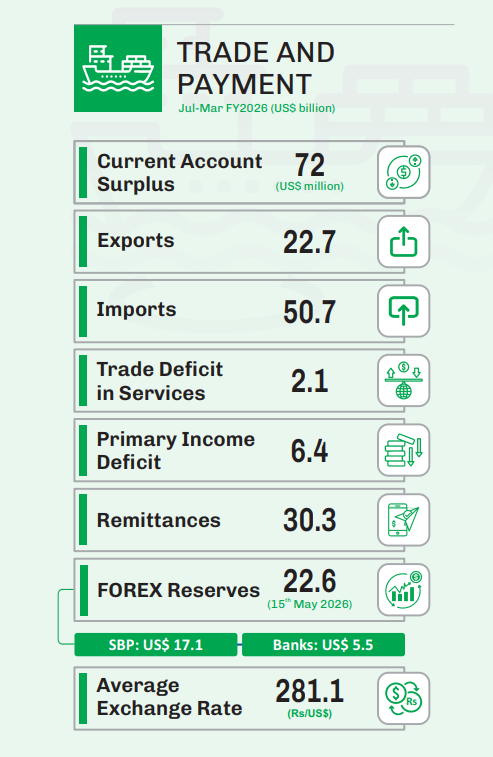
Middle East crisis turns account into Deficit
The onset of the Middle East crisis following the US-Iran
conflict in late February 2026 reversed the positive trend. Brent crude surged
from an average of $62.7 per barrel in December 2025 to $103.7 per barrel in
March 2026.
Suspension of shipments to key markets, closure of a land
transit route, and higher freight costs pushed the current account into a
deficit of $324m in April 2026 though it remained within manageable limits.
Merchandise trade: Deficit widens to $27.9bn
The merchandise trade deficit widened to $27.9bn during
July-March FY2026, against $22.7bn in the same period last year.
Exports stood at $22.7bn versus $24.7bn last year.
The textile sector contributing 59.6% of total exports at $13.5bn remained
broadly stable with a marginal 0.5% decline.
Readymade garments rose 3.8% to$3.2bn while knitwear dipped
1.1%. Food exports fell sharply to $3.8bn, a 33.9% decline, with rice exports
alone contracting 38.6%.
Petroleum exports, though modest at 2.58% of total, surged
37.5% to $586m, driven by enhanced domestic refining capacity and rising global
demand.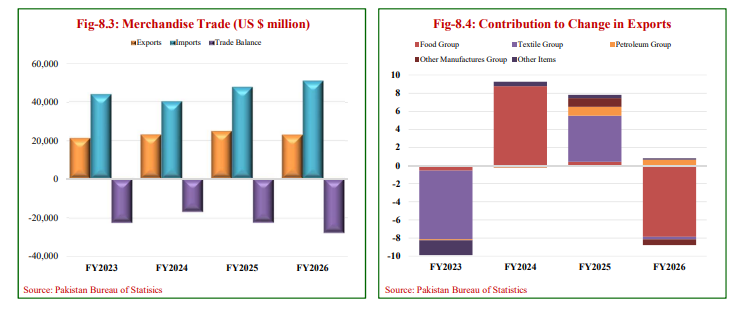
Imports increased 6.9% $50.7bn. The transport group
surged 82.8% to $2.9bn, driven by a doubling of motor car parts imports to $1.5bn
following easing of import restrictions.
Machinery imports rose 10.3% to $7.9bn, led by a 27.3 jump
in telecom machinery. Food imports climbed 15.2% to $7.1bn on higher palm oil
prices.
Petroleum imports, however, declined 5.9% to $11.2bn, helped
by lower LNG demand and increased solar power contribution.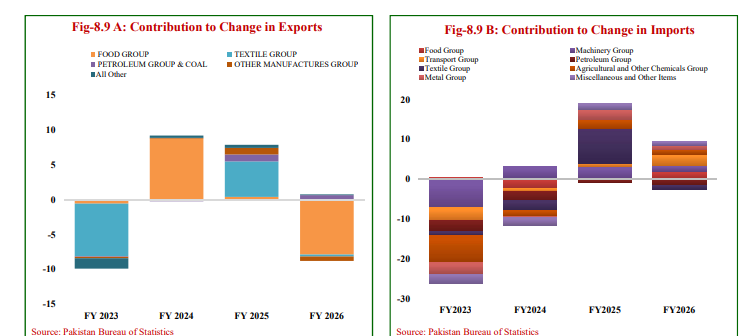
IT sector drives services surplus narrowing
The services trade deficit narrowed 10.4% to $2.1bn.
Services exports grew 17.2% to $7.4bn, with IT exports alone jumping 19.8% to $3.4bn
accounting for 46.1% of total services exports and surpassing readymade
garments in value.
Other business services rose 27.7% to $1.6bn, largely driven
by a threefold increase in freelance technical services.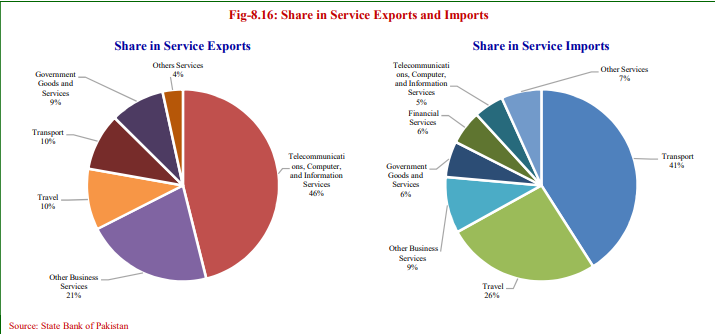
Remittances exceed goods export receipts
Workers' remittances rose 8.2%to $30.3bn during July-March
FY2026, exceeding goods export receipts for the period.
Saudi Arabia and the UAE remained the anchor sources, while
inflows from the European Union particularly Italy, Spain, and Ireland
registered notable growth, pointing to a gradual diversification of remittance
sources.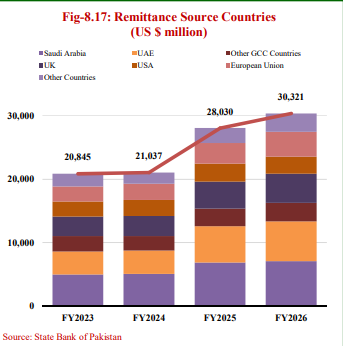
FDI moderates; Capital market milestones achieved
Net FDI stood at $1.4bn, down from $1.9bn last year, mainly
due to a one-off telecom-sector divestment of $465.5m by a Norway-based
company.
Excluding this, underlying inflows remained concentrated in
power and financial services sectors. China led with $678.6m in net FDI
inflows.
On the capital markets front, Pakistan raised $750m through
a three-year Eurobond and completed its inaugural Panda Bond issuance in
China's onshore market, raising RMB1.75bn (approximately $250m), broadening
access to non-dollar financing sources.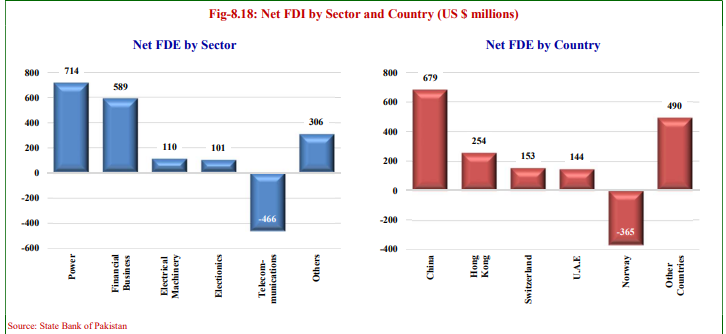
Reserves surge; PKR stays stable
Total foreign exchange reserves reached $21.8bn by end-March
2026, up $6.8bn from $15.0bn a year earlier.
SBP reserves stood at $16.4bn while commercial banks held $5.4bn.
The exchange rate remained stable at an average PKR279.5 per US dollar in March
2026, a marginal 0.2% appreciation year-on-year.
Pakistan's credit ratings were upgraded by Fitch (CCC+ to
B-), Moody's (Caa2 to Caa1), and S&P (CCC+ to B-) during the period,
bolstering investor confidence.
Copyright Mettis Link News
Related News
.png?width=280&height=140&format=Webp)


| Name | Price/Vol | %Chg/NChg |
|---|---|---|
| KSE100 | 167,089.28 109.91M | -0.21% -352.63 |
| ALLSHR | 101,117.40 308.32M | -0.15% -155.10 |
| KSE30 | 49,841.71 50.59M | -0.28% -142.15 |
| KMI30 | 240,372.43 78.75M | -0.02% -45.72 |
| KMIALLSHR | 65,518.16 188.07M | -0.05% -35.70 |
| BKTi | 46,228.77 7.60M | -0.60% -281.04 |
| OGTi | 33,974.66 4.20M | -0.27% -91.31 |
| Symbol | Bid/Ask | High/Low |
|---|
| Name | Last | High/Low | Chg/%Chg |
|---|---|---|---|
| BITCOIN FUTURES | 83,875.00 | 84,320.00 82,645.00 | 1405.00 1.70% |
| BRENT CRUDE | 104.54 | 105.09 102.33 | 0.26 0.25% |
| RICHARDS BAY COAL MONTHLY | 128.50 | 0.00 0.00 | 0.75 0.59% |
| ROTTERDAM COAL MONTHLY | 143.40 | 143.40 143.40 | -1.15 -0.80% |
| USD RBD PALM OLEIN | 1,167.50 | 1,167.50 1,167.50 | 0.00 0.00% |
| CRUDE OIL - WTI | 91.66 | 0.00 0.00 | -0.19 -0.21% |
| SUGAR #11 WORLD | 20.27 | 20.44 20.09 | 0.12 0.60% |
Chart of the Day
Latest News
Top 5 things to watch in this week
 PIB Auction
Pakistan Stock Movers
| Name | Last | Chg/%Chg |
|---|
| Name | Last | Chg/%Chg |
|---|