
Pakistan maps Rs28.6tr borrowing plan for FY27

MG News | September 30, 2026 at 12:40 PM GMT+05:00

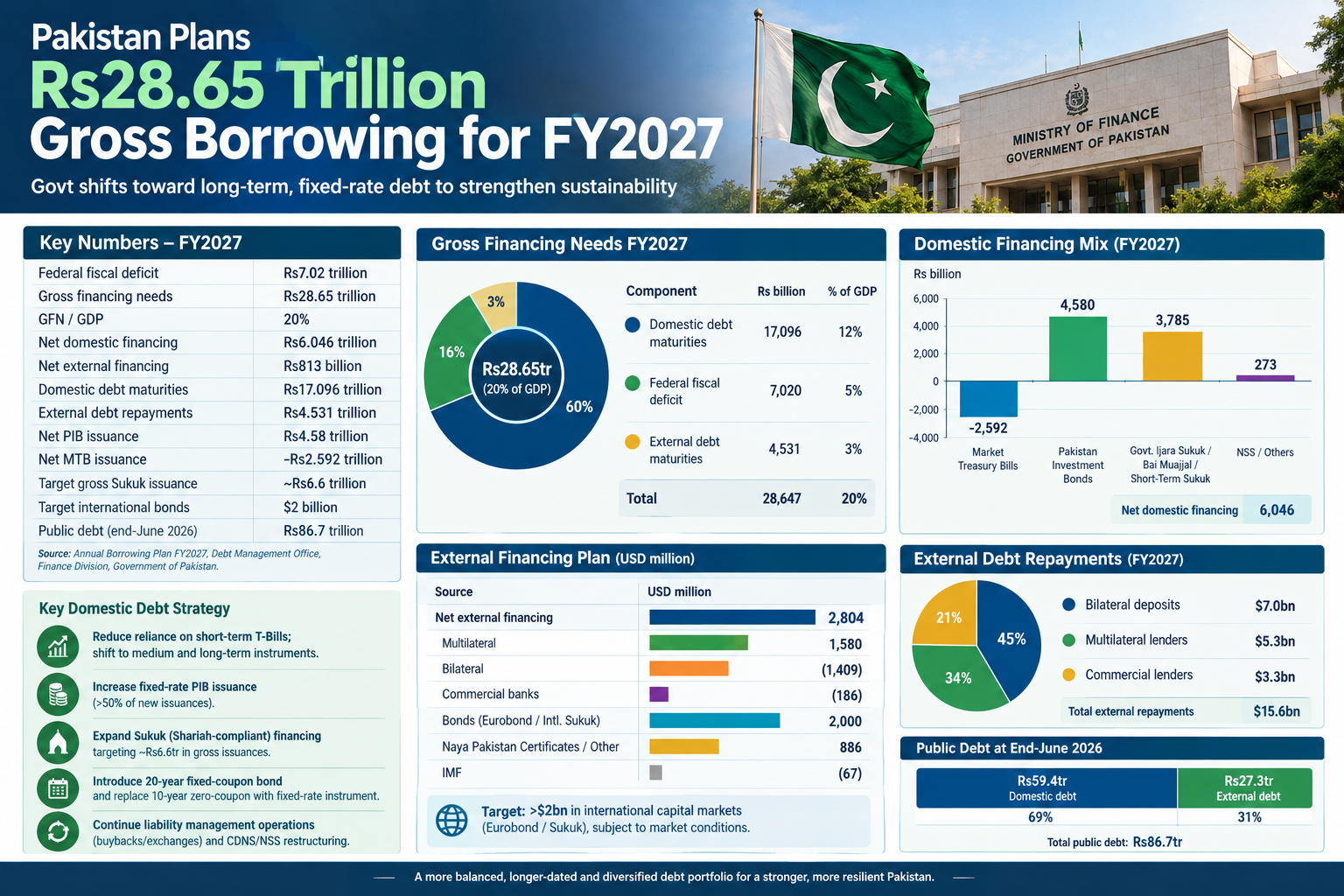
September 30, 2026 (MLN): The government has projected gross financing needs of Rs28.65 trillion for FY2026-27, equivalent to around 20% of GDP, as it plans to finance the federal fiscal deficit primarily through domestic borrowing while increasing reliance on longer-term debt instruments.
According to the Annual Borrowing Plan (ABP) FY2027 issued by the Debt Management Office of the Finance Division, the federal fiscal deficit is projected at Rs7.02tr, comprising a primary surplus of Rs1.034tr and interest expenses of Rs8.054tr.
The government plans to meet the deficit through Rs6.046tr in net domestic borrowing, Rs813 billion in net external financing and Rs161bn in privatization proceeds.
The borrowing strategy is aligned with the Medium-Term Debt Management Strategy FY2026-28 and seeks to reduce refinancing and interest-rate risks by shifting borrowing toward medium- and long-term fixed-rate instruments.
Domestic borrowing strategy
The government plans a net reduction of Rs2.592tr in Market Treasury Bills (MTBs) during FY27, while targeting Rs4.58tr in net issuance of Pakistan Investment Bonds (PIBs).
Fixed-rate PIBs are expected to account for more than half of new PIB issuance as the government seeks to increase the share of fixed-rate debt and reduce exposure to interest-rate volatility.
The plan also envisages Rs3.785tr in net financing through Government Ijara Sukuk, Bai Muajjal and short-term Sukuk.
Gross Sukuk issuance is targeted at around Rs6.6tr during FY27, following the introduction of a hybrid Sukuk structure in April 2026 and short-term Sukuk with three- and six-month tenors.
The government also plans to introduce a 20-year fixed-coupon bond following consultations with stakeholders and replace the 10-year zero-coupon floating-rate structure with a 10-year fixed-rate instrument.
The ABP said long-dated zero-coupon bonds introduced in FY25 have attracted interest from commercial banks and non-bank institutional investors, and their issuance will continue to diversify the investor base.
Rs17tr domestic debt maturities
Domestic debt maturities during FY27 are estimated at around Rs17.1tr, excluding the rollover of T-Bills.
T-Bill maturities account for approximately Rs11.1tr, with the bulk falling due during the first two quarters of the fiscal year.
PIB maturities are estimated at Rs3.1tr, including floating-rate PIBs, while Government Ijara Sukuk maturities amount to around Rs1.9tr. GIS one-year discount instruments account for another Rs0.9tr.
The government said it will continue liability management operations, including debt buybacks and switches, subject to available fiscal space and market conditions.
Since September 2024, liability management transactions amounting to Rs4.7tr have been conducted, according to the borrowing plan.
Gross financing needs at 20% of GDP
The government's total gross financing needs comprise the Rs7.02tr fiscal deficit and Rs21.627tr in debt maturities.
Domestic debt maturities are estimated at Rs17.096tr, while external debt repayments are projected at Rs4.531tr.
The government expects gross financing needs to remain around 20% of GDP, compared with 21% in FY26.
The plan noted that the average time to maturity (ATM) of public debt increased from 2.7 years in June 2024 to 3.8 years in June 2026, with a target of 4.2 years by FY28.
Meanwhile, interest expenditure declined by 22% during FY26, according to the document.
External financing plan
For external financing, the government expects net inflows of $2.804bn during FY27.
Multilateral partners are expected to provide the largest net contribution at $1.58bn, while the government plans to raise around $2bn through international bonds, subject to market conditions.
The external financing plan also includes refinancing of existing foreign commercial bank loans and potential new facilities where financing terms are favorable.
The government expects total external inflows of $13.378bn during FY27 against outflows of $10.574bn.
External inflows include $4.975bn from multilateral lenders, $2.4bn from bilateral sources, $2.35bn from commercial banks, $2bn through bonds, $1.122bn through Naya Pakistan Certificates and other sources, and $530m under the IMF's Resilience and Sustainability Facility.
External outflows comprise $3.395bn to multilateral lenders, $3.81bn to bilateral creditors, $2.536bn to commercial banks, $236m under Naya Pakistan Certificates and other sources, and $597m to the IMF.
$15.6bn external principal maturities
Pakistan's external debt principal maturities during FY27 are estimated at $15.6bn.
Bilateral deposits account for around $7bn of these maturities and are expected to be rolled over, while $5.3bn is owed to multilateral lenders and $3.3bn to commercial lenders.
No Eurobond maturities are scheduled during FY27.
The government plans to use international capital market issuance partly as replacement financing, replacing shorter-dated external debt with longer-term market-based borrowing to extend debt duration and reduce refinancing risk.
The ABP also identifies Panda bonds, a return to the Eurobond market and greater foreign portfolio investment in domestic government securities as part of the medium-term strategy.
Public debt reaches Rs86.7tr
Pakistan's total public debt stood at Rs86.7tr at end-June 2026, comprising Rs59.4tr in domestic debt and Rs27.3tr in external debt.
Over the past decade, an average of 81% of the federal fiscal deficit was financed through domestic sources, while external financing accounted for the remaining 19%.
For FY27, the government said it will maintain maximum reliance on domestic sources while managing foreign-exchange risks associated with external borrowing.
The borrowing plan also includes restructuring the Central Directorate of National Savings (CDNS) through improved products, market-driven pricing and digitalization.
The government plans to further expand retail participation through digital investment in MTBs, the InvestPak platform and other channels for investment in government securities.
The Finance Division said implementation of the borrowing plan will remain dependent on domestic and international macroeconomic conditions, debt-market dynamics, fiscal discipline and developments in the geopolitical environment.
Copyright Mettis Link News
Related News

_20260513052023717_7e8bb5.jpeg?width=280&height=140&format=Webp)

| Name | Price/Vol | %Chg/NChg |
|---|---|---|
| KSE100 | 163,924.32 118.89M | -1.21% -2006.67 |
| ALLSHR | 99,526.88 364.30M | -1.08% -1083.61 |
| KSE30 | 48,313.81 50.96M | -1.53% -750.07 |
| KMI30 | 235,637.18 55.46M | -1.36% -3247.37 |
| KMIALLSHR | 64,683.09 191.88M | -0.90% -587.30 |
| BKTi | 45,181.21 14.21M | -1.56% -715.82 |
| OGTi | 33,395.61 3.57M | -0.82% -277.39 |
| Symbol | Bid/Ask | High/Low |
|---|
| Name | Last | High/Low | Chg/%Chg |
|---|---|---|---|
| BITCOIN FUTURES | 81,230.00 | 84,945.00 80,845.00 | -3385.00 -4.00% |
| BRENT CRUDE | 112.73 | 113.50 109.81 | 3.91 3.59% |
| RICHARDS BAY COAL MONTHLY | 128.50 | 0.00 0.00 | -1.55 -1.19% |
| ROTTERDAM COAL MONTHLY | 147.10 | 0.00 0.00 | 1.80 1.24% |
| USD RBD PALM OLEIN | 1,167.50 | 1,167.50 1,167.50 | 0.00 0.00% |
| CRUDE OIL - WTI | 99.09 | 100.17 97.72 | 1.94 2.00% |
| SUGAR #11 WORLD | 20.13 | 20.64 20.10 | -0.32 -1.56% |
Chart of the Day
Latest News
Top 5 things to watch in this week
 Repatriation of Profit and Dividend
Pakistan Stock Movers
| Name | Last | Chg/%Chg |
|---|
| Name | Last | Chg/%Chg |
|---|