
Pakistan fiscal deficit narrows to record low: PES
MG News | June 11, 2026 at 04:38 PM GMT+05:00

June 11, 2026 (MLN): Pakistan’s fiscal consolidation strategy has yielded a dramatic improvement in its public finances during the first nine months of the fiscal year 2025–26.
Driven by robust revenue generation, an aggressive domestic austerity drive, and a substantial reduction in national debt-servicing burdens, the country’s overall fiscal deficit collapsed to just 0.7% of GDP between July 2025 and March 2026.
This marked one of the lowest fiscal deficits recorded for the three-quarter period in recent history, dropping precipitously from the 2.6% of GDP deficit reported during the same window last year.
According to Economic Survey of Pakistan for FY2025–26, the cash-strapped South Asian economy recorded a massive primary surplus of 3.2% of GDP, amounting to Rs4.0915 trillion ($36.19 billion). This is up from a primary surplus of 3.0% of GDP (Rs 3.4687 trillion) over the same period in FY2024–25.
Pakistan’s Journey Toward Stability in FY2025
The dramatic fiscal turnaround in the ongoing fiscal year builds heavily on structural successes locked in during the full fiscal year ending June 2025 (FY2025).
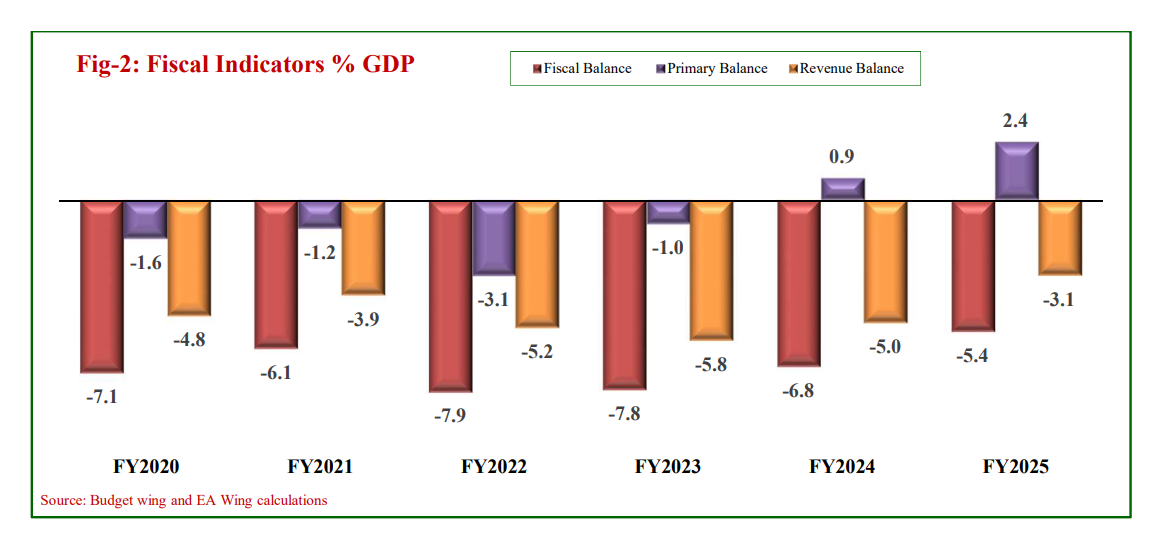
In the full-year review of FY2025, Pakistan successfully shrunk its annual fiscal deficit to 5.4% of GDP from 6.8% in FY2024.
The full-year primary balance recorded a massive turnaround, closing at a surplus of 2.4% of GDP compared to a meager 0.9% in FY2024.
Simultaneously, the revenue deficit, the gap between tax-and-non-tax income and current running operational expenditures, shrank down to 3.1% of GDP from 5.0% in FY2024.
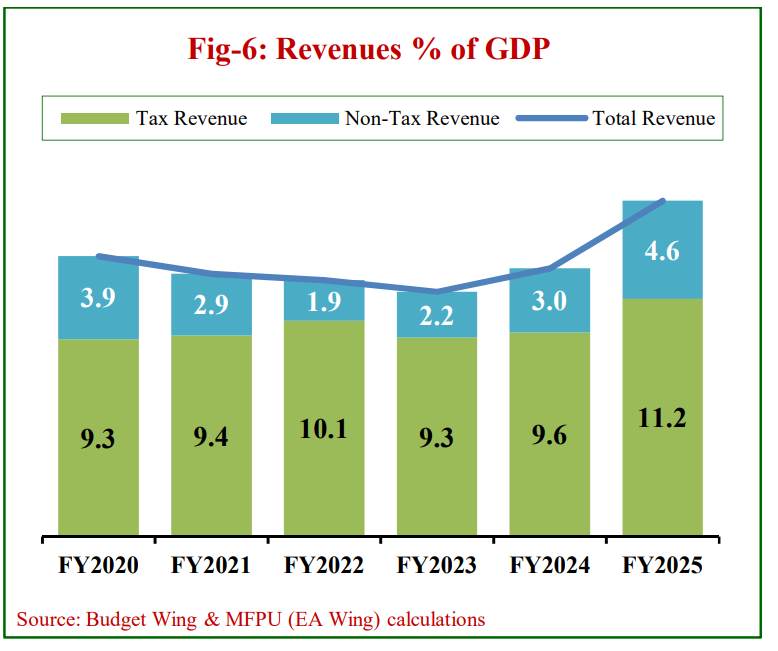
This stabilization occurred even though total expenditures as a percentage of GDP rose to 21.2% in FY2025 compared to 19.4% in FY2024. This spending expansion was offset by an extraordinary full-year revenue mobilization effort, where total national revenues expanded to 15.8% of GDP in FY2025 from 12.6% in FY2024.
Tax revenues climbed to 11.2% of GDP in FY2025 (up from 9.6% in FY2024), while non-tax revenue jumped to 4.6% of GDP (up from 3.0% in FY2024).
This 65.7% surge in non-tax inflows was propelled by stellar profitability at the central bank, with State Bank of Pakistan (SBP) profits expanding by 169.5%, dividend income rising by 110.6%, and petroleum levy collections advancing by 19.7%.
Expenditure Rationalization, Austerity Measures Take Hold in FY2026
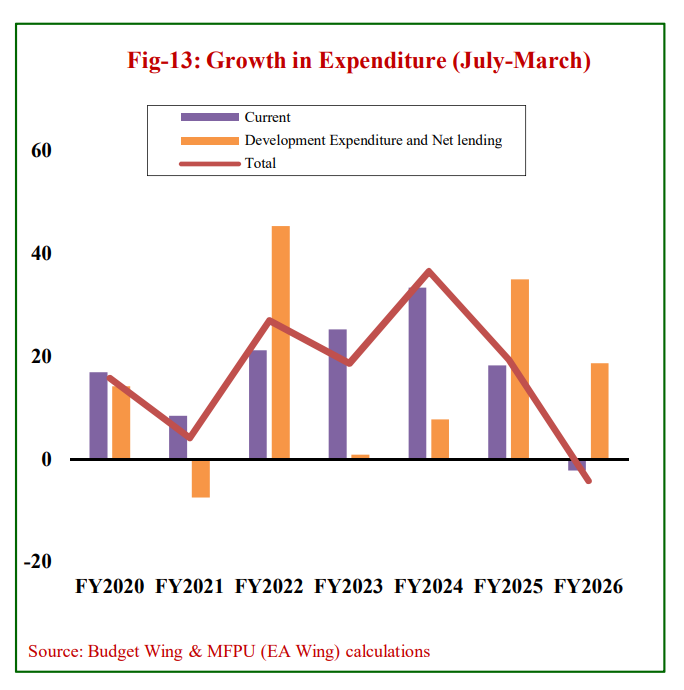
For the current period of July–March FY2026, total consolidated expenditures fell by 4.2%, settling at Rs 15.6556 trillion down from Rs 16.3370 trillion in the same period last year.
This contraction was catalyzed by a major domestic easing of interest rates and an effective public debt management strategy.
Total markup (interest) payments, which have long crippled Pakistan's budget flexibility, plummeted by 23.2% to Rs 4.9479 trillion, compared to a crushing Rs 6.4388 trillion paid out by the federation in July–March FY2025.
This provided immense breathing space, causing current expenditures to edge down by 2.2% to Rs 14.2674 trillion.
To lock down these gains, the federal cabinet enacted stringent austerity mechanisms. These included:
An outright ban on the government purchase of all luxury and civil vehicles, strictly exempting core operational vehicles like ambulances, fire trucks, and school buses.
A complete freeze on the generation of new employment posts, alongside the immediate abolition of all public sector jobs that had remained vacant for more than three years.
A total ban on non-obligatory official foreign tours and medical treatments abroad funded by public tax money.
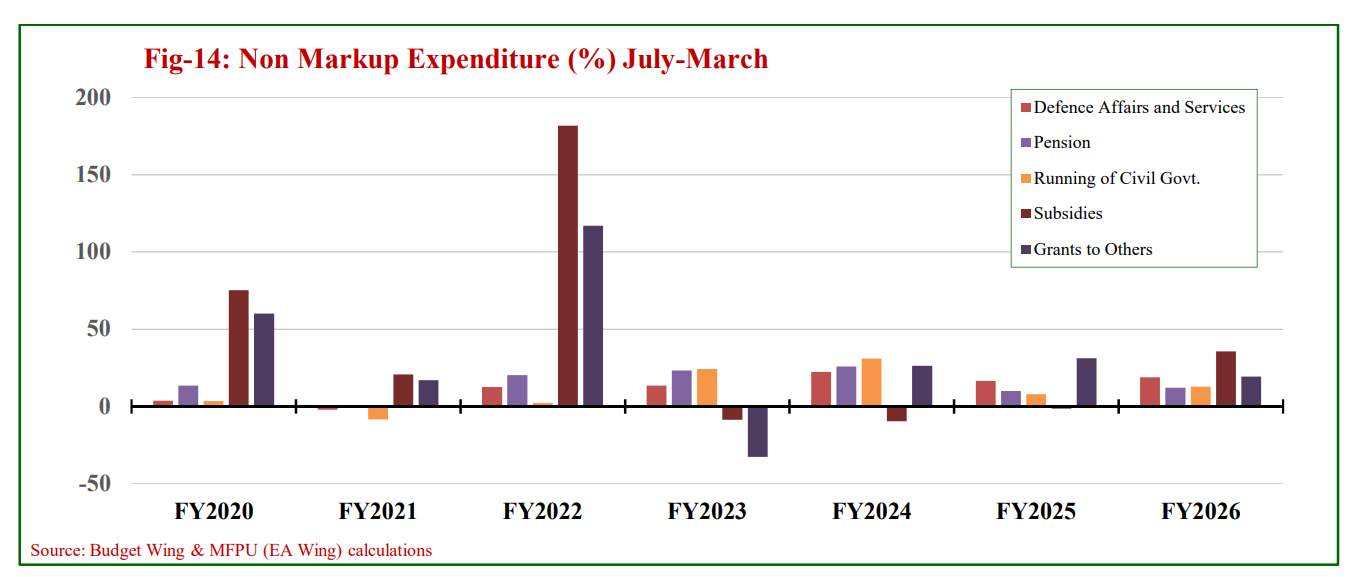
However, non-markup operational costs across the civil-military apparatus continued to expand under inflationary pressures.
Defense affairs and services grew by 18.7% to Rs 1.6899 trillion (up from Rs 1.4240 trillion last year).
Public grants escalated to Rs 1.2180 trillion, while domestic cross-subsidies rose to Rs 632.0 billion.
Revenues Soar as Tax Regime Evolves
On the receipts ledger, Pakistan's consolidated revenue base hit Rs 14.7993 trillion in July–March FY2026, tracking a solid 10.7% growth path from last year's Rs 13.3670 trillion.
Total tax revenues accounted for Rs 10.1666 trillion (up 11.3%), while non-tax receipts rounded out at Rs 4.6327 trillion (up 9.5%).
Federal collection via the Federal Board of Revenue (FBR) surged by 10.1% during the nine-month period. This upward trajectory extended into a 10-month review (July–April FY2026), where FBR's net collections officially crossed the 10-trillion mark to reach Rs 10.2626 trillion.
Although this 10-month performance represented an impressive 10.3% annual expansion, it still fell Rs 684.4 billion short of the aggressive Rs 10.9470 trillion target set under IMF-backed fiscal programs.
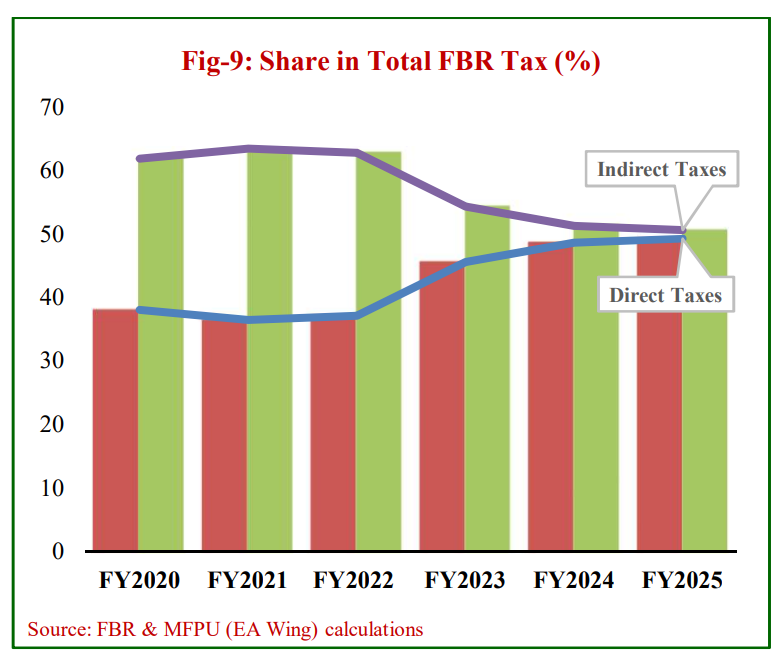
Structurally, the country is executing a critical shift toward progressive taxation. Historically heavily reliant on regressive indirect taxes, direct taxes skyrocketed to command a 49.3% share of total FBR revenues by the close of FY2025, up from 36.5% in FY2021.
Conversely, the share of indirect taxes retreated down to 50.7%.
Concurrently, provincial tax collections witnessed an impressive 25.8% jump to help fund local deficits.
This was structurally bolstered by a historic milestone: all four provinces passed synchronized, updated legislation on Agriculture Income Tax, effectively aligning undertaxed agrarian wealth with corporate and personal income tax brackets for the first time.
Provinces Build Up Large Surpluses
The consolidated fiscal ledger was immensely buttressed by localized fiscal discipline, as the federal government successfully weaponized cash surplus targets for provincial administrations.
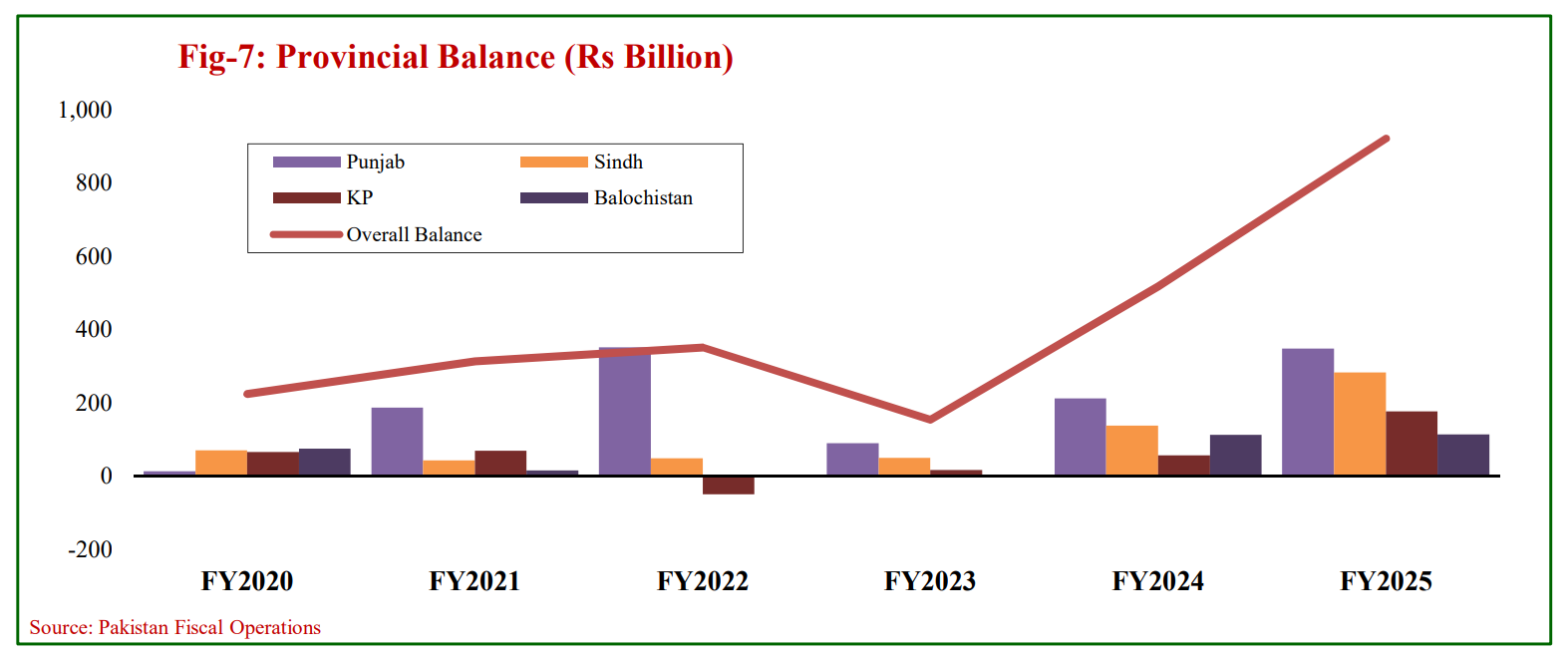
The cumulative provincial surplus nearly doubled across full-year cycles, ballooning from Rs 518.2 billion in FY2024 to an extraordinary Rs 921.5 billion in FY2025.
A breakdown of provincial contributions reveals:
Punjab: Surpassed its prior surplus of Rs 212.2 billion to lock in Rs 348.5 billion.
Sindh: More than doubled its fiscal reserve from Rs 137.6 billion to Rs 283.0 billion.
Khyber Pakhtunkhwa (KP): Scaled up its savings from Rs 56.2 billion to Rs 176.2 billion.
Balochistan: Maintained steady discipline, inching up its surplus from Rs 112.3 billion to Rs 113.8 billion.
Despite sweeping consolidation, the state protected infrastructure and human capital investments. Total development expenditures and net lending expanded by 18.7% to Rs 1.8318 trillion during July–March FY2026.
Under the trillion-rupee Public Sector Development Programme (PSDP 2025–26), the government drastically shifted priorities away from political projects toward existing commitments.
Over 98% of total PSDP funds were exclusively locked into completing ongoing projects, leaving less than 2% for new projects.
Infrastructure captured Rs 616.0 billion, followed by Rs 177.0 billion for the social sector (health and education), Rs 82.0 billion for Special Areas (AJK and Gilgit-Baltistan), and Rs 65.0 billion for the Merged Districts of KP.
However, the survey warns that Pakistan's hard-won fiscal stability remains sitting on a geopolitical powder keg.
The escalating Middle East conflict represents a critical risk to the economic horizon.
Fresh supply chain disruptions or global oil price spikes could rapidly disrupt revenue streams, fuel domestic inflation, expand public debt liabilities, and force the government into high-cost energy subsidies, potentially unraveling the fiscal discipline achieved so far.
Copyright Mettis Link News
Related News

| Name | Price/Vol | %Chg/NChg |
|---|---|---|
| KSE100 | 167,089.28 109.91M | -0.21% -352.63 |
| ALLSHR | 101,117.40 308.32M | -0.15% -155.10 |
| KSE30 | 49,841.71 50.59M | -0.28% -142.15 |
| KMI30 | 240,372.43 78.75M | -0.02% -45.72 |
| KMIALLSHR | 65,518.16 188.07M | -0.05% -35.70 |
| BKTi | 46,228.77 7.60M | -0.60% -281.04 |
| OGTi | 33,974.66 4.20M | -0.27% -91.31 |
| Symbol | Bid/Ask | High/Low |
|---|
| Name | Last | High/Low | Chg/%Chg |
|---|---|---|---|
| BITCOIN FUTURES | 83,875.00 | 84,320.00 82,645.00 | 1405.00 1.70% |
| BRENT CRUDE | 104.54 | 105.09 102.33 | 0.26 0.25% |
| RICHARDS BAY COAL MONTHLY | 128.50 | 0.00 0.00 | 0.75 0.59% |
| ROTTERDAM COAL MONTHLY | 143.40 | 143.40 143.40 | -1.15 -0.80% |
| USD RBD PALM OLEIN | 1,167.50 | 1,167.50 1,167.50 | 0.00 0.00% |
| CRUDE OIL - WTI | 91.66 | 0.00 0.00 | -0.19 -0.21% |
| SUGAR #11 WORLD | 20.27 | 20.44 20.09 | 0.12 0.60% |
Chart of the Day
Latest News
Top 5 things to watch in this week
 PIB Auction
Pakistan Stock Movers
| Name | Last | Chg/%Chg |
|---|
| Name | Last | Chg/%Chg |
|---|