
PSX in July
MG News | August 03, 2026 at 10:38 AM GMT+05:00

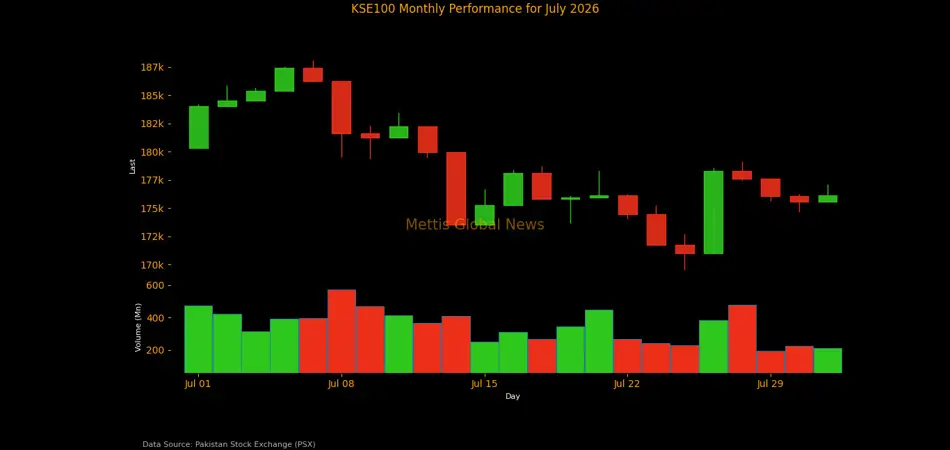
August 03, 2026 (MLN): The KSE-100 Index closed out July 2026 on a weak note, as geopolitical tensions kept investors on the back foot for most of the month.
The benchmark index opened the month around the 180,302 mark, its June 2026 close, and steadily eroded through the four weeks to settle at 176,094 points, shedding 4,208 points, or 2.3%, on a month-on-month basis.
This marked a reversal from the strong upward momentum the index had built over the preceding months, as risk sentiment turned cautious amid rising regional tensions that overshadowed otherwise improving macroeconomic fundamentals.
Despite the monthly pullback, the index's longer-term trajectory remains firmly positive. On a year-on-year basis, the KSE-100 is still up a robust 26.3%, having climbed from 139,390 points in July 2025 to 176,094 points in July 2026, a gain of nearly 36,704 points over the twelve-month period.
This indicates that July's decline was more a bout of near-term risk-off positioning than a break in the market's underlying structural uptrend, which has been underpinned by falling inflation, a stable monetary policy stance, and improving external account metrics over the past year.
_20260803052434686_2fbd5d.jpeg)
Market Capitalisation
The KSE-100's market capitalisation contracted in tandem
with the index, falling to PKR 5.003 trillion at the end of July 2026 from PKR
5.157 trillion in June 2026, a month-on-month decline of roughly PKR 153.5
billion, or 2.98%. This mirrors the index's points-based retreat and reflects
broad-based erosion in scrip valuations during the month rather than any
single-name-driven distortion.
On a year-on-year basis, however, market capitalisation
remains sharply higher. Against PKR 4.169 trillion recorded in July 2025, the
July 2026 market cap of PKR 5.003 trillion represents an increase of roughly
PKR 834.3 billion, translating into 20.0% YoY growth, a reflection of the
sustained re-rating the market has undergone over the past year even after
accounting for July's dip.
In US dollar terms, the KSE-100's market capitalisation
stood at approximately $18.01 billion as of July 2026, down from $18.54 billion
in June 2026, a month-on-month decline of about $528.8 million, or 2.85%.
The dollar-denominated decline closely tracks the
PKR-denominated one, indicating that currency movement played only a marginal
role in the month's cap erosion, with the PKR actually appreciating slightly
against the dollar during July (from 278.16 to 277.80).
Compared to July 2025, when dollar-denominated market
capitalisation stood at roughly $14.74 billion, the current $18.01 billion
level represents a year-on-year increase of approximately $3.27 billion, or
22.2%, again illustrating that the twelve-month uptrend has comfortably
absorbed the one-month setback.
_20260803052415001_adcd8f.jpeg)
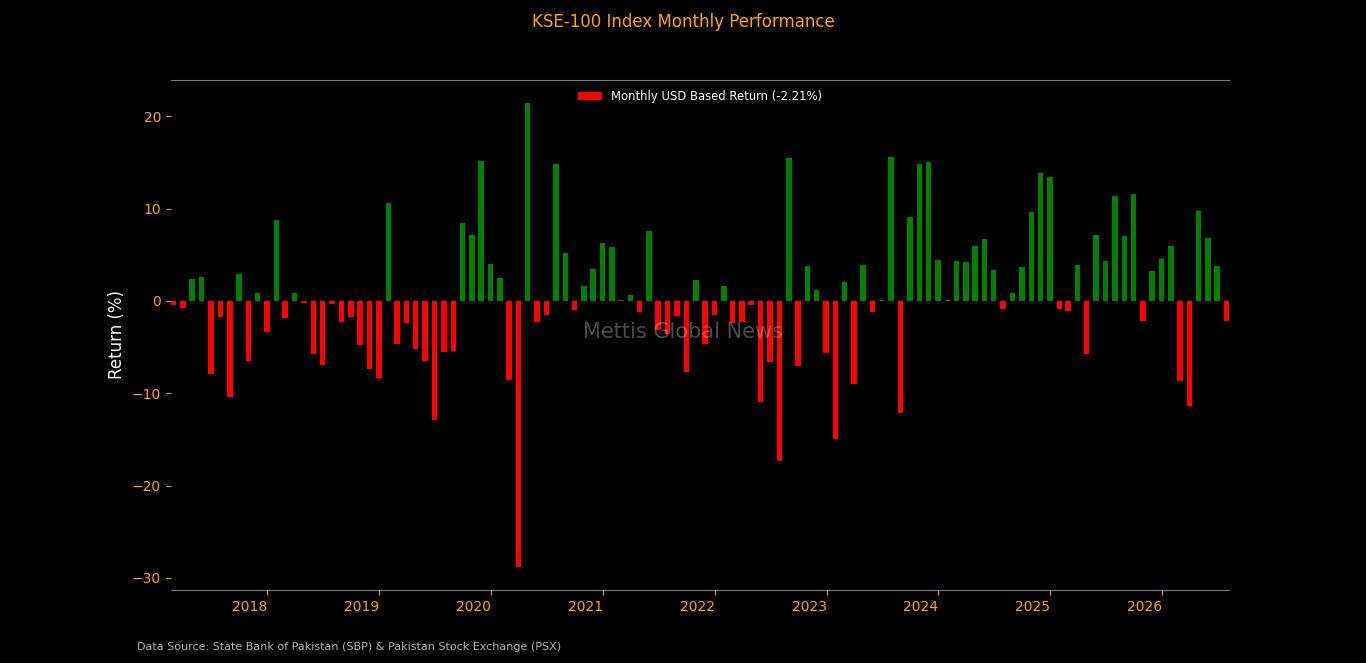
Adjusting for currency movement, the KSE-100 delivered a dollar-denominated return of -2.21% in July 2026, almost identical to the PKR-based return of -2.3%, since the rupee held broadly steady over the month, appreciating only marginally from PKR 278.16/USD to PKR 277.80/USD.
In other words, currency stability meant dollar-based investors experienced a decline of a similar magnitude to local-currency investors, with almost no additional cushioning or drag from exchange-rate movement.
On a year-on-year basis, the picture is considerably more favourable. The dollar-denominated KSE-100 return over the twelve months to July 2026 works out to approximately 28.6%, moderately outpacing the local-currency return of 26.3%. This gap reflects the rupee's appreciation over the trailing year, from around PKR 282.87/USD in July 2025 to PKR 277.80/USD in July 2026, a currency tailwind that added further to dollar-based returns on top of the index's own gain.
Economic Backdrop
July's index performance has to be read against a mixed economic backdrop, one where several structural positives were ultimately outweighed by geopolitical risk aversion. On the inflation front, CPI for June 2026 eased to 11.1% YoY from 11.7% in May'26, continuing the disinflation trend that has supported the case for monetary easing over recent quarters.
Meanwhile, the Monetary Policy Committee chose to hold the policy rate unchanged at 11.5% at its 27th July 2026 meeting, a unanimous decision that signalled a cautious, wait-and-watch stance.
The month's standout positive was S&P Global Ratings' upgrade of Pakistan's long-term sovereign credit rating to 'B' from 'B-', with a stable outlook, citing stronger institutional capacity, continued IMF-backed reform implementation, improved fiscal performance, and a meaningful buildup in foreign exchange reserves.
In an ordinary month, this would typically be expected to catalyse a rally, particularly in banking and other rate-sensitive names, but the upgrade's impact appears to have been overshadowed by the prevailing geopolitical unease that dominated investor psychology through July.
External account dynamics presented a more nuanced picture. Pakistan's current account balance posted a deficit of $139 million in FY26 (Jul-Jun), against a surplus of $1.84bn in FY25, the latest data issued by the State Bank of Pakistan (SBP) revealed today.
During June alone, the current account balance stood at a deficit of $649m, compared to a surplus of $220m in June last year, while in May 2026, the current account had posted a surplus of $500m.
Total inflows into Roshan Digital Accounts (RDA) during June, 2026 stood at $306 million, bringing the total cumulative inflows into RDA to $13,365 million.
Compared to the previous month's inflow of $312.0, June showed an decrease of $6 million.
On the real economy side, large-scale manufacturing output fell 1.0% YoY in May 2026 even as it rose 1.2% MoM, leaving the cumulative 11MFY26 LSMI figure up a healthier 5.8% YoY, suggesting the industrial recovery remains intact on a broader time horizon even if monthly readings are choppy.
Energy policy also featured prominently in the month's newsflow, with the government approving amendments to the Oil Refining Policy 2023, offering a seven-year incentive package aimed at attracting roughly USD 6 billion in investment and accelerating Euro-V refinery upgrades.
This development is clearly constructive for the energy sector given refineries' high fuel oil yield against a backdrop of declining FO demand, and this is visible in the Refinery sector's positive contribution to the index during the month.
Sector and Scrip-wise Movers
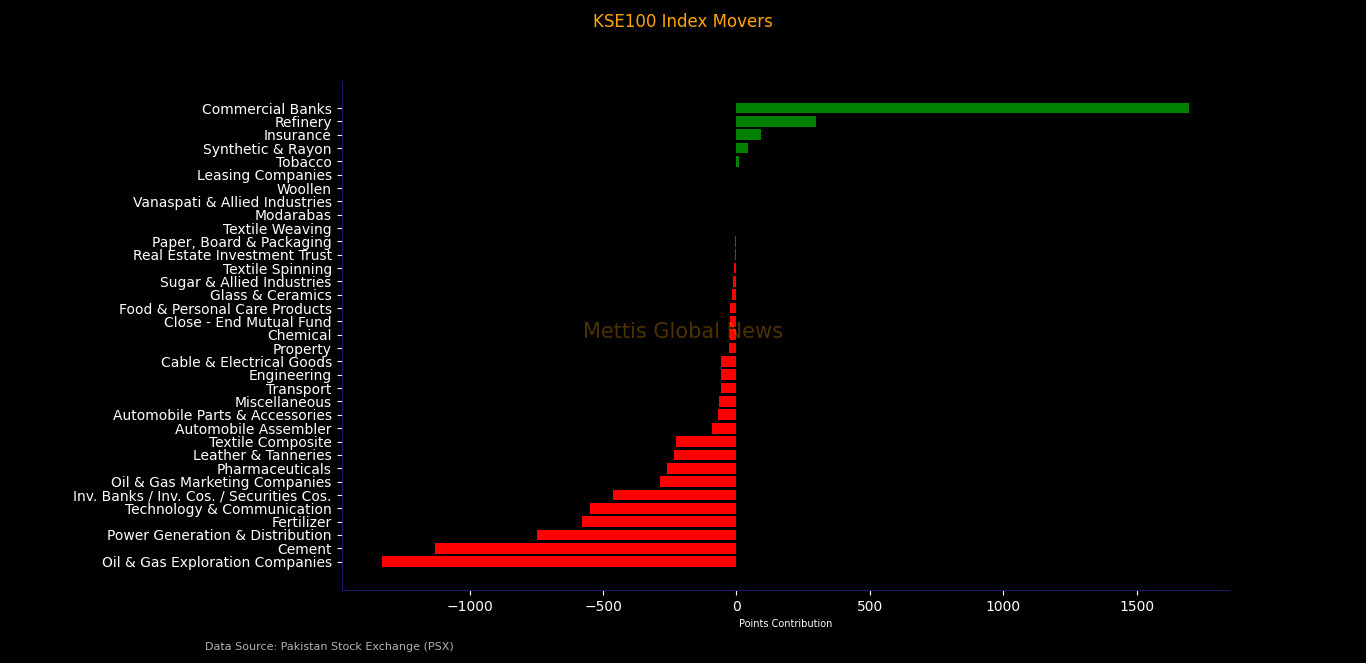
Sectoral performance was overwhelmingly negative in July 2026, with only a handful of sectors managing to add points to the index. Commercial Banks stood out as the sole heavyweight positive contributor, adding 1,696.79 points and comfortably offsetting losses elsewhere, followed at a distance by Refinery, which contributed 299.35 points on the back of the refining policy amendments discussed above.
Insurance added a modest 90.92 points, while Synthetic & Rayon, Tobacco, Leasing Companies, and Woollen rounded out the positive contributors with small single-digit additions.
On the losing side, Oil & Gas Exploration Companies was the single largest drag, shaving off 1,329.04 points, followed closely by Cement at 1,131.41 points and Power Generation & Distribution at 748.61 points.
Fertilizer subtracted 577.46 points, Technology & Communication 548.89 points, and Investment Banks/Investment Companies/Securities Companies 463.97 points. Oil & Gas Marketing Companies, Pharmaceuticals, Leather & Tanneries, and Textile Composite each detracted between roughly 226 and 287 points, with smaller negative contributions spread across Automobile Assembler, Transport, Cable & Electrical Goods, Engineering, and several other sectors.
At the individual scrip level, the rally in banking names was led decisively by UBL, which alone contributed 783.19 points, followed by Meezan Bank at 700.91 points and HBL at 234.63 points, together these three banks accounted for the overwhelming majority of the sector's, and indeed the market's, positive contribution.
Attock Refinery added 175.65 points, Pakistan Telecommunication Company 134.75 points, and Cnergyico 123.70 points, while Ghandhara Nissan, Adamjee Insurance, Bank Alfalah, and MCB Bank rounded out the list of double-digit positive contributors.
On the downside, Pakistan Petroleum led the single-stock declines, subtracting 619.21 points, followed by Hub Power at 556.25 points, Systems Limited at 543.65 points, Oil & Gas Development Company at 470.95 points, and Engro Holdings at 441.91 points.
Lucky Cement was not far behind at 440.40 points, with Mari Petroleum, Service Industries, Engro Fertilizers, and Fauji Fertilizer each shedding between roughly 222 and 235 points.
A broad swathe of cement names, Maple Leaf, Kohat, Cherat, Fauji Cement, D.G. Khan Cement, along with K-Electric, Sui Northern Gas, and technology names such as Airlink and K-Tech Mills, each contributed meaningfully to the month's negative tally, reinforcing that the sell-off was broad-based rather than confined to one or two sectors.
_20260803052348786_7c7169.jpeg)
Foreign and Local Investor Flows
Foreign investors turned net buyers of Pakistani equities in July'26, with total FIPI equity inflows of USD 34.38 million, taking the grand total including debt to USD 34.42 million.
Foreign corporates were the standout buyers, pouring in USD 23.75 million, with overseas Pakistanis adding a further USD 10.64 million; foreign individual investors were roughly flat, net selling a negligible USD 19,503. On the debt side, overseas Pakistani investors added a modest USD 40,079, rounding out the foreign flow picture.
Local investors were net sellers of equities to almost exactly the same extent that foreigners bought, with LIPI equity outflows totalling USD 34.38 million, a near-perfect mirror image of the foreign inflow, reflecting local investors absorbing the geopolitical uncertainty by rotating out even as foreign capital rotated in.
Mutual funds were by far the largest local sellers, offloading USD 30.30 million of equities, followed by companies at USD 13.95 million and other organisations at USD 5.64 million; broker proprietary books trimmed USD 5.59 million, insurance companies USD 2.51 million, and banks/DFIs USD 1.39 million.
Bucking the selling trend, individual investors were significant net buyers, adding USD 23.73 million, with NBFCs contributing a smaller USD 1.26 million of buying.
In the debt segment, local flows told a different story: mutual funds added a substantial USD 52.65 million, while banks and DFIs pulled out a sizeable USD 58.55 million, making them the dominant net sellers of debt for the month. Insurance companies and other organisations added USD 4.16 million and USD 2.24 million respectively, while companies, NBFCs, and individuals recorded small net outflows.
On a combined equity-and-debt basis, local investors were net sellers of roughly USD 34.42 million, almost exactly offsetting the foreign inflow of the same magnitude, underlining that July's market action was, at its core, a story of foreign capital stepping in to absorb local profit-taking and de-risking amid the month's heightened geopolitical backdrop.
_20260803052357424_13102b.jpeg)
Copyright Mettis Link News
Related News

_20261009161631180_9d2ce0.jpeg?width=280&height=140&format=Webp)
_20260518072716198_9300ef.jpeg?width=280&height=140&format=Webp)
| Name | Price/Vol | %Chg/NChg |
|---|---|---|
| KSE100 | 167,089.28 109.91M | -0.21% -352.63 |
| ALLSHR | 101,117.40 308.32M | -0.15% -155.10 |
| KSE30 | 49,841.71 50.59M | -0.28% -142.15 |
| KMI30 | 240,372.43 78.75M | -0.02% -45.72 |
| KMIALLSHR | 65,518.16 188.07M | -0.05% -35.70 |
| BKTi | 46,228.77 7.60M | -0.60% -281.04 |
| OGTi | 33,974.66 4.20M | -0.27% -91.31 |
| Symbol | Bid/Ask | High/Low |
|---|
| Name | Last | High/Low | Chg/%Chg |
|---|---|---|---|
| BITCOIN FUTURES | 83,505.00 | 84,320.00 82,645.00 | 1035.00 1.26% |
| BRENT CRUDE | 104.54 | 0.00 0.00 | -0.18 -0.17% |
| RICHARDS BAY COAL MONTHLY | 128.50 | 0.00 0.00 | 0.75 0.59% |
| ROTTERDAM COAL MONTHLY | 143.40 | 143.40 143.40 | -1.15 -0.80% |
| USD RBD PALM OLEIN | 1,167.50 | 1,167.50 1,167.50 | 0.00 0.00% |
| CRUDE OIL - WTI | 91.66 | 0.00 0.00 | -0.19 -0.21% |
| SUGAR #11 WORLD | 20.27 | 20.44 20.09 | 0.12 0.60% |
Chart of the Day
Latest News
Top 5 things to watch in this week
 PIB Auction
Pakistan Stock Movers
| Name | Last | Chg/%Chg |
|---|
| Name | Last | Chg/%Chg |
|---|