
No Easy Exit : A Refund is not an Exoneration
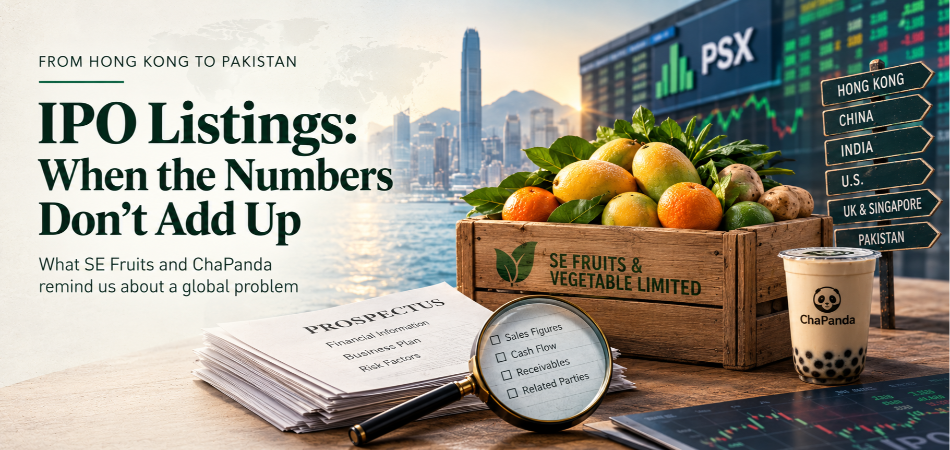
MG News | October 30, 2026 at 11:45 AM GMT+05:00

October 30, 2026 (MLN): On the night of
October 12, Hong Kong’s securities regulator did something remarkable. While
the city slept, the Securities and Futures Commission (SFC) served restriction
notices on 31 brokerages and froze nearly HK$4.7 billion in assets.
By the next
morning, trading in bubble-tea chain ChaPanda had been suspended. The SFC said
it had “serious concerns” that ChaPanda’s IPO, raised two and a half years
earlier, “may have been rigged’’. In plain terms, the regulator suspects the
listing was a performance staged for the public.
The story the
regulator tells is simple and unsettling. According to the SFC, the suspected
syndicates struck undisclosed agreements with companies preparing to list. Big
investors placed large orders; the book looked full; confidence spread;
ordinary investors followed, believing serious money had already judged the
company worthy.
Part of the IPO
proceeds was then diverted into so-called “financial products” and secretly
channelled back to those same major investors or their connected parties. In
effect, the company’s own IPO money was used to manufacture the demand that
drew the public in.
Hong Kong did
not wait for a trial to protect what was left. It froze the money first and
asked questions after. On the same day, it sent a circular
to every firm that sponsors or markets IPOs in the city. As law
firm Gibson Dunn summarises it, the circular tells them to look out for
sudden loans or payments to investors, buyers introduced by the company itself,
large orders that arrive just before the book closes, and accounts run by the
same person or sharing one address.
If a concern
cannot be resolved, the order must be rejected and reported to the SFC and the
stock exchange. Having put these expectations in writing, the regulator has
made one thing clear that no banker can now say they did not know.
Closer to home
Weeks earlier,
a different story was unfolding in Pakistan. SE Fruits and Vegetable Limited, a
Sargodha-based exporter of mangoes, citrus and potatoes, came to the market
seeking PKR 1.2 billion at its floor price and up to PKR 1.92 billion at the
top of its price band. The deal was run by two Consultants to the Issue (CTIs),
the licensed investment firms that prepare a prospectus and vouch for it
Topline Securities and Growth Securities.
SECP approved the prospectus on September 9. Later, it received an anonymous complaint questioning the company’s sales figures. Book building still opened ten days later and was fully subscribed within two hours. Two weeks after the public subscription closed, retail applicants told Mettis Global they had received neither shares nor refunds, and that calls to the lead manager went unanswered.
On October 13 the company announced it would
withdraw its IPO and refile with fuller disclosure. Three days later, SECP said
it had found “material discrepancies” in the prospectus. On October 22, PSX
confirmed that the entire subscription amount had been refunded. SECP, in its
latest statement said that it will examine the preparation and approval of the
prospectus, identify any lapses or negligence, and determine those responsible.
In fairness
SE Fruits
is not Hong Kong. We are aware of no allegation that its demand was faked, and
nothing has been proven against the company or anyone involved. The question
here is narrower but no less important: were the numbers investors were asked
to trust actually true?
We asked our own questions before the book opened. On September 19, after putting them to the company’s CFO, we reported that operating cash flow had shrunk to about 1.2% of reported profit in FY26, that receivables had climbed from PKR 212.6 million to PKR 995.9 million, and that one of the largest customers, at 13.2% of revenue, was Shaheen Enterprises, the company’s own predecessor partnership.
Similar questions had already been raised in
August, during the public-comment period, by a CFA charterholder, and the CTIs
answered every one. Both firms had also signed an undertaking to PSX stating,
“on solemn affirmation”, that all material information had been disclosed and
nothing concealed, as Mettis
Global reported on October 13, citing pages 101–102 of the prospectus.
The rulebook: how other countries treat it in law
Across the
world’s major markets, one principle holds firm. When an IPO misleads the
public, the company is not the only one held to account. The bank that carried
it to market is answerable too, and often so are the individual bankers who
signed.
What differs is
the weapon each country reaches for first. China fines and jails, Hong Kong
freezes and bans, India shuts the door, and the United States lets investors
sue.
Mainland China
China treats a
fraudulent IPO as a crime against the market, and it makes the sponsor bank and
its two signing bankers pay alongside the company.
|
|
The rule |
|
Regulator |
China Securities Regulatory Commission (CSRC) |
|
Who vouches for the
IPO |
The sponsor and two named sponsor representatives who sign
personally, as the S2C case shows |
|
Company penalty |
Fine of RMB 2–20 million if shares are not yet issued;
10%–100% of funds raised if issued; responsible persons fined RMB 1–10
million (Securities Law Art. 181) |
|
Bank penalty |
Business income confiscated plus a fine of 1–10 times that
income; sponsor permit suspended or revoked in serious cases (Art. 182) |
|
Individual bankers |
Warning and fine of RMB 0.5–5 million (Art. 182); up to 10 years in prison for
false certification, with sponsors now expressly covered (Criminal Law Art. 229, as amended) |
|
Company leaders |
Up to 15 years for fraudulent issuance (Criminal Law Art. 160; Amendment XI) |
|
Investor remedy |
Sponsors, underwriters and service firms jointly liable to
compensate investors unless they prove they were not at fault (Arts. 85, 163); regulator can order a buy-back of
shares (Art. 24) |
|
Market abuse |
Manipulation: gains confiscated plus a 1–10x fine, or RMB
1–10 million (Art. 192) |
In practice. Ping An Securities had RMB 25.55 million of income confiscated, was fined RMB 51.10 million and had its sponsor licence suspended for three months over Wanfu Biotechnology, according to a 2013 filing by its parent company. Xintai Electric became the first company delisted for IPO fraud, and its sponsor, Industrial Securities, said it would set up a RMB 550 million fund for investors, People’s Daily reported in 2016.
When chip designer S2C withdrew its IPO, the case did not end: CICC was fined RMB 6 million, had RMB 2 million of fees confiscated, and each of its two signing bankers was fined RMB 1.5 million, the South China Morning Post reported.
In December 2023 a Shanghai court
approved what Yicai
Global described as the securities industry’s first class-action settlement
in China, worth over RMB 280 million for 7,195 investors. And in October 2026,
Qingyue Technology’s sponsor, auditor and controlling shareholder set up a RMB
370 million compensation fund, according
to OLED-Info.
Hong Kong
Hong Kong’s
sponsor rules are among the most detailed anywhere, and its regulator can act
within hours.
|
|
The rule |
|
Regulator |
Securities and Futures Commission (SFC), with the Stock
Exchange of Hong Kong |
|
Who vouches for the
IPO |
The sponsor (Code of Conduct para. 17); the overall coordinator or lead
bookrunner (para. 21, in force since 5 August
2022) |
|
Banker’s duty |
Reasonable due diligence so the prospectus is accurate;
professional scepticism; reliance on experts does not dilute the duty; probe,
reject and report suspicious orders (SFC circular, Oct 2026; Gibson Dunn) |
|
Bank penalty |
Reprimand, licence suspension or revocation, and a fine of
up to the greater of HK$10 million or three times the profit gained or loss
avoided (SFO ss. 194, 196) |
|
Criminal: false
prospectus |
Up to HK$700,000 and 3 years (CWUMPO s. 40A); the SFC regards sponsors as
persons who “authorise the issue”, though this has not been tested in court |
|
Criminal: market
misconduct |
False or misleading information, fraudulent devices: up to
HK$10 million and 10 years (SFO ss. 298, 300, 303) |
|
Investor remedy |
Civil compensation (CWUMPO s. 40; SFO s. 108); court restitution orders on SFC
application (SFO s. 213) |
In practice. In March 2019 the SFC fined UBS HK$375 million and banned it from sponsoring IPOs for a year, and fined Morgan Stanley HK$224 million, Merrill Lynch HK$128 million and Standard Chartered HK$59.7 million, Bloomberg reported. A UBS managing director’s licence was suspended for two years, according to the South China Morning Post.
In the China Forestry IPO, the sponsors
had not adequately verified that the company owned the forests behind its
valuation, Euromoney
reported. In 2012 a court ordered Hontex to offer HK$1.03 billion to about
7,700 shareholders after it admitted its IPO prospectus was materially false, according
to Hogan Lovells. And in October 2026 the SFC froze HK$4.66 billion linked
to two suspected IPO-rigging syndicates, the
South China Morning Post reported.
India
India’s market
regulator moves to stop a banker taking new business while the facts are
established.
|
|
The rule |
|
Regulator |
Securities and Exchange Board of India (SEBI) |
|
Who vouches for the
IPO |
The lead merchant banker, who must file a due-diligence
certificate on the prospectus and follow a statutory code of conduct (Merchant Bankers Regulations, regs. 13, 23) |
|
Criminal: false
prospectus |
Anyone who authorises a misleading prospectus is liable for
fraud: 6 months to 10 years, at least 3 years where public interest is
involved, and a fine from the amount involved up to three times it (Companies Act 2013, ss. 34 and 447) |
|
Regulatory penalty |
Fraudulent and unfair trade practices: ₹5 lakh up to ₹25
crore or three times the profit, whichever is higher (SEBI Act s. 15HA) |
|
Interim powers |
Bar from new mandates, registration suspension, market bans
(SEBI Act ss. 11, 11B, 12(3)) |
In practice. In May 2025, a SEBI interim order barred First Overseas Capital from taking new assignments after a preliminary finding that about 54% of Synoptics Technologies’ IPO money (₹19 crore) had been siphoned off, allegedly at the banker’s direction, Business Standard reported. SEBI also began examining 20 other IPOs the firm had handled.
In a separate matter, a final order in October 2025 imposed a two-year
market bar and a ₹20 lakh fine on the same firm, according
to Fox Mandal. Days after Synoptics, SEBI barred Inventure Merchant Banking
over Varyaa Creations, where its investigation found that more than 71% of IPO
proceeds had been moved to third parties on the lead manager’s instruction, Business
Standard reported.
United States
America puts
the burden on the underwriter: it pays unless it proves it did its homework.
|
|
The rule |
|
Regulator |
Securities and Exchange Commission (SEC); FINRA; Department
of Justice for crimes |
|
Who vouches for the
IPO |
Every underwriter is liable for material misstatements in
the registration statement (Securities Act 1933, s. 11(a)(5)) |
|
Banker’s defence |
Only if it proves a “reasonable investigation” and
reasonable grounds to believe the statements were true (s. 11(b)(3)) |
|
Criminal |
Wilful untrue statement in a registration statement: up to
5 years and a $10,000 fine (s. 24) |
|
Allocation abuse |
Underwriters may not induce aftermarket buying during an
offering (Regulation M, Rule 101) |
In practice. Credit Suisse First Boston paid $100 million in 2002 for allocating hot IPO shares to customers who kicked back 33–65% of their profits through inflated commissions, according to the SEC. Morgan Stanley and Goldman Sachs paid $40 million each in 2005 for tying IPO allocations to customers’ promises to buy more shares after listing, the SEC said, a close cousin of the allocation games now under scrutiny in Hong Kong.
Citigroup paid $2.65 billion in 2004 to settle claims by WorldCom investors, Accounting Today
reported, part of $6.1 billion eventually approved for investors, according
to the New York Sun. Since September 2025, an SEC
task force has targeted the underwriters and auditors of small foreign
IPOs.
United Kingdom and Singapore
Both treat a
misleading offer document as a civil wrong and a crime.
|
|
The rule |
|
UK: compensation |
Persons responsible for a prospectus must compensate
investors for untrue or misleading statements (FSMA 2000, s. 90) |
|
UK: crime |
Knowingly or recklessly making a misleading statement, or
creating a misleading impression, to induce investment: up to 7 years (Financial Services Act 2012, ss. 89,
90, 92) |
|
Singapore |
A false or misleading prospectus is an offence under the
Securities and Futures Act (s. 253) |
In practice.
In Singapore, Auston International pleaded guilty over an IPO prospectus that
overstated pre-tax profit by S$374,000, and a district court fined it S$90,000,
according
to the High Court’s 2007 judgment. It is a sign that even a modest
misstatement is prosecuted.
The message
everywhere is the same. A signature on a prospectus is a promise, and
promises have prices.
Pakistan’s paper shield
The
surprise is that Pakistan’s law is not weak. On paper, it is strong.
|
|
The rule in Pakistan |
|
Regulator |
Securities and Exchange Commission of Pakistan (SECP), with
PSX as front-line regulator |
|
Who vouches for the
IPO |
The Consultant to the Issue (CTI), who prepares the
prospectus (PO Regs 18(1)) and must, after “due and careful
enquiry”, have reasonable grounds to believe it is not false or misleading (Reg 19(1)(i)); and the Book Runner, who runs the
bidding (Reg 20) |
|
When the client won’t
answer |
The CTI must withdraw from the assignment (Reg 19(1)(x)) |
|
Criminal: false
prospectus |
An offence under Securities Act s. 92, punishable by up to 3 years or PKR 100 million, or both,
unless the statement was immaterial or reasonably believed to be true (s. 159(4)) |
|
Market abuse |
False trading, manipulation and fraud (ss. 132–136): up to 3 years or PKR 200 million for individuals and up
to PKR 300 million for companies (s. 159(2)), the same penalties SECP cited in its 2024 manipulation cases |
|
Bank penalty |
Licence suspension or cancellation, public reprimand, and a
penalty of up to PKR 50 million or the profit gained (s. 150); restriction on dealing with property (s. 144) |
|
Individuals |
Officers liable where a company’s offence involved their
consent, connivance or neglect (s. 166) |
|
Investor remedy |
Compensation from the issuer, its directors and anyone who
signed the prospectus (s. 93); damages for false filings and
market abuse (s. 157) |
|
Protecting the cash |
Book-building money is not released to the issuer until
shares are credited and trading begins (PO Regs 8(18)) |
A simple rule protected SE Fruits investors. Under Regulation 8(18) of SECP’s Public Offering Regulations, 2017, the money investors pay in an IPO through book building is not handed to the company until the shares are credited and trading begins on PSX.
The problems came to light before that point, so the money had not reached the company, and every rupee was returned. If the problems had surfaced six months after listing, investors would be in the same position as ChaPanda’s shareholders today: the money would already be with the company, and getting it back would be far harder.
No easy exit
That is why the
SE Fruits inquiry matters far beyond one company and one withdrawn offer.
Withdrawal must not become an escape hatch. Refunding the money is not the same
as answering the questions. And the right to come back with a fresh application
must not mean a fresh start with a clean slate.
There must be no easy exit
for anyone before this case is fully settled:
•
Not for the company, which
should not return to the market until every discrepancy is explained in public.
•
Not for the auditor, whose
figures the prospectus relied upon.
•
Not for the CTIs, who
stated “on solemn affirmation” that nothing had been concealed, and whose fees
rested on that promise.
•
Not for the regulators, PSX and
SECP alike, whose own processes are now part of the inquiry.
Finally, SECP
has promised to make its findings public. It should publish them in full, name
the firms and individuals responsible, and, where wrongdoing is established,
apply the penalties the law already provides. Those penalties must be used, and
seen to be used, so that the next company and the next adviser understand that
a mismatch in the numbers will not be quietly settled with a refund.
But punishment
after the fact is not enough. Scrutiny must begin at the first step, not after
the money is collected. Public comments and complaints should be answered in
full before a single bid is taken, and no IPO should open while serious
questions remain unanswered.
An IPO is not a
private deal. It is an invitation to the public to trust a company with its
savings. Each time that trust is broken, the cost falls not on one company but
on the whole market. Investors who have been let down once are slow to return,
and every honest company that comes after them pays the price.
Trust, once
lost, does not come back easily, and that is why there must be no easy exit.
Hong Kong froze the money first and asked questions after. Pakistan was luckier: the money never left. But luck is not a regulatory system. Next time the cash may already be gone, and the only protection then will be a market where everyone knows there is no easy way out.
Related News


| Name | Price/Vol | %Chg/NChg |
|---|---|---|
| KSE100 | 167,128.22 140.17M | -0.04% -65.22 |
| ALLSHR | 101,105.62 480.64M | -0.06% -59.33 |
| KSE30 | 49,260.55 34.26M | -0.12% -60.13 |
| KMI30 | 239,165.76 31.69M | 0.09% 207.60 |
| KMIALLSHR | 65,294.51 189.76M | -0.06% -41.55 |
| BKTi | 46,115.27 6.28M | -0.37% -169.28 |
| OGTi | 33,810.60 2.90M | 0.11% 37.54 |
| Symbol | Bid/Ask | High/Low |
|---|
| Name | Last | High/Low | Chg/%Chg |
|---|---|---|---|
| BITCOIN FUTURES | 78,540.00 | 79,875.00 76,260.00 | -2205.00 -2.73% |
| BRENT CRUDE | 111.95 | 114.07 111.03 | -2.93 -2.55% |
| RICHARDS BAY COAL MONTHLY | 128.50 | 0.00 0.00 | -1.55 -1.19% |
| ROTTERDAM COAL MONTHLY | 145.70 | 145.70 145.60 | -0.15 -0.10% |
| USD RBD PALM OLEIN | 1,182.50 | 1,182.50 1,182.50 | 0.00 0.00% |
| CRUDE OIL - WTI | 102.87 | 104.99 102.43 | 0.87 0.85% |
| SUGAR #11 WORLD | 19.52 | 19.80 19.34 | 0.18 0.93% |
Chart of the Day
Latest News
Top 5 things to watch in this week
 MTB Auction
Pakistan Stock Movers
| Name | Last | Chg/%Chg |
|---|
| Name | Last | Chg/%Chg |
|---|