
US-Iran peace could be Pakistan's $20bn moment
MG News | June 04, 2026 at 03:10 PM GMT+05:00

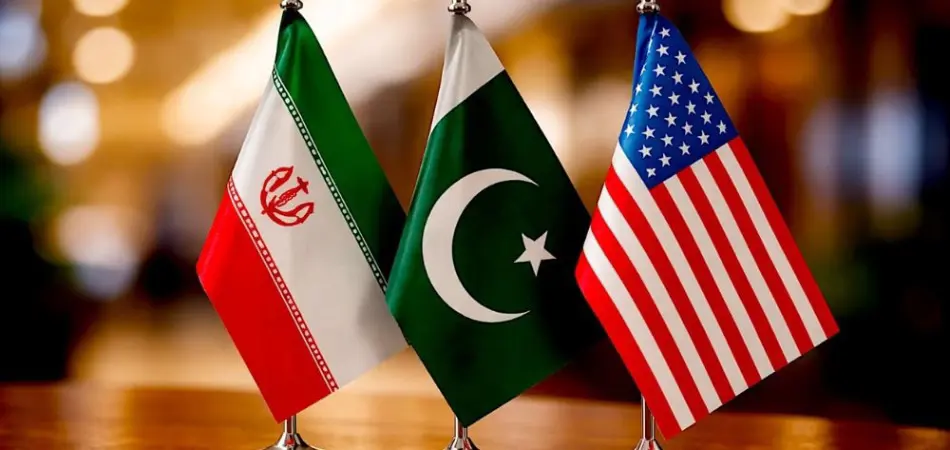
June 04, 2026 (MLN): A resolution of the US-Iran conflict could unlock a near-term economic opportunity worth up to $20bn for Pakistan.
This positions the country as one of the largest relative beneficiaries among emerging markets if a phased settlement is signed and the Strait of Hormuz reopens to commercial traffic.
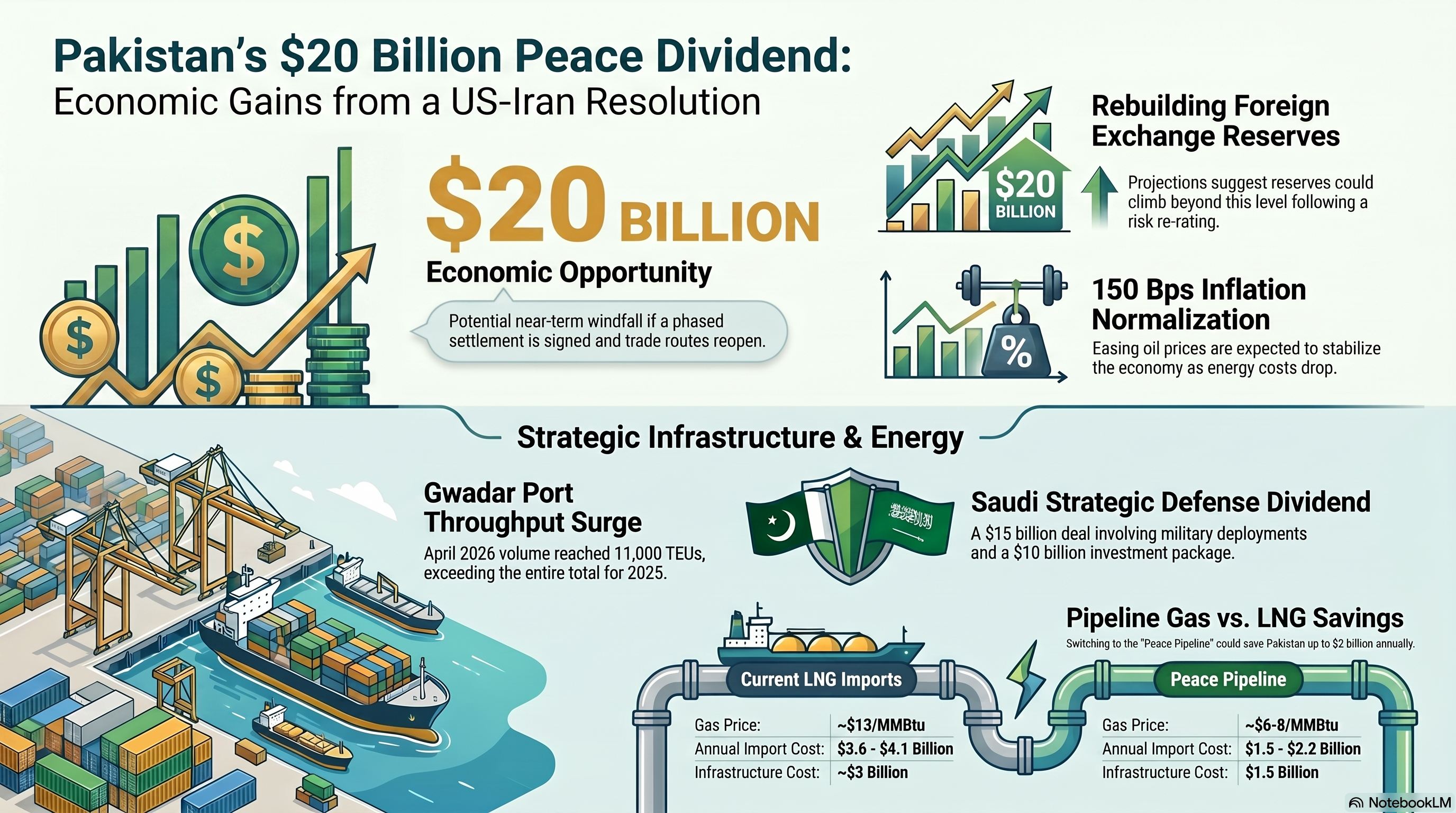
The opportunity spans six measurable channels: a 75-150 basis points country risk re-rating, foreign exchange reserves rebuilding beyond $20bn, approximately $4bn in GCC export recovery.
Furthermore, inflation normalisation of 125-150 bps as oil prices ease, a
current account swing to surplus of $3.75-5bn annually, and the restoration of
Saudi Vision 2030 labour demand for 700,000-800,000 Pakistani workers each
year.
According to a
research report by KTrade Securities, Pakistan finds itself at a rare
geopolitical inflection point as the sole credible intermediary in Iran-US
negotiations, with the potential to transform a costly regional crisis into a
strategic and economic windfall.
The report maps
out how the conflict has already inflicted measurable damage on the Pakistani
economy before tracing the full scope of recovery and structural gains that a
peace deal could set in motion.
The Hormuz closure cost Pakistan an estimated $10-14bn, equivalent to 2-3% of GDP.
It
pushed CPI to 11.7% in May 2026, swung the current account into deficit, and
forced the State Bank of Pakistan to raise its policy rate by 100 basis points
in April 2026.
Even after a settlement, the report warns that the Strait remains a structural risk.
Existing bypass options the East-West Pipeline and the Habshan-Fujairah Pipeline carry a combined capacity of roughly 8.5 million barrels per day.
It is far short of the 20 million barrels that transit the
Strait daily, leaving global energy flows without a credible alternative if the
corridor closes again.
This gap has
elevated Gwadar's strategic profile considerably. Located outside the Hormuz
chokepoint, the port remains accessible even during naval blockades or
sustained maritime disruption.
Container
throughput at Gwadar surged to 11,000 TEUs in April 2026 alone, exceeding the
full-year 2025 total of 8,300 TEUs.
The report
estimates that sustained volumes at April 2026 levels could generate $50-80
million annually in port handling fees, supplemented by transit dues,
transshipment charges, and Special Economic Zone revenues.
Saudi Arabia,
having watched its onshore storage fill rapidly during the closure, is now
planning new oil storage facilities at Gwadar and transferred $2bn to Pakistan
in April 2026 with a further $3bn pledged a direct financial acknowledgment
that Gwadar's operational readiness serves Gulf interests.
Pakistan-Iran
bilateral trade is a second major opportunity. Trade between the two countries
peaked at $1.32bn in 2008-09 before international sanctions on Tehran caused a
sharp decline.
A sanctions-free corridor would revive flows across several categories.
The report values the
near-term trade potential with Iran at $2bn, with additional upside from
Pakistan's cement sector supplying reconstruction material, given that an
estimated 42,000-45,000 civilian structures were damaged or destroyed in the
joint US-Israeli military campaign.
Historical
export and import flows between the two countries are captured in the table
below.
Pakistan-Iran
Trade: Key Commodity Flows
|
Potential
Pakistan Exports to Iran |
Potential
Iran Exports to Pakistan |
|
Rice and Meat |
Organic
Chemicals |
|
Construction
Material (Cement etc.) |
Plastics and
Plastic Articles |
|
Textiles and
Fabric |
Petroleum and
Oil Products |
|
Fruits
(Mangoes, Oranges), Sesame Seeds and Chickpeas |
Iron and steel |
|
Surgical and
Medical Goods |
Cheap Energy
Supply |
The Iran-Pakistan gas pipeline commonly known as the Peace Pipeline represents a third structural gain.
The pipeline is
designed to deliver up to 750 million cubic feet of natural gas per day from
Iran's South Pars field.
Pakistan currently imports 863-914 MMcfd of LNG from Qatar at approximately $13 per MMBtu.
Pipeline gas from Iran is estimated at $6-8 per MMBtu, yielding an estimated annual saving of $1.5-2.0bn.
The Iranian section spanning 1,100km was
completed in 2013.
Pakistan's 780km section from the Iranian border to Nawab Shah remains largely unbuilt, primarily due to US sanctions.
The current construction status of the pipeline
is detailed in the table below.
Iran-Pakistan
Gas Pipeline: Construction Status
|
Section |
Length |
Status |
|
Within Iran |
1,100 km |
Completed
(2013) |
|
Pak-Border to
Gwadar (Phase 1) |
80 km |
In Progress |
|
Gwadar to
Balochistan Interior |
585 km |
Not Built |
|
Balochistan to
Nawab Shah |
115 km |
Not Built |
|
Total |
1,880 km |
~58% Complete |
At equivalent
import volumes and a conservative gas price midpoint of $7 per MMBtu versus $13
per MMBtu for LNG, Pakistan would pay roughly $2.2bn per year through the
pipeline compared to $3.6-4.1bn at current LNG rates, as the comparison below
illustrates.
LNG vs
Iran-Pakistan Pipeline: Cost Comparison
|
Current
LNG Imports |
Iran-Pakistan
Pipeline |
|
|
Volume (MMcfd) |
~900 |
~750 |
|
Gas Price
(US$/MMBtu) |
~13 |
~6-8
(estimated) |
|
Annual Import
Cost (US$ bn) |
~3.6-4.1 |
1.5-2.2 |
|
Infrastructure
Cost (US$ bn) |
~3 |
1.5 |
The Pakistan-Saudi Arabia Strategic Mutual Defense Agreement, formally signed on September 17, 2025 at the Al Yamamah Palace in Riyadh by Prime Minister Shehbaz Sharif and Crown Prince Mohammed bin Salman, adds a $15bn near-term line item to the peace dividend.
This makes it the single largest component.
The agreement
commits Pakistan to deploying 25,000 troops structured across four army
brigades, two air force squadrons and two naval fleets to Saudi soil.
In exchange, the
deal is anchored by a $10bn Saudi investment package targeting Pakistan's
infrastructure, energy, mining and domestic defense production sectors, with
the bilateral trade target to be tripled from $5bn to $15bn annually.
The core terms
of the agreement are summarized below.
Pakistan-Saudi
Arabia Strategic Mutual Defense Agreement: Key Terms
|
Aspect |
Detail |
|
Saudi
Investment Package |
$10bn across
infrastructure, energy, mining, and defense sectors |
|
Bilateral
Trade Target |
Tripled from
$5bn to $15bn annually |
|
Pakistan's
Military Commitment |
25,000 troops:
4 army brigades, 2 air force squadrons, 2 naval fleets |
|
Previous Saudi
Support |
$3bn loan
renewed December 2024; $1.5bn (2014) and $4.2bn (2018) bailout packages |
CPEC extends the
opportunity further north and west. With planned investment growing from $46bn
at its 2015 launch to $62bn through FY2030, the corridor's road and rail
infrastructure can give Iran immediate access to Chinese markets.
Iran has expressed readiness to formally join CPEC, which would create a southeastern transport corridor diversifying China’s route to West Asia and Europe, and over the longer term connect Gwadar to Russia and Northern Europe via the International North-South Transport Corridor.
Pakistan's total trade with
Central Asia currently stands at only $429 million, showcasing the scale of
untapped potential.
Pakistan's
mediation role has also elevated its standing with the European Union. At the
8th Pakistan-EU Strategic Dialogue, the EU explicitly acknowledged Pakistan's
constructive facilitation role in brokering a ceasefire.
The report notes this diplomatic capital can be translated into trade concessions under the GSP+ framework and accelerated bilateral investment discussions.
Pakistan's exports
to the EU stood at $8.8bn in FY25, with a GSP+ preference utilization rate of
87.9%. The 9th dialogue session is scheduled for Brussels in 2027.
On markets, the
KSE-100 Index retains meaningful re-rating headroom, sitting 12% below its
January 2026 peak.
A Brent
reversion from approximately $100 per barrel to $80 per barrel would normalize
headline CPI, potentially returning it to the 5-7% target band by Q4 2026 and
enabling a resumption of the rate-cut cycle.
If Pakistan can
match its geographic advantage with competitive port charges, efficient customs
clearance and reliable security guarantees, the structural gains unlocked by
the peace deal could prove durable well beyond the immediate recovery window.
Copyright Mettis Link News
Related News
_20260421112347985_f8783f.jpeg?width=280&height=140&format=Webp)

| Name | Price/Vol | %Chg/NChg |
|---|---|---|
| KSE100 | 165,124.41 104.27M | -1.18% -1964.87 |
| ALLSHR | 100,157.69 359.84M | -0.95% -959.71 |
| KSE30 | 49,004.16 46.99M | -1.68% -837.55 |
| KMI30 | 237,813.98 72.72M | -1.06% -2558.45 |
| KMIALLSHR | 64,882.76 191.40M | -0.97% -635.41 |
| BKTi | 45,521.99 13.55M | -1.53% -706.78 |
| OGTi | 33,558.03 3.78M | -1.23% -416.63 |
| Symbol | Bid/Ask | High/Low |
|---|
| Name | Last | High/Low | Chg/%Chg |
|---|---|---|---|
| BITCOIN FUTURES | 83,765.00 | 84,320.00 82,645.00 | 1295.00 1.57% |
| BRENT CRUDE | 105.33 | 105.43 104.70 | 0.61 0.58% |
| RICHARDS BAY COAL MONTHLY | 128.50 | 0.00 0.00 | 1.00 0.78% |
| ROTTERDAM COAL MONTHLY | 143.40 | 0.00 0.00 | -0.70 -0.49% |
| USD RBD PALM OLEIN | 1,167.50 | 1,167.50 1,167.50 | 0.00 0.00% |
| CRUDE OIL - WTI | 92.42 | 92.43 91.71 | 0.57 0.62% |
| SUGAR #11 WORLD | 20.27 | 20.44 20.09 | 0.12 0.60% |
Chart of the Day
Latest News
Top 5 things to watch in this week
Pakistan Stock Movers
| Name | Last | Chg/%Chg |
|---|
| Name | Last | Chg/%Chg |
|---|