
Pakistan ranks among world's top five digital services suppliers: World Bank
MG News | October 07, 2026 at 02:05 PM GMT+05:00

October 07, 2026 (MLN): Pakistan is emerging as a major
supplier of artificial intelligence services in the Middle East, North Africa,
Afghanistan and Pakistan (MENAAP) region, ranking among the top five global
providers across more than 2,700 skill areas, the World Bank said, while
warning that the country also accounts for nearly half of the region's extreme
poor.
According to the Middle East, North Africa, Afghanistan & Pakistan Economic Update, From Divide to Opportunity: AI, Jobs, and Growth, the World Bank's October report, Pakistan is positioning itself as a talent-led exporter of AI services.
It is backed by about 75,000
information technology graduates every year and record ICT services exports of
$4.6bn in FY26.
Pakistan shares its top-five ranking
on major online platforms with Egypt.
The country is also building a
domestic AI ecosystem and developing "small AI" solutions to deliver
digital services suited to local contexts and languages.
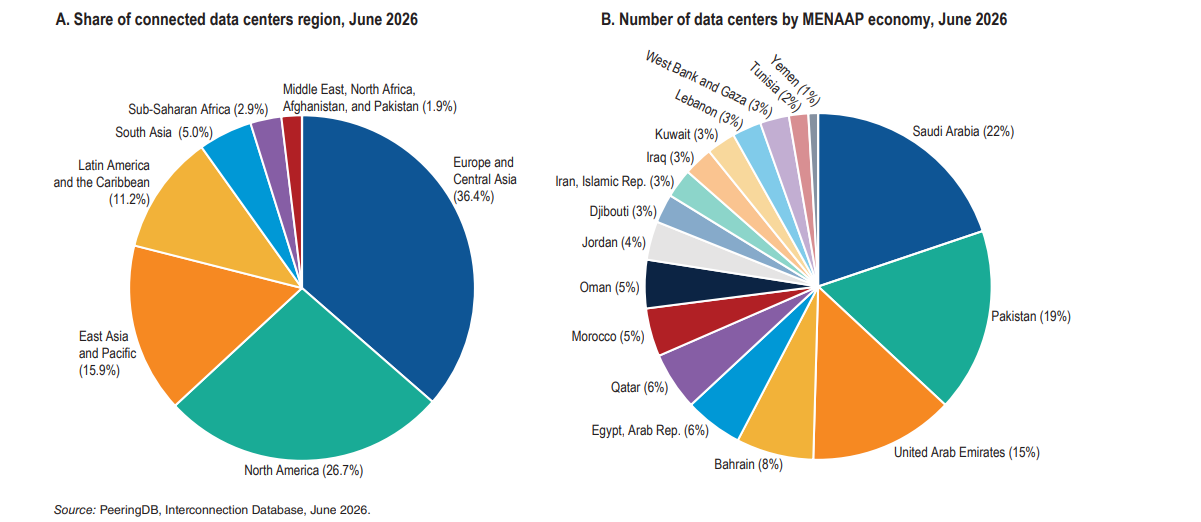
It is one of the region's biggest data-centre hosts, with the largest number of facilities in MENAAP alongside Saudi Arabia and the UAE, which anchor the region's data-centre capacity.
The report said Pakistan is pursuing
what it described as "AI sovereignty", meaning a home-grown ecosystem
in which AI serves national priorities.
A $1bn programme running through 2030
is meant to fund shared GPU infrastructure, a sovereign multilingual AI model,
1,000 AI PhD scholarships and training for one million non-IT professionals.
Pakistan has also set a target of
training 200,000 people in AI every year and offering 3,000 postgraduate
scholarships.
Pakistan is among 14 of the 21 MENAAP
economies to have published a national AI strategy.
The strategy marks agriculture as a
key area for AI use, including pesticide and fertiliser management, irrigation,
yield estimation, trade decisions and food security.
It also flags social risks such as
gender bias, the digital gender divide and the wage gap, along with data
privacy and regulatory gaps.
The World Bank said Pakistan performs
strongly on digital infrastructure compared with income peers but remains weak
on innovation and economic integration. Across the region, it said, economies
are entering the AI transition at very different speeds.
Saudi Arabia and the UAE rank among
the world's top 25 for both AI model development and high-performance
computing, whereas fragile economies still struggle with basic institutional
and infrastructure constraints. Middle-income countries, Pakistan included, sit
in between, with ambition and growing technical capacity but wide gaps in
implementation.
The region's largest readiness gap
lies in regulation and institutional capacity, where MENAAP economies lag
income peers on adaptable legal frameworks, enforcement and accountability.
Limited private-sector dynamism is
another obstacle. Only about 24% of firms in the region invest in physical
capital, against 37% in other emerging and developing economies, while just 19%
provide formal training, compared with 30% elsewhere. The World Bank said
private-sector reform would be a precondition for an effective AI-led growth
strategy.
For Pakistan's large services
workforce, which depends heavily on global freelance and outsourcing markets,
AI brings both opportunity and risk.
The report said Pakistan recorded the
highest absolute number of AI-related conversations in the region, though usage
is concentrated in graphic design, content creation and translation rather than
software development, possibly reflecting its large presence on international
freelance platforms.
Integration into global online markets
opens opportunities but leaves workers exposed to shifts in demand as AI starts
replacing some outsourced tasks.
Demand for digital and AI skills has
risen sharply, with Pakistan among the countries recording double-digit
percentage-point gains in the share of job postings requiring digital skills
between 2021 and 2025.
The World Bank said the scope for AI
to augment workers exceeds the immediate threat of automation across the
region.
Automation risk affects roughly 0% to
10% of jobs, with the smallest shares in Afghanistan and Pakistan, while 13% to
20% of jobs have potential for AI-driven augmentation.
Even so, Pakistan has relatively high
exposure among tertiary-educated workers, as graduates are concentrated in
cognitive occupations more open to AI. Women are less exposed overall because
they are disproportionately employed in crafts, elementary occupations and
skilled agricultural work.
Exposure is also concentrated in
government and public enterprises, where clerical, ICT and professional jobs
are heavily represented, and among self-employed workers and employers in
clerical, professional, ICT, business administration and managerial roles.
On poverty, the report said Pakistan
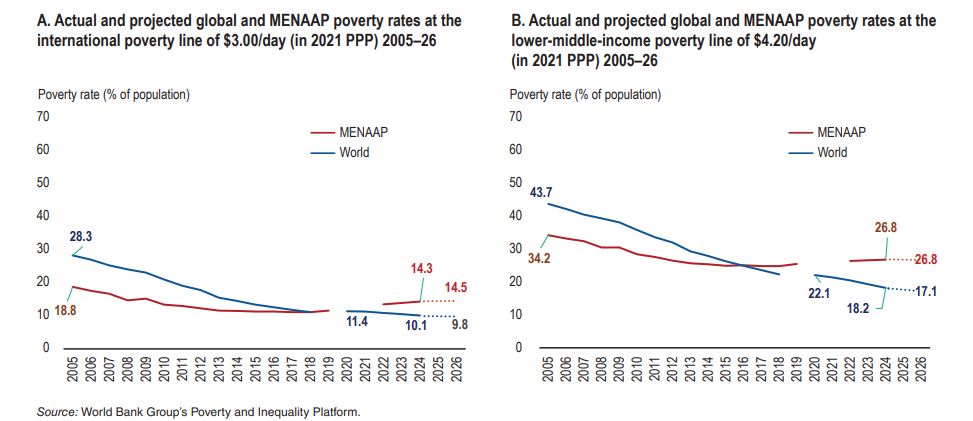
accounts for about 48% of people in MENAAP living below the $3-a-day line,
while Afghanistan, Syria and Yemen together account for another 47%.
Pakistan's poverty rate rose by 6.4
percentage points at the $3-a-day line and by 3.2 percentage points at the
$4.20-a-day line between FY19 and FY25, following the COVID-19 pandemic, the
devastating 2022 floods, a macroeconomic crisis marked by high inflation and
currency depreciation, and a prolonged adjustment that eroded real incomes and
jobs.
MENAAP is the only region where
poverty remains above pre-pandemic levels and is still rising. In 2024, 14.3%
of its population lived on less than $3 a day, against 10.4% globally, while
26.9% lived below $4.20 a day, compared with 18.9% worldwide.
The region now holds 14% of the world's extreme poor, second only to Sub-Saharan Africa. Significant shares of people in Afghanistan, Djibouti, Lebanon and Pakistan face crisis-or-worse food insecurity.
The World Bank said fuel price
increases have added to pressure on household incomes.
Gasoline prices have risen 40% or more
in Lebanon, Pakistan, Syria and the UAE since the start of the conflict, and
diesel prices have climbed over 40% in Pakistan and the West Bank and Gaza.
Higher fuel costs have contributed to
protests in some economies, including Pakistan. Pakistan has introduced
targeted fuel and farm support to cushion vulnerable households.
The country also remains exposed to
external shocks. Higher oil and commodity prices can stoke inflation, shrink
fiscal space and raise external financing costs, while a prolonged slowdown in
Gulf tourism, construction and related services could weaken remittances.
A stronger-than-usual El Niño forecast
for late 2026 could bring heat stress, erratic rainfall, drought, localised
flooding and crop losses, with changes in monsoon patterns a particular risk.
The report added that transport,
aviation, shipping, petrochemicals and much of industry still depend on
hydrocarbons, leaving oil-importing economies like Pakistan vulnerable to fresh
energy price shocks.
Despite these pressures, the World
Bank projects Pakistan's economy to grow 3.7% in FY26, up from 3.2% in FY25,
supported by resilience in services, manufacturing and livestock.
It said higher commodity and transport
costs would keep pressure on inflation and the external balance, though strong
domestic activity is expected to outweigh them.
Pakistan is also gradually expanding
into higher-technology manufacturing exports, following Tunisia and Morocco,
which lead the region at over 7% and 5% of manufacturing exports respectively,
and Egypt.
Financial markets have not priced in a
lasting deterioration in Pakistan's sovereign creditworthiness, the report
said. Sovereign bond spreads widened across most MENAAP economies in March
before narrowing, and by early September Pakistan's spreads stood below their
February 27 levels, among the largest declines in the region.
Pakistan's equity market fell sharply
in March before recovering to near January levels, suggesting domestic earnings
prospects continued to shape investor sentiment alongside the regional security
shock.
The World Bank said AI is moving
quickly from a frontier technology to a general-purpose tool affecting firms,
workers and governments.
For developing economies like
Pakistan, the key question is how fast it spreads, who can use it productively,
and whether it narrows or widens gaps in productivity and opportunity.
Pakistan's large digitally oriented
workforce, expanding data-centre base, growing online services exports and
government-backed $1bn AI programme place it among the economies seeking to
turn AI adoption into a broader source of growth, even as it grapples with gaps
in innovation, regulation and private-sector capacity.
Copyright Mettis Link News
Related News

| Name | Price/Vol | %Chg/NChg |
|---|---|---|
| KSE100 | 169,031.26 201.65M | 0.34% 571.15 |
| ALLSHR | 102,188.41 484.42M | 0.43% 436.98 |
| KSE30 | 50,542.45 107.68M | 0.39% 196.35 |
| KMI30 | 242,916.03 75.34M | 0.38% 914.06 |
| KMIALLSHR | 66,193.71 326.55M | 0.38% 251.97 |
| BKTi | 46,906.00 7.01M | 0.15% 72.26 |
| OGTi | 34,790.18 4.31M | 0.17% 57.96 |
| Symbol | Bid/Ask | High/Low |
|---|
| Name | Last | High/Low | Chg/%Chg |
|---|---|---|---|
| BITCOIN FUTURES | 83,940.00 | 85,855.00 83,720.00 | -1920.00 -2.24% |
| BRENT CRUDE | 101.44 | 102.06 100.76 | 0.86 0.86% |
| RICHARDS BAY COAL MONTHLY | 128.50 | 0.00 0.00 | 1.20 0.94% |
| ROTTERDAM COAL MONTHLY | 143.75 | 143.80 143.75 | -0.90 -0.62% |
| USD RBD PALM OLEIN | 1,167.50 | 1,167.50 1,167.50 | 0.00 0.00% |
| CRUDE OIL - WTI | 89.51 | 90.61 89.33 | 0.07 0.08% |
| SUGAR #11 WORLD | 20.91 | 21.24 20.72 | 0.09 0.43% |
Chart of the Day
Latest News
Top 5 things to watch in this week
 Central Government Debt
Pakistan Stock Movers
| Name | Last | Chg/%Chg |
|---|
| Name | Last | Chg/%Chg |
|---|