
FCC bars the door on port cess
MG News | November 23, 2026 at 11:46 AM GMT+05:00

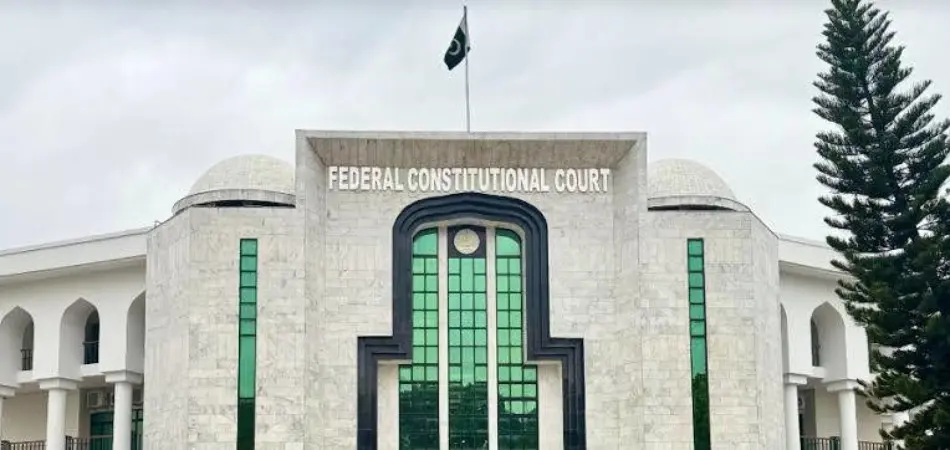
November 23, 2026 (MLN): Pakistan's Federal Constitutional Court (FCC) has struck down the infrastructure cess that Sindh and Khyber Pakhtunkhwa charge on goods entering or leaving the country. It held that a levy triggered by importation or exportation is, in substance, a customs impost. Under the Constitution, only Parliament can impose one.
The judgment in C.A. 80 of 2020 and connected matters was written
by Chief Justice Amin-ud-Din Khan, sitting with Justice Aamer Farooq. It was
announced in open court in Islamabad on 19 November 2026, after hearings on 10,
11 and 12 November.
It covers more than 400 appeals, petitions, transferred writ
petitions and applications. They came from the Peshawar High Court, the Sindh
High Court and the Balochistan High Court, and the transferred writ petitions
came from the Lahore High Court. Many of the appellants are among the largest
names on the Pakistan Stock Exchange.
What the court ordered
The court struck down the earlier KP charge under
Section 94 of the KPK Finance Act, 2013, along with the 2014 Collection of Cess
Rules, the Sindh charge under the Sindh Development and Maintenance of
Infrastructure Cess Act, 2017, and the import, export, and international or
interprovincial transit component under Section 3(1)(b) of the KP
Infrastructure Development Cess Act, 2022, as amended by the KPK Finance Act,
2024.
It barred enforcement of any demand, surcharge or
penalty based solely on these invalid charges and ordered the release of
securities furnished exclusively against them, subject to verification and any
subsisting order governing their disposal.
However, provinces remain free to introduce
constitutionally competent infrastructure or service charges on goods
manufactured and consumed within their respective territories. No costs were
awarded.
Why the Provinces lost
The judgment rests on Article 142 and Part I of the
Federal Legislative List. Entry 27 covers imports and exports across customs
frontiers and interprovincial trade, while Entry 43 covers duties of customs,
including export duties. The court acknowledged that the Eighteenth Amendment
expanded provincial legislative powers.
However, it held that subjects expressly retained in
the Federal Legislative List remained within the federal domain. Spending the
proceeds on a provincial purpose cannot confer legislative authority over a
subject falling within federal jurisdiction.
The court applied the pith-and-substance test,
drawing persuasive support from the Canadian Supreme Court's Canadian
Western Bank v. Alberta (2007) and relying on this Court's own Civil
Petition No. 315 of 2024. The decisive consideration was the event triggering
liability under the respective laws.
In Sindh, Section 3 of the 2017 Act imposes the levy
on owners of goods entering or leaving the province from or for places outside
Pakistan by air or sea.
The amount is determined based on customs-assessed
value, weight and distance. In KP, liability attaches to goods moving from or
for places outside Pakistan, with the levy calculated on their customs-assessed
value and collected through the customs clearance system.
The bench held that the goods attract the levy
"in their character as imports or exports", making the encroachment
on the federal legislative field substantive rather than incidental.
The court rejected the provinces' main defences one by one:
The road-use argument. The weight and distance elements in the
Sindh schedule affect the amount, not the taxable event. An ancillary distance
component cannot turn a largely ad valorem import levy into a general road-user
fee.
The fee argument. A fee must bear a real and reasonable
relationship to an identified service. A general list of roads, schools,
hospitals and parks does not establish one. Value-based pricing points the same
way, because high-value goods that cause little road wear pay more than heavy,
low-value cargo. Entry 54 does not let a province relabel a charge as a fee to
legislate in the federal field.
Article 163. It permits taxes on professions, trades and callings,
not a charge on individual consignments because they were imported or exported.
Collection by Customs. Entrustment under Article 147, which KP's
section 18 expressly invokes, concerns administration only. It cannot validate
a charge the Provincial Assembly had no power to impose. Federal participation
in the past does not stop the Federation or taxpayers from challenging the levy
now.
The octroi analogy. Municipal octroi applied to goods entering a
local area for consumption, use or sale, with transit treated separately. These
cesses have no such local condition.
Retrospective validation. Sindh's Act runs from 1 July 1994 and
contains validation and indemnity clauses (sections 13 and 14). The court held
that retrospectivity and clauses overriding judgments cannot cure an invasion
of the exclusive federal field.
NFC share and fiscal need. A province's share of federal revenue
does not give it the power to levy that tax itself, and "fiscal need
cannot supply the missing power."
On the 2022 KP law, the court acknowledged that the Act, unlike
the earlier schemes, also reaches domestic goods. After the 2024 amendment,
section 3(1) prescribes a 2% charge, with domestic goods in clause (a) and
imported, exported and transited goods in clause (b).
That wider reach did not save clause (b). Section 17 of the Act
describes the cess as compensation for road deterioration, but the court held
that the label cannot decide constitutional competence.
The court also found that Article 151, which protects freedom of
trade, is engaged by a charge imposed on entry, departure or transit itself. A
general infrastructure purpose does not satisfy the public-interest exception
in clause (4).
For the federal side, the Additional Attorney General and the FBR
supported the taxpayers. The bench stressed that this federal concurrence was
not decisive, because competence flows from the Constitution, not from
governmental agreement.
What the court did not decide
For investors and finance teams, the limits of the ruling matter
as much as its headline. Our reading of the judgment finds five points that
will shape how much value is actually released:
No automatic cash refund. The order stops future enforcement and
discharges securities. It does not direct the provinces to return cess already
paid. Paragraph 27 leaves individual disputes over payment, quantification and
refunds to "the appropriate administrative or judicial process."
Paragraph 24 states that pleas of finality, withdrawal, compromise or past and
closed transactions remain subject to the particular orders and parties
concerned.
KP's domestic limb survives for now. Section 3(1)(a) of the 2022
Act, covering domestic goods, "requires separate constitutional
analysis," including under Entry 49.
The court expressed no concluded opinion on purely
intra-provincial applications. It added that this neither validates them nor
permits recovery of the invalid charge "by mere re-labelling."
Former tribal areas. Arguments under the pre-merger Articles 246
and 247 were not finally decided, because legislative incompetence already
disposed of the charge.
Discrimination. A full ruling under Article 25 was found
unnecessary.
Punjab and Balochistan. Matters transferred from the Lahore High
Court and appeals from the Balochistan High Court were allowed with the rest.
However, the judgment's statutory analysis names only the KP and Sindh
enactments. Companies with Punjab or Balochistan exposure should check how the
relief applies to their specific charging provision.
Way forward
Three threads will decide how far this judgment travels. The first
is the provinces' response. The court explicitly allows a redesigned levy on
goods manufactured and consumed within a province, and Sindh and KP may
legislate quickly to protect revenue.
The second is how KP handles the surviving domestic limb, and any
challenge to it under Entry 49. The third is the refund litigation that will
follow, where the court's past-and-closed caveat gives provinces room to
resist.
Copyright Mettis Link News
Related News


| Name | Price/Vol | %Chg/NChg |
|---|---|---|
| KSE100 | 178,639.75 64.28M | 0.71% 1257.18 |
| ALLSHR | 106,818.69 303.79M | 0.50% 528.86 |
| KSE30 | 52,280.91 39.76M | 0.88% 458.51 |
| KMI30 | 258,613.50 44.46M | 1.09% 2790.22 |
| KMIALLSHR | 69,104.65 107.05M | 0.50% 344.91 |
| BKTi | 48,639.96 4.68M | 0.43% 207.43 |
| OGTi | 36,013.82 2.04M | 0.71% 254.32 |
| Symbol | Bid/Ask | High/Low |
|---|
| Name | Last | High/Low | Chg/%Chg |
|---|---|---|---|
| BITCOIN FUTURES | 61,370.00 | 61,850.00 55,150.00 | 3065.00 5.26% |
| BRENT CRUDE | 92.42 | 93.12 91.57 | -0.15 -0.16% |
| RICHARDS BAY COAL MONTHLY | 127.15 | 0.00 0.00 | 2.40 1.92% |
| ROTTERDAM COAL MONTHLY | 131.75 | 0.00 0.00 | -0.75 -0.57% |
| USD RBD PALM OLEIN | 1,182.50 | 1,182.50 1,182.50 | 0.00 0.00% |
| CRUDE OIL - WTI | 83.29 | 83.95 82.63 | -0.12 -0.14% |
| SUGAR #11 WORLD | 17.07 | 0.00 0.00 | 0.04 0.23% |
Chart of the Day
Latest News
Top 5 things to watch in this week
Pakistan Stock Movers
| Name | Last | Chg/%Chg |
|---|
| Name | Last | Chg/%Chg |
|---|