
Half a point, and a longer road to target
Nilam Bano | October 27, 2026 at 11:51 AM GMT+05:00

October 27, 2026 (MLN): The State Bank of Pakistan (SBP) did what most of the market
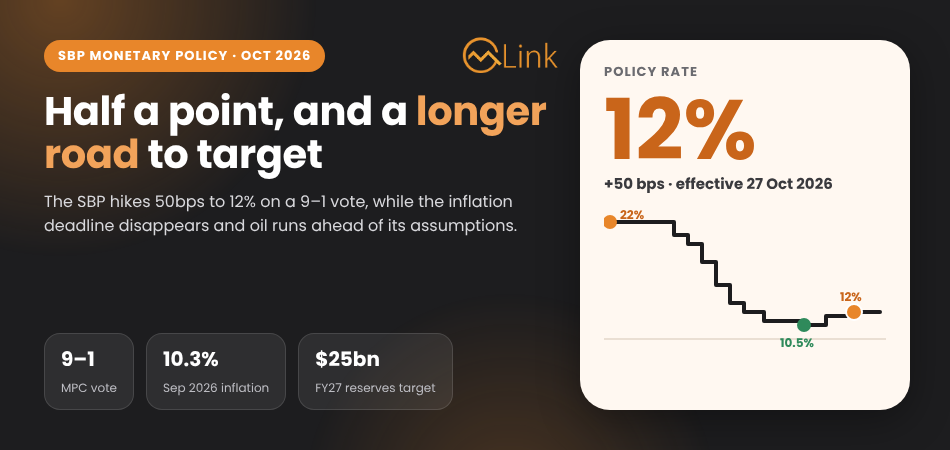
expected. It raised the policy rate by 50 basis points to 12%, effective
October 27. But the headline decision is the least interesting part of the latest
Monetary Policy Statement. Two other changes show how much the Committee's thinking has shifted in six weeks.
The first is the vote. On September 14, the MPC held the rate by seven votes to three, with the three dissenters wanting a 100bps hike. Yesterday, nine of the ten members backed an increase. The lone dissenter wanted a larger one. According to SBP Governor Jameel Ahmed, the argument inside the Committee is no longer whether to tighten, but how fast.
The second is the timeline. In September, the SBP said inflation would "gradually ease towards the upper bound of 5-7 percent target range by June 2027". Yesterday's statement drops the date. Inflation is now to come within the target range "over the medium term", and the Committee says geopolitical developments "have worsened the inflation outlook as compared to the earlier assessment".
At the press conference, Governor Jameel Ahmad said bringing inflation back into the target range will take longer than planned, and that FY27 inflation will be higher than earlier projected.
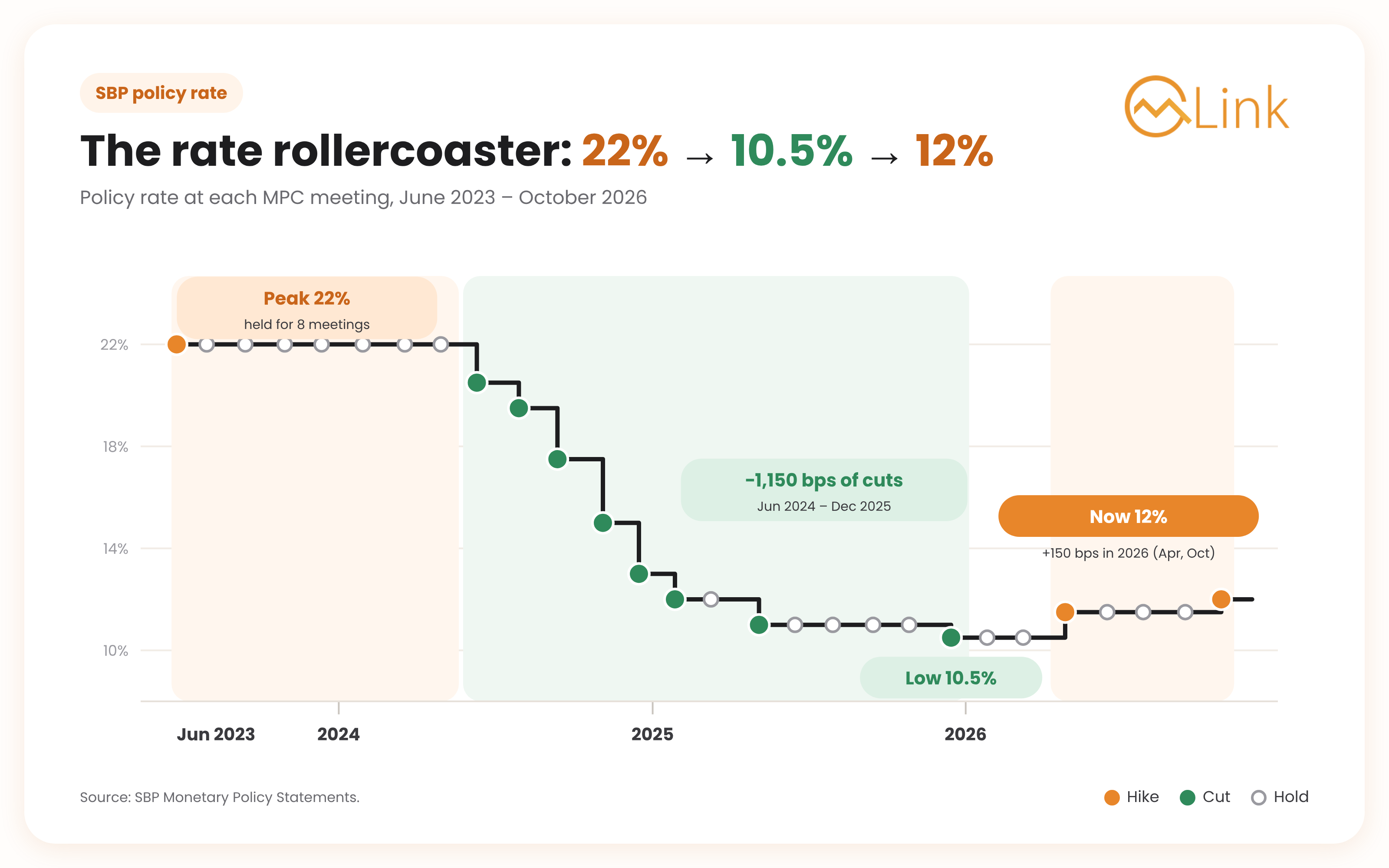
It is important to note that the SBP’s policy rate peaked at 22% in June 2023 and was held there for eight straight meetings, until April 2024. It then fell 1,150 basis points in a series of cuts, reaching a low of 10.5% in December 2025.
With the Middle East conflict pushing up energy prices, the SBP reversed course in 2026, raising the rate by 150bps in two steps to 12%.
Why the SBP moved, and why only 50bps
The case for tightening was clear. Headline inflation was
10.3% in September, which the MPC says "turned out higher than the MPC's
expectation", driven by energy and by wheat and its products. Core
inflation has steadied at around 8.4%, but its make-up is more telling.
The real-rate arithmetic explains the urgency. In September
2025, with the policy rate at 11% and inflation at 5.8%, the real rate was 5.2
percentage points. By September this year it had fallen to 1.2ppt, at 11.5%
against 10.3% inflation.
Even after yesterday’s move it is only 1.7ppt against
headline inflation, though 3.6ppt against core. The SBP says it wants the real
policy rate "adequately positive on forward-looking basis", and the
Governor said inflation will reach target as real rates become increasingly
positive. That depends on inflation falling from here.
So why not 100bps, as three members wanted in September, and one still did yesterday? Because growth is only just coming back. The Governor said the Middle East conflict cut growth to 2.0% in the final quarter of FY26, from an average of 4.2% in the first three quarters. Large-scale manufacturing grew 1.9% in July–August, after only 0.4% in the previous quarter.
The SBP keeps its
3.5–4.5% GDP forecast for FY27 and expects growth to beat FY26's 3.7%, helped
by sugarcane, rice and maize crops coming in above target. A smaller step lets
the SBP signal resolve without choking that recovery, and leaves room to act
again if oil keeps rising.
The market had largely priced the move. At the October 14
auction, the 3-month T-bill cleared at 12.00%, where the policy rate now sits.
In our survey, 44.4% of respondents expected a 50bps increase, the single most
common call.
At 12.50%, the 12-month bill sits about 50bps above the new
policy rate, roughly its usual spread. That suggests the market sees yesterday's
hike as broadly sufficient for now.
The strong suit
The external side is where the SBP is on firmest ground.
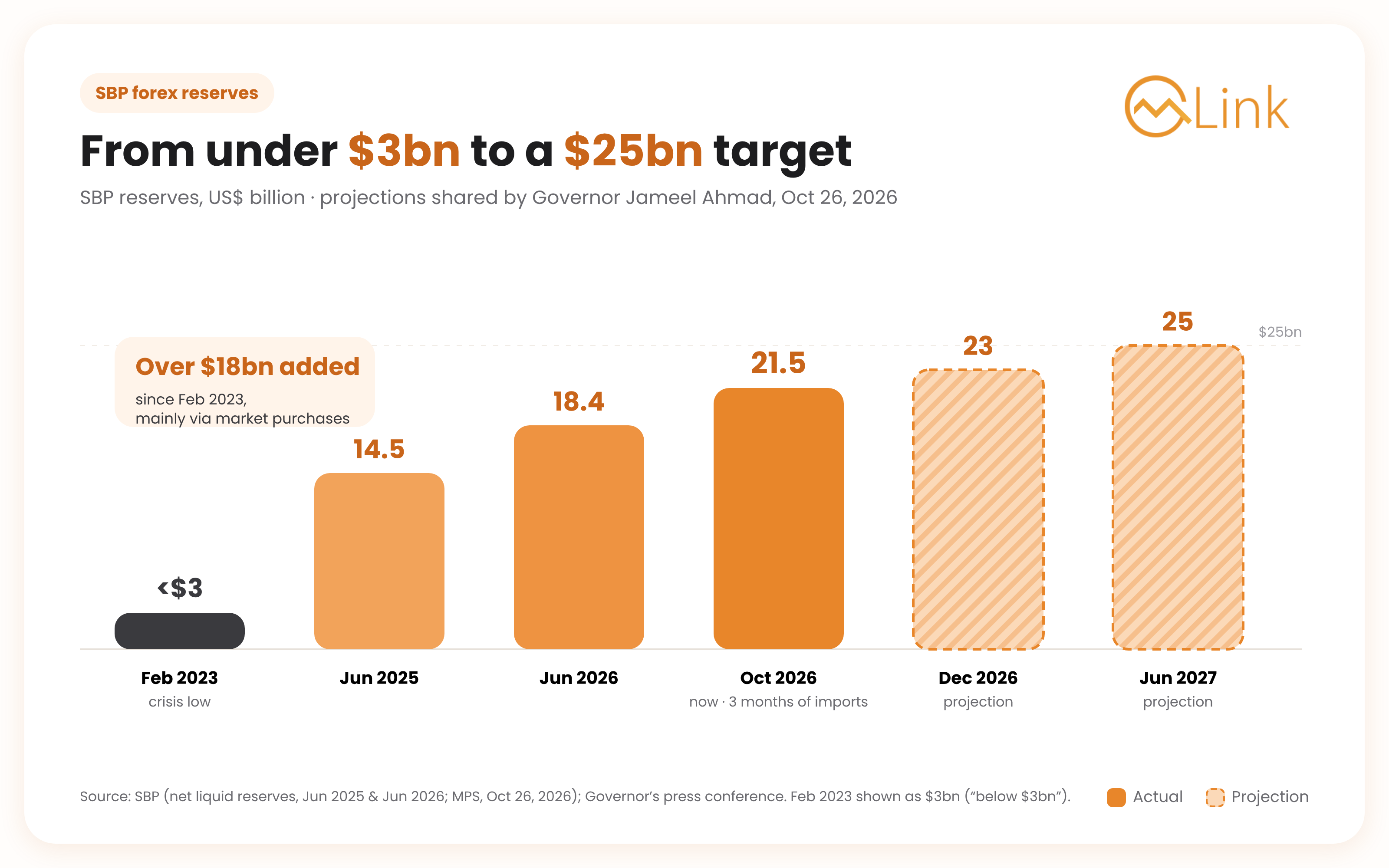
Reserves are about $21.5 billion, three months of import cover, and a
staff-level agreement has been reached with the IMF.
The Governor
projected reserves of $23 billion by December 2026 and $25 billion by June
2027, and, the SBP aims to exceed the latter.
He stressed that the build-up came mainly from market purchases rather than borrowing. That is a very different starting point from February 2023, when reserves had fallen below $3 billion.
The debt profile has also improved. The Governor said about
80% of external debt is now owed to multilateral and bilateral lenders, against
55% in early 2023, and average maturity has lengthened from under three years
to over four.
FY27 external debt servicing is still heavy at $21.5 billion.
$17.5 billion of principal and $4 billion of interest. But about $7.3 billion
of bilateral debt is expected to be rolled over, and the $3 billion Saudi
deposit has been rolled over, with documentation in process.
That leaves net repayments of about $10 billion. Roughly $5
billion was repaid in the first four months, so about $5.5 billion remains.
The reserves path, though, depends on financing. The $23–25
billion projections assume the remaining Panda bond issuance, multilateral
inflows and IMF disbursements, net of debt servicing. Reserves have already
been helped by a $3 billion Eurobond, issued after upgrades from all three
rating agencies.
The Ministry of Finance has floated requests for proposals
for more Eurobonds, with timing tied to financing needs and pricing. According
to briefing notes, a couple of recent short-term lending offers were turned
down on cost and tenor. That discipline is welcome, but it means the reserves
target depends on market access holding up.
On the exchange rate, the Governor said the real effective
exchange rate (REER) index uses a 2010 base and should not be read on its own
as a measure of the rupee's value, and that the rate remains market-determined.
The SBP's focus is on narrowing the gap between interbank
and open-market rates, reforming exchange companies, and curbing smuggling,
hundi/hawala and trade-based money laundering.
The pressure point
The current account deficit is widening. It reached $874
million in July–September, against $594 million a year earlier, and was already
almost three times the full-year FY26 deficit of $304 million.
Jameel Ahmed acknowledged that the current account had
deteriorated since the last meeting. The SBP now expects the FY27 deficit
slightly above the midpoint of its 0–1% of GDP range, against the lower end
earlier.
The revised projections include imports up to about $71
billion, and exports at $32.5–33 billion, against $30.8 billion in FY26. Meanwhile,
remittances raised to $45 billion from $44 billion. They reached $10.9 billion
in the first quarter, and the two Eids in the second half are expected to add
at least $1 billion.
The bigger risk is the oil assumption. The SBP has raised it
by about $10 a barrel, to close to $90, based on prevailing prices and futures.
With crude trading above $114, that assumption looks optimistic. If prices stay
at current levels, both the inflation and current account projections are
exposed to further upward revision.
Revenue and demand
The fiscal numbers look stronger in nominal terms than in
real terms. FBR collections exceeded the first-quarter target by Rs33 billion,
but grew only 7.0% year on year while CPI inflation averaged 10.2%. Adjusted
for inflation, tax revenue contracted by roughly 3%. The quarter's fiscal and
primary surpluses therefore rest largely on a sizeable SBP profit transfer and
expenditure restraint, rather than on buoyant tax revenue.
On the demand side, monetary conditions remain far from
restrictive. Private-sector credit grew 14.1% and broad money 12.7%, which
implies real credit growth of about 3.5%. The SBP itself describes credit
growth as broad-based and expects that momentum to continue.
Since the demand is still expanding, the Committee has room
to tighten without stalling the recovery. But credit growth at this pace also
weakens transmission and keeps the possibility of further tightening open.
SBP's next move
Four things will shape the SBP's next move:
- Oil.
The gap between the SBP's $90 assumption and a market price above $110 is
the single biggest risk to its projections.
- Wheat.
The SBP names domestic wheat supply frictions as one of the two main
forces keeping inflation high, so food prices matter as much as energy.
- Inflation
expectations. Consumer expectations have already risen, and the SBP
warns they "may seep into core inflation going forward". With
core services inflation already above its historical average, any rise in
core from 8.4% would strengthen the hawks' case.
- Financing.
Reserves need to keep rising towards $23 billion by December even as the
import bill grows. That depends on the next Eurobond, the Panda bond and
multilateral flows arriving on time.
Copyright Mettis Link News
Related News


| Name | Price/Vol | %Chg/NChg |
|---|---|---|
| KSE100 | 164,185.66 79.76M | 0.70% 1147.19 |
| ALLSHR | 99,537.60 173.11M | 0.66% 649.91 |
| KSE30 | 48,423.30 61.55M | 0.69% 332.29 |
| KMI30 | 235,692.82 23.99M | 0.73% 1715.97 |
| KMIALLSHR | 64,475.96 118.05M | 0.60% 383.05 |
| BKTi | 45,194.30 6.68M | 0.81% 361.66 |
| OGTi | 33,537.82 0.74M | 0.48% 159.47 |
| Symbol | Bid/Ask | High/Low |
|---|
| Name | Last | High/Low | Chg/%Chg |
|---|---|---|---|
| BITCOIN FUTURES | 79,465.00 | 80,245.00 79,385.00 | -435.00 -0.54% |
| BRENT CRUDE | 116.14 | 116.33 114.51 | 0.33 0.28% |
| RICHARDS BAY COAL MONTHLY | 128.50 | 0.00 0.00 | -0.35 -0.27% |
| ROTTERDAM COAL MONTHLY | 147.10 | 0.00 0.00 | 0.10 0.07% |
| USD RBD PALM OLEIN | 1,182.50 | 1,182.50 1,182.50 | 0.00 0.00% |
| CRUDE OIL - WTI | 102.01 | 102.16 100.60 | 0.25 0.25% |
| SUGAR #11 WORLD | 19.10 | 19.89 18.85 | -1.14 -5.63% |
Chart of the Day
Latest News
Top 5 things to watch in this week
 MPC Decision
Pakistan Stock Movers
| Name | Last | Chg/%Chg |
|---|
| Name | Last | Chg/%Chg |
|---|